
Free Safe Operating Procedure (Weighbridge Operation) Template
Download our free Safe Operating Procedure (Weighbridge Operation) template. This document provides a structured starting point for your workplace safety needs.
Free Safe Operating Procedure (Weighbridge Operation) Template
DOCX • 126 KB + PDF
Updated Oct 2026
No signup required
Purpose of the Free Safe Operating Procedure (Weighbridge Operation) Template
A weighbridge is a critical control point in logistics, agriculture, and resource industries, but it also presents significant safety risks. This Free Safe Operating Procedure (Weighbridge Operation) Template provides a structured framework for documenting the required steps to operate weighbridge equipment safely.
An effective SOP helps organisations manage hazards associated with vehicle movement, interaction between pedestrians and vehicles, and data entry processes. By establishing a clear, documented procedure, you can standardise operations, simplify training, and demonstrate a commitment to meeting your work health and safety obligations.
Using a detailed SOP ensures that every operator understands the potential hazards and the control measures in place to protect themselves and others. It covers key safety actions from pre-operational checks to shutdown procedures, addressing risks like vehicle collisions, slips, trips, and falls.
For businesses involved in earthmoving, a dedicated SOP for scraper operations can complement weighbridge procedures by managing risks at the source of material loading.
Video walkthrough
How to use the Free Safe Operating Procedure (Weighbridge Operation) Template
This template is a comprehensive starting point, designed to be adapted to your specific operational context. It is not a finished, out-of-the-box solution.
You must systematically review and customise each section to align with the unique equipment, traffic management plan, and environmental conditions of your worksite. Effective customisation ensures the procedure is practical, relevant, and addresses the actual risks your workers face.
To do this effectively, we recommend a collaborative approach involving workers who operate the weighbridge and their supervisors. This customisation is critical for ensuring the SOP reflects the specific equipment, environment, and risks present in your workplace.
Integrating this document into your broader WHS management systems ensures consistency and reinforces your safety culture. Once customised, the SOP becomes a vital tool for worker induction, training, and ongoing competency assessments.
What's included in the template?
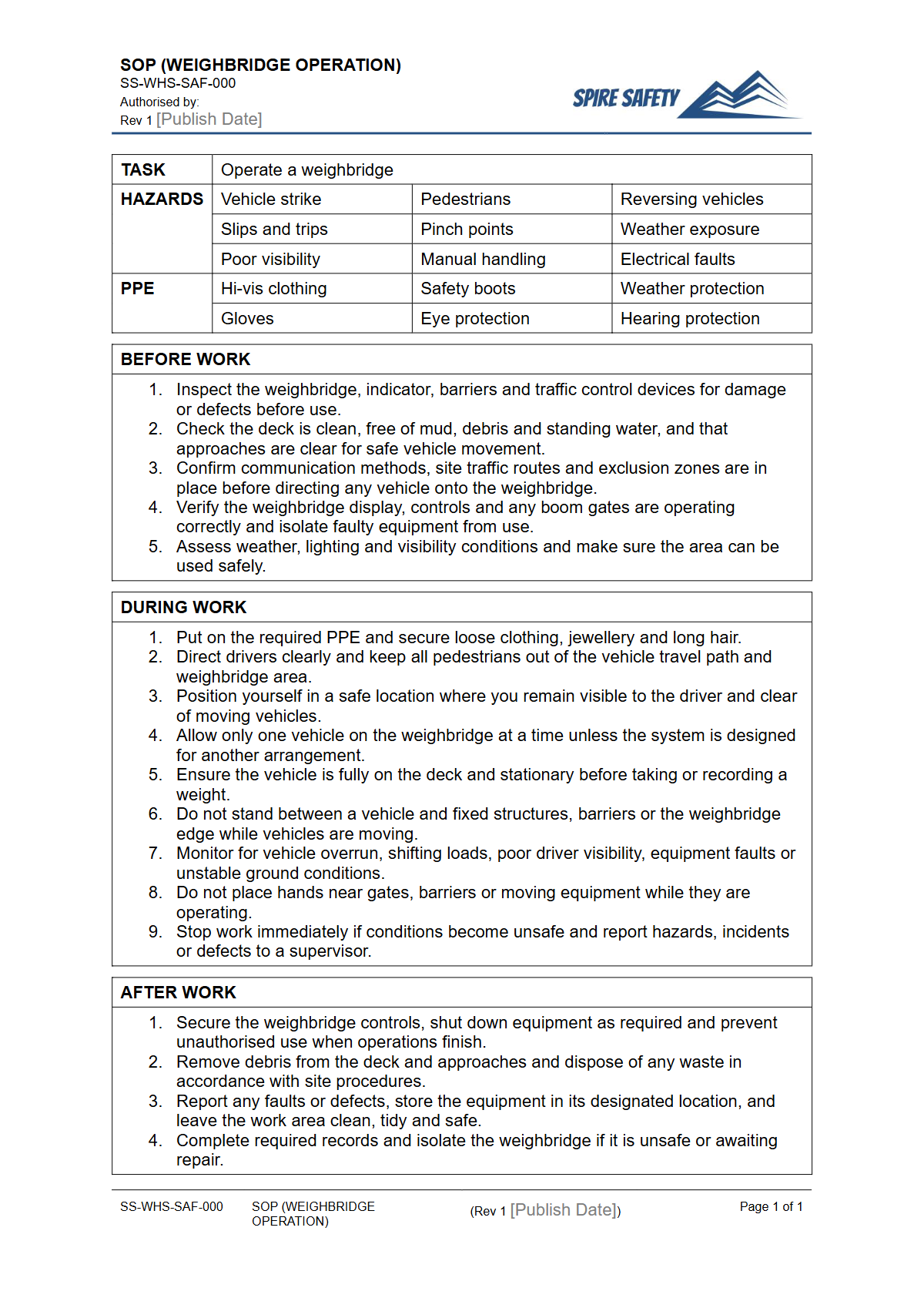
Our Safe Operating Procedure template provides a logical structure for you to populate with your site-specific details. Key sections include:
- SOP Details: Document number, version, and review dates.
- Personal Protective Equipment (PPE): A checklist for mandatory PPE such as high-visibility clothing and safety footwear.
- Hazards & Control Measures: A risk assessment matrix to identify potential dangers (e.g., moving vehicles, uneven surfaces) and outline corresponding controls.
- Step-by-Step Procedure: A sequence of actions covering pre-operational checks, safe vehicle guidance, operation of the weighbridge console, and shutdown tasks.
- Emergency Procedures: Clear instructions for responding to incidents, accidents, or equipment failure.
When to use it
A Safe Operating Procedure for weighbridge operation should be used consistently as a primary reference document. It is essential during the induction and training of new operators to ensure they learn the correct, safe method from the outset.
The SOP should also be readily accessible in the weighbridge office or control room for quick reference during daily operations. Furthermore, it serves as a critical checklist during incident investigations and regular performance reviews.
Its use extends to tasks involving other machinery on site; for example, workers should always consult the safe operating procedure for telehandler use before loading or unloading vehicles that will be weighed.
Who should use it
This SOP is intended for a range of personnel within an organisation to ensure a coordinated approach to safety. Key users include:
- Weighbridge Operators: As the primary users, this document guides their day-to-day tasks, ensuring they follow safe, standardised processes.
- Truck Drivers: While not the primary authors, drivers entering the site should be made aware of the key rules outlined in the SOP, such as speed limits and communication protocols.
- Supervisors and Managers: Responsible for implementing the SOP, conducting training, and ensuring compliance. They use it as a tool for supervision and performance management.
- WHS Professionals: Safety officers use the SOP as a baseline document for risk assessments, training development, and periodic WHS compliance audits.
By defining clear roles and responsibilities, the SOP ensures everyone understands their part in maintaining a safe weighbridge environment. For sites with integrated logistics, it's also beneficial to have similar documentation, like a safe operating procedure for conveyer systems, to manage associated risks.
Find more templates like this in our free WHS resources library to build out your safety documentation.
Common mistakes
Common mistakes to avoid
- Failing to ensure the weighbridge platform is completely clear before a vehicle enters or exits.
- Allowing drivers or other personnel to stand on or walk across the weighbridge during weighing.
- Neglecting regular calibration, maintenance, and cleaning, which can lead to inaccurate readings and equipment failure.
- Using a generic SOP template without customising it for the site’s specific traffic flow, vehicle types, and hazards.
Legal references
Legal considerations
The following legal requirements may be relevant to this type of work.
- Work Health and Safety Act (Harmonised) — Provides the primary duties for protecting workers and other people from work health and safety risks.
- Work Health and Safety Regulations (Harmonised) — Sets out requirements supporting the management of workplace hazards and risks.
The following codes may be relevant to this type of work.
- Managing WHS Risks Code of Practice — Provides practical guidance on identifying hazards, assessing risks and applying effective controls.
- Work Health and Safety Consultation, Cooperation and Coordination Code of Practice — Provides practical guidance on consulting workers and coordinating with other duty holders.
- Managing the Work Environment and Facilities Code of Practice — Provides practical guidance on safe work environments, workplace facilities and related controls.
Did you know
Chain of Responsibility
Inaccurate weighbridge readings can lead to breaches of the Heavy Vehicle National Law (HVNL), placing legal liability not just on the driver but on every party in the supply chain under Chain of Responsibility (CoR) laws.
FAQ
Frequently asked questions
01What are the key hazards of operating a weighbridge?
02How often should a weighbridge SOP be reviewed?
03Is specific training required to operate a weighbridge?
04What information should be included in a weighbridge SOP?
Share this resource
Free Safe Operating Procedure (Weighbridge Operation) Template
Browse Categories
How To Use It
- 1Download and open in Word or PDF.
- 2Replace the placeholders with your business details.
- 3Get it reviewed by a WHS specialist before rollout.
Need it customised?
Our WHS consultants can adapt this template to your site, run a gap analysis, or audit what you already have in place.
Book a Free Consultation WHS consulting servicesor call 1300 156 382
Related templates
- Free Safe Operating Procedure (Weighbridge Ticketing) Template
- Free Safe Operating Procedure (Weld Post Heating) Template
- Free Safe Operating Procedure (Weld Preheating) Template
- Free Safe Operating Procedure (Weld Purging) Template
- Free Safe Operating Procedure (Welder - Stick Arc Operation) Template
- Free Safe Operating Procedure (Welder - TIG Operation) Template