
Free Safe Operating Procedure (Weld Preheating) Template
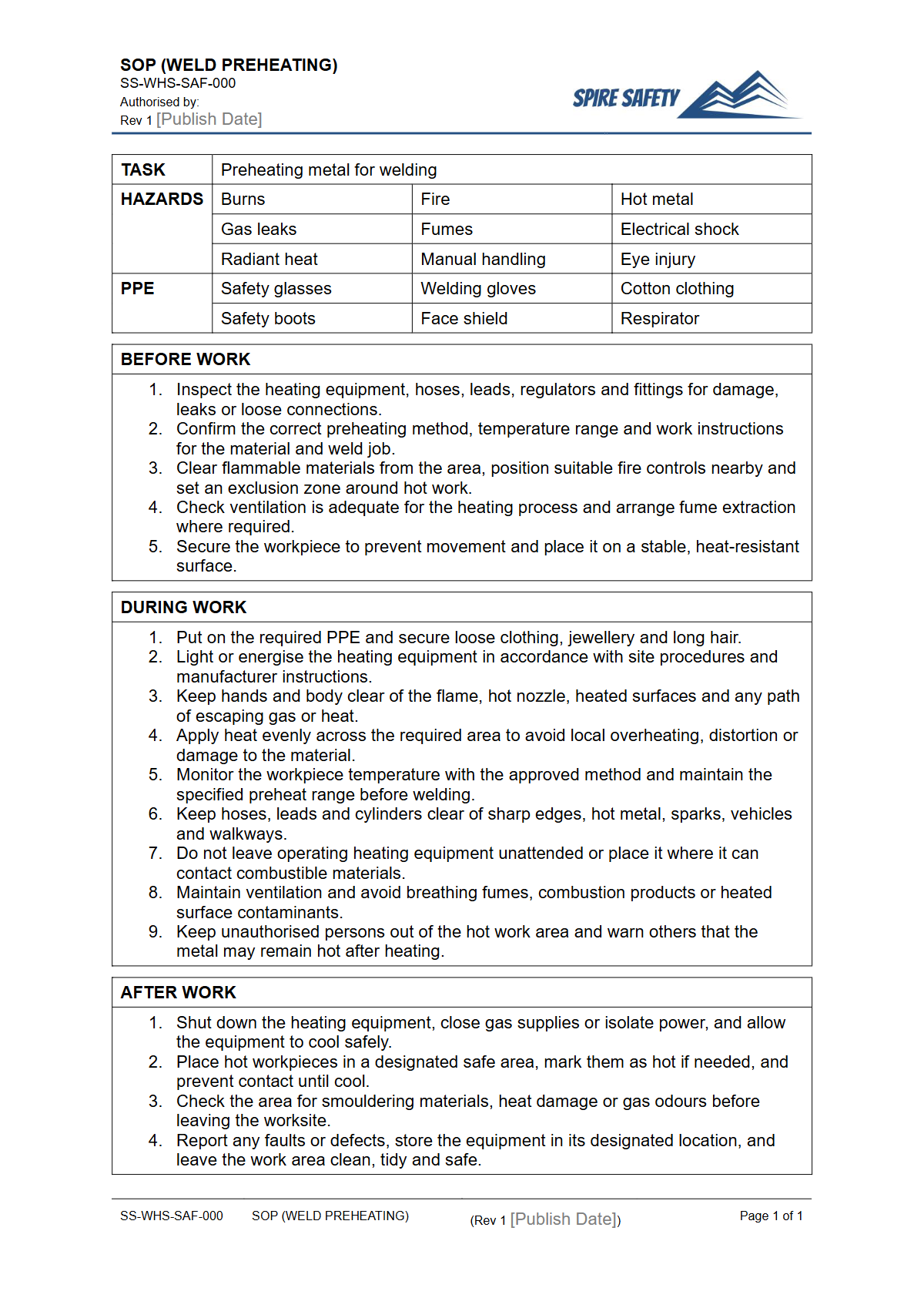
Properly preheating materials is crucial for weld quality and safety. Download our free Safe Operating Procedure (Weld Preheating) Template to get started.
Free Safe Operating Procedure (Weld Preheating) Template
DOCX • 126 KB + PDF
Updated Oct 2026
No signup required
Purpose of the Free Safe Operating Procedure (Weld Preheating) Template
Weld preheating is a critical control measure for ensuring the structural integrity of many welded components. This free Safe Operating Procedure (Weld Preheating) Template provides a structured starting point for your organisation to document a safe, repeatable process.
Using an SOP helps control the significant hazards associated with heating metal to high temperatures, such as severe burns, fire, and the generation of hazardous fumes. It formalises the steps required to achieve the correct temperature, preventing issues like hydrogen cracking, thermal shock, and distortion, which can lead to catastrophic weld failure.
A documented procedure ensures that all workers, regardless of experience level, follow a consistent, approved method. It serves as a vital training tool for new employees and apprentices and forms an essential part of a compliant safety framework.
By clearly outlining responsibilities, equipment, and safety protocols, this SOP helps your business meet its primary duty of care under Australian WHS legislation. It demonstrates a proactive approach to risk management and is a key component of effective WHS management systems.
Video walkthrough
How to use the Free Safe Operating Procedure (Weld Preheating) Template
This Safe Operating Procedure for weld preheating is provided as a downloadable DOCX file that you can easily adapt to your specific operational needs. While it is aligned with Australian WHS principles, it is essential that you customise it to reflect the unique hazards, equipment, and materials present in your workplace.
Generic procedures are not effective; a site-specific risk assessment must inform the final document.
Customisation Steps:
- Conduct a Risk Assessment: Before using the template, identify all potential hazards associated with your preheating tasks. This includes risks from gas cylinders, electrical equipment (induction heaters), hot surfaces, and fumes.
- Add Specific Details: Populate the template with your specific requirements. This includes the types of metals being welded (e.g., high-carbon steel, alloy steels), required preheat and interpass temperatures as per the welding procedure specification (WPS), and the exact equipment to be used (e.g., brand/model of induction heater, oxy-fuel torch setup, temperature indicating crayons).
- Define PPE: List the mandatory Personal Protective Equipment (PPE), including heat-resistant gloves, welding helmets, flame-retardant clothing, and respiratory protection if required.
- Consult Your Team: Involve the welders and supervisors who will be using the procedure. Their practical input is invaluable for creating a document that is both safe and workable.
- Train and Implement: Once finalised, formally train all relevant personnel on the SOP. Ensure they understand every step and have demonstrated their competence. Ongoing effectiveness often relies on periodic checks, which can be part of your formal WHS compliance auditing program.
Important: This document is a template only. We provide it as a starting point, but you must customise it to your specific workplace, equipment, and processes to ensure it is useful and helps you meet your WHS obligations.
When to use it
A weld preheating SOP should be implemented whenever the task is required by an engineering specification or Australian Standard. Preheating is not necessary for all welding but is critical in specific situations to control the cooling rate of the weld and surrounding parent metal.
A formal procedure is essential for consistency and safety in these high-risk scenarios.
Common triggers for using a weld preheating procedure include:
- Welding thick material sections (typically above 25mm, but this varies).
- Working with high-carbon or low-alloy steels that are susceptible to cracking.
- When welding highly constrained joints where shrinkage stresses are high.
- Operating in low ambient temperatures or high humidity, which can accelerate cooling.
- When required by a specific welding code, such as AS/NZS 1554 (Structural steel welding).
The principles of managing thermal processes are also relevant in related tasks. For example, a similar systematic approach is needed when using gas cutting equipment, as outlined in a free Oxy Acetylene SOP Template.
Who should use it
This Safe Operating Procedure is intended for several key roles within an organisation to ensure the task is planned, executed, and supervised safely. The document should be accessible to and understood by:
- Welders, Boilermakers, and Fabricators: The primary users who perform the preheating and welding tasks. They must follow the procedure step-by-step.
- Welding Supervisors and Team Leaders: Responsible for ensuring workers are trained on the SOP and adhere to it during operations. They also monitor for correct temperature application and safe work behaviour.
- WHS and Safety Officers: Use the SOP as part of risk assessments, incident investigations, and workplace inspections. They ensure the document is reviewed regularly and integrated into the broader safety system.
- Engineers and Quality Control Inspectors: Refer to the SOP to verify that the specified preheat temperatures and methods are being correctly applied to meet quality and engineering standards.
The entire workflow, from material handling to final weld, must be considered. Moving heavy steel sections for welding requires its own procedures; for mobile plant use, a document like a Telehandler SOP is essential for safe lifting and positioning.
If you need other templates, you can browse our complete free WHS resources library for more downloads.
Common mistakes
Common mistakes to avoid
- Using a generic SOP without customising it for the specific material, thickness, and equipment.
- Measuring the temperature incorrectly or on the wrong surface (e.g., too far from the weld joint).
- Failing to maintain the minimum preheat temperature throughout the welding process (interpass temperature).
- Applying heat too quickly, which can cause distortion or thermal stress in the material before welding even begins.
Legal references
Legal considerations
The following legal requirements may be relevant to this type of work.
- Work Health and Safety Act (Harmonised) — Provides the primary duties for protecting workers and other people from work health and safety risks.
- Work Health and Safety Regulations (Harmonised) — Sets out requirements supporting the management of workplace hazards and risks.
The following codes may be relevant to this type of work.
- Managing WHS Risks Code of Practice — Provides practical guidance on identifying hazards, assessing risks and applying effective controls.
- Work Health and Safety Consultation, Cooperation and Coordination Code of Practice — Provides practical guidance on consulting workers and coordinating with other duty holders.
- Managing the Work Environment and Facilities Code of Practice — Provides practical guidance on safe work environments, workplace facilities and related controls.
Did you know
Hydrogen's Enemy
A key reason for preheating steel is to allow trapped hydrogen to diffuse out of the metal. At room temperature, hydrogen is trapped, causing brittleness, but preheating increases the diffusion rate, allowing it to escape harmlessly and preventing hydrogen-induced cracking.
More Than Just Temperature
Effective preheating requires not just reaching a target temperature, but also ensuring the heat 'soaks' through the entire thickness of the material at the joint. A surface-only heat reading can be misleading and lead to weld failures.
FAQ
Frequently asked questions
01What is the primary purpose of preheating a weld?
02What temperature should I preheat to?
03Is a Safe Operating Procedure for weld preheating legally required in Australia?
04What PPE is required for weld preheating?
Share this resource
Free Safe Operating Procedure (Weld Preheating) Template
Browse Categories
How To Use It
- 1Download and open in Word or PDF.
- 2Replace the placeholders with your business details.
- 3Get it reviewed by a WHS specialist before rollout.
Need it customised?
Our WHS consultants can adapt this template to your site, run a gap analysis, or audit what you already have in place.
Book a Free Consultation WHS consulting servicesor call 1300 156 382
Related templates
- Free Safe Operating Procedure (Weld Purging) Template
- Free Safe Operating Procedure (Welder - Stick Arc Operation) Template
- Free Safe Operating Procedure (Welder - TIG Operation) Template
- Free Safe Operating Procedure (Welding Fume Extractor) Template
- Free Safe Operating Procedure (Welding Positioner) Template
- Free Safe Operating Procedure (Welding Rotator) Template