
Free Safe Operating Procedure (Welder - Stick Arc Operation) Template
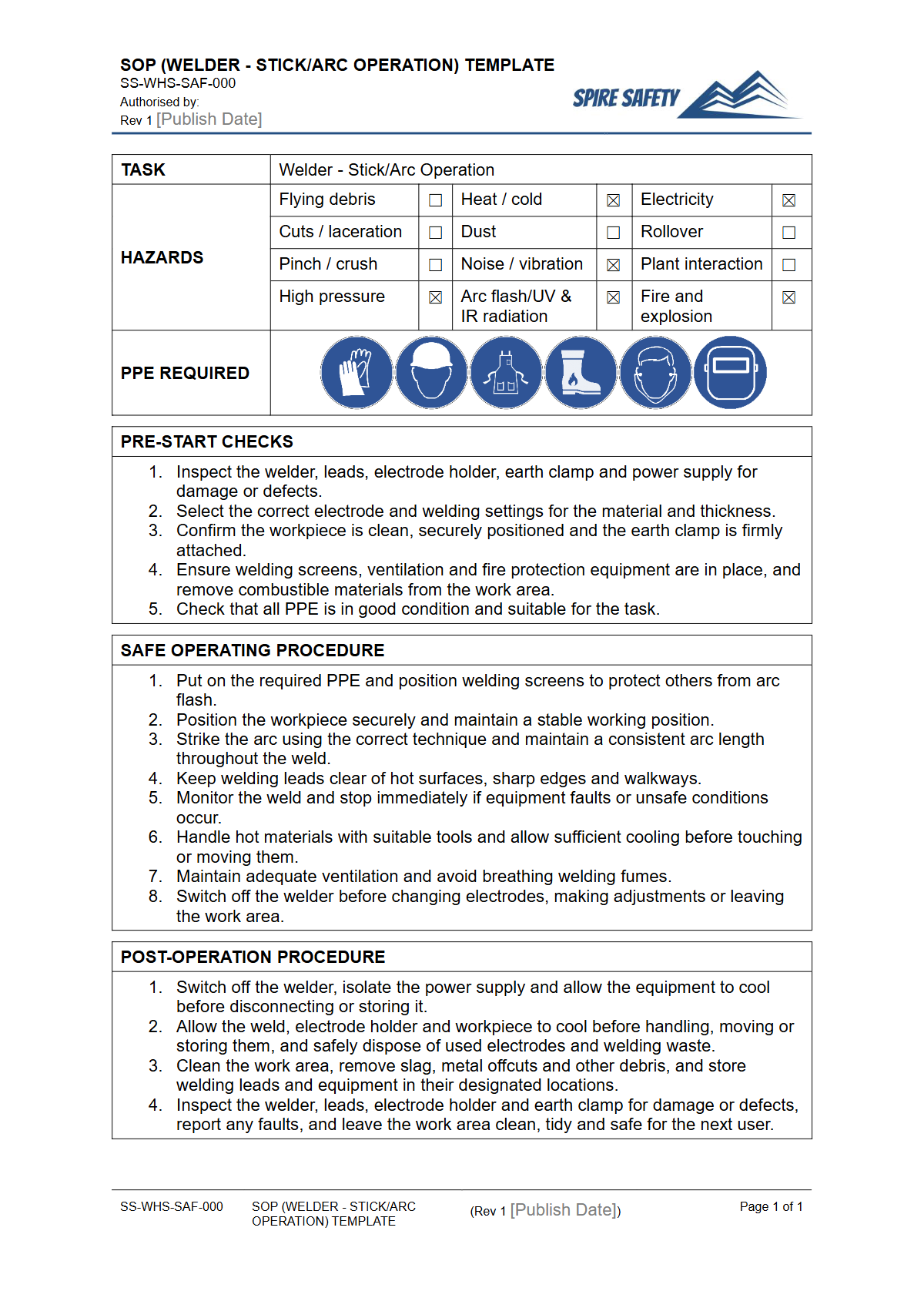
Download our free Safe Operating Procedure for Welder (Stick Arc Operation). This template (DOCX/PDF) helps you document safe work methods for stick welding.
Free Safe Operating Procedure (Welder - Stick Arc Operation) Template
DOCX • 180 KB + PDF
Updated Oct 2026
No signup required
Purpose of the Free Safe Operating Procedure (Welder - Stick Arc Operation) Template
This Safe Operating Procedure (SOP) template for Welder - Stick Arc Operation provides a structured foundation for documenting the risks and controls associated with Shielded Metal Arc Welding (SMAW). Stick welding presents significant hazards, including electric shock, severe burns, exposure to ultraviolet (UV) and infrared (IR) radiation, and inhalation of toxic fumes.
Using a formalised procedure helps organisations standardise safe work practices, ensuring all operators understand the required steps to perform the task safely. Implementing clear SOPs is a fundamental part of demonstrating due diligence and is a key component of effective WHS management systems.
A well-drafted SOP serves as a critical training tool for new workers and a refresher for experienced ones. It systematically outlines pre-operational checks, operational steps, and post-operational clean-up, helping to minimise the risk of injury or incident.
This template is designed as a starting point, aligned with Australian WHS principles, to help you fulfil your duty of care to provide a safe working environment.
Video walkthrough
How to use the Free Safe Operating Procedure (Welder - Stick Arc Operation) Template
To effectively use this Safe Operating Procedure for welder stick arc operation, you must first download the DOCX file and adapt it to the specific context of your workplace. This involves identifying the particular make and model of the welding equipment used, the types of materials being welded, and the unique environmental conditions of the work area.
A generic document is not sufficient for compliance; it requires site-specific customisation.
Note: We are not WHS consultants, and this document is a template only. It is the responsibility of the Person Conducting a Business or Undertaking (PCBU) to ensure this procedure is tailored to their specific workplace hazards and operational needs.
We strongly recommend conducting a thorough risk assessment and consulting with operators and supervisors during the customisation process. You should also reference the manufacturer's instruction manual for your specific welding machine.
In complex industrial settings, this SOP may form part of a broader safety framework that includes procedures for other equipment, such as a Brake Press SOP template, to ensure comprehensive coverage of workshop hazards.
When to use a Safe Operating Procedure
An SOP for stick arc welding should be used consistently as a reference and control measure. It is essential during the induction and training of new employees to establish a baseline of safe behaviour.
The document should also be readily available in the work area for operators to consult before starting a welding task, especially for non-routine jobs. It serves as a checklist for pre-start inspections and a guide for correct shutdown procedures.
Furthermore, this SOP is a valuable tool during incident investigations and regular safety reviews, helping to identify procedural gaps or areas for improvement. Regular reviews are part of maintaining system integrity, a process that can be formalised through periodic WHS compliance auditing.
Who should use this Welder SOP
This SOP is intended for use by several key roles within an organisation. Workers and operators who perform stick welding are the primary users and must be trained on its contents.
Supervisors and team leaders are responsible for enforcing the procedure, ensuring operators follow the outlined steps, and providing necessary resources like correct PPE and ventilation. WHS managers and safety officers will use this template to develop, implement, and review the final document as part of the overall safety management system.
Finally, PCBUs and company directors should ensure such procedures are in place to meet their overarching health and safety obligations. Many fabrication workshops will manage a suite of SOPs for various tasks, such as surface preparation documented in a FREE Sand Blasting SOP.
Developing and implementing a range of task-specific procedures is a hallmark of a mature safety culture. Consistency across different types of machinery and activities helps reinforce safe work habits. For example, the principles of pre-start checks and PPE usage in this welder SOP are also central to the safe use of other workshop tools, as outlined in our Free Air Compressor SOP.
For more templates covering a wide range of plant, equipment, and high-risk tasks, feel free to browse our complete free WHS resources library, where you can find documents to support your safety management needs.
Common mistakes
Common mistakes to avoid
- Failing to adequately prepare the work area by not removing flammable or combustible materials.
- Using an incorrect electrode type or amperage setting for the base material, leading to poor weld quality and potential defects.
- Neglecting to use proper local exhaust ventilation or respiratory protection, especially in confined spaces.
- Attempting to weld on sealed containers or tanks without ensuring they are properly cleaned, purged, and vented to prevent explosion.
Legal references
Legal considerations
The following legal requirements may be relevant to this type of work.
- Work Health and Safety Act (Harmonised) — Provides the primary duties for protecting workers and other people from work health and safety risks.
- Work Health and Safety Regulations (Harmonised) — Sets out requirements supporting the management of workplace hazards and risks.
The following codes may be relevant to this type of work.
- Managing WHS Risks Code of Practice — Provides practical guidance on identifying hazards, assessing risks and applying effective controls.
- Work Health and Safety Consultation, Cooperation and Coordination Code of Practice — Provides practical guidance on consulting workers and coordinating with other duty holders.
- Managing the Work Environment and Facilities Code of Practice — Provides practical guidance on safe work environments, workplace facilities and related controls.
Did you know
Arc Eye
The intense ultraviolet (UV) radiation from a welding arc can cause a painful condition called photokeratitis, or 'arc eye,' which feels like sand in the eyes. It is a temporary but severe and painful burn to the cornea.
Welding Fumes
Welding fumes are a complex mixture of metallic oxides, silicates, and fluorides. Certain components, like manganese from steel or hexavalent chromium from stainless steel, are highly toxic and have strict workplace exposure standards in Australia.
FAQ
Frequently asked questions
01What PPE is required for stick arc welding?
02Is a Safe Operating Procedure a legal requirement in Australia?
03How often should a welder SOP be reviewed?
04Can I use this template for MIG or TIG welding?
Share this resource
Free Safe Operating Procedure (Welder - Stick Arc Operation) Template
Browse Categories
How To Use It
- 1Download and open in Word or PDF.
- 2Replace the placeholders with your business details.
- 3Get it reviewed by a WHS specialist before rollout.
Need it customised?
Our WHS consultants can adapt this template to your site, run a gap analysis, or audit what you already have in place.
Book a Free Consultation WHS consulting servicesor call 1300 156 382
Related templates
- Free Safe Operating Procedure (Welder - TIG Operation) Template
- Free Safe Operating Procedure (Welding Fume Extractor) Template
- Free Safe Operating Procedure (Welding Positioner) Template
- Free Safe Operating Procedure (Welding Rotator) Template
- Free Safe Operating Procedure (Wet Floor Cleaning) Template
- Free Safe Operating Procedure (Wet Sanding) Template