
Free Safe Operating Procedure (Welding Positioner) Template
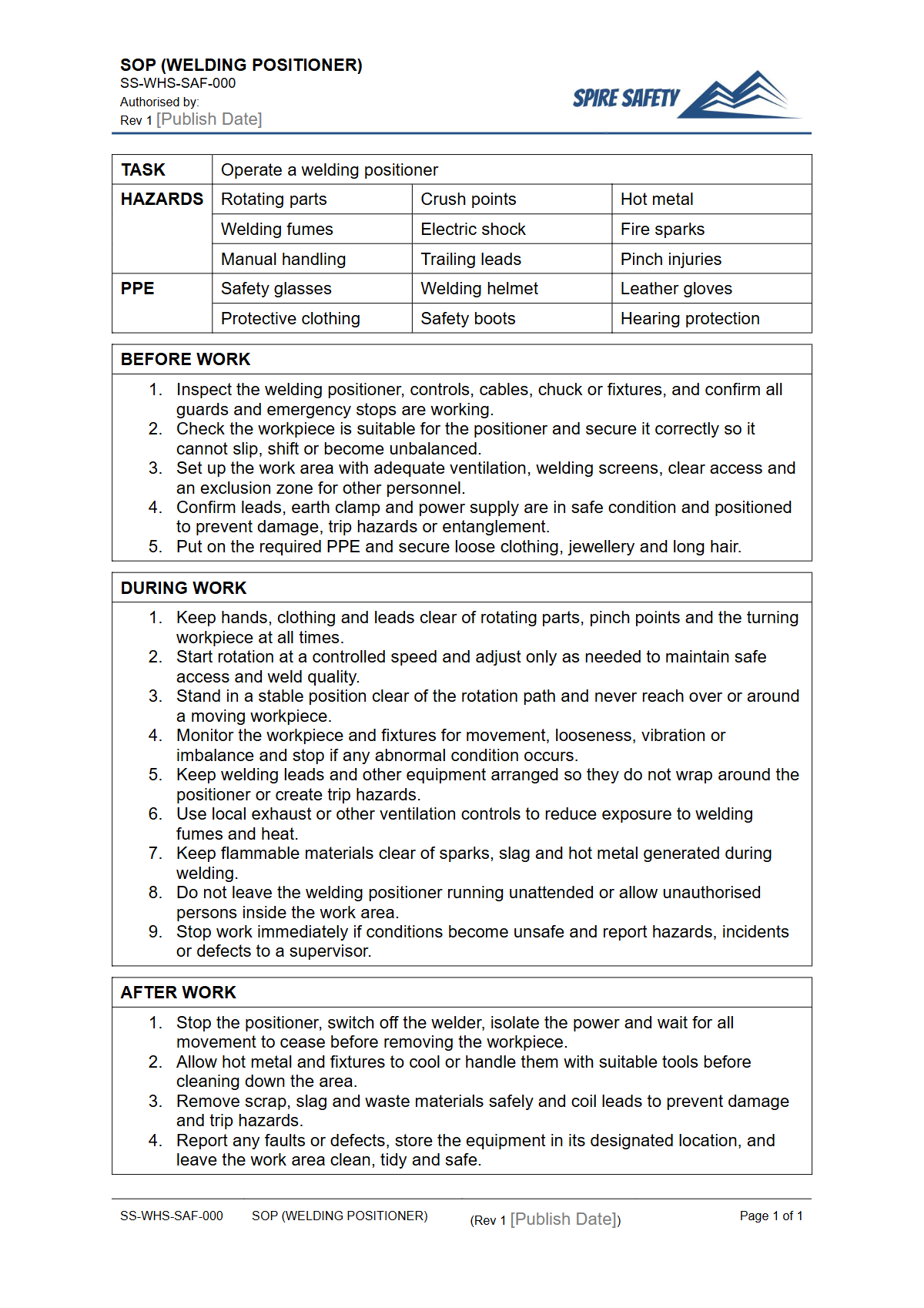
Need a Safe Operating Procedure for a welding positioner? Our free template provides a structured starting point for your workplace safety documentation.
Free Safe Operating Procedure (Welding Positioner) Template
DOCX • 126 KB + PDF
Updated Oct 2026
No signup required
Purpose of the Free Safe Operating Procedure (Welding Positioner) Template
This Free Safe Operating Procedure (Welding Positioner) Template provides a framework for documenting the step-by-step process required to operate this equipment safely. A well-developed SOP is a critical tool for managing risks associated with welding positioners, including crush and pinch points, electrical hazards, burns from hot surfaces, and ergonomic strains from handling heavy or awkward workpieces.
By clearly outlining pre-operational checks, operational steps, and shutdown procedures, this document helps standardise safe work practices, train new operators, and reduce the likelihood of incidents and injuries in your workshop.
Implementing robust SOPs is a fundamental part of effective WHS management systems. This template helps a Person Conducting a Business or Undertaking (PCBU) meet their primary duty of care by providing clear instruction and information to workers. It guides users in identifying specific hazards related to their model of positioner, assessing the risks, and implementing suitable control measures to ensure a safe working environment.
The procedure should be used as a key training document for all personnel required to operate the machinery.
Video walkthrough
How to use the Free Safe Operating Procedure (Welding Positioner) Template
Our template is available in both DOCX and PDF formats for your convenience. The DOCX version is fully editable, allowing you to tailor the content directly to the specific make and model of welding positioner used in your operations, as well as your unique site conditions and work processes.
It is crucial to adapt this document to your workplace context.
Important: We've provided a comprehensive starting point, but you MUST customise this document to reflect the specific equipment, tasks, and control measures in your workplace. This involves conducting a risk assessment, consulting with the equipment operators and supervisors, and incorporating manufacturer's instructions.
The final SOP should be a practical, user-friendly document that your team understands and follows.
Key Elements to Customise
- Equipment Specifics: Detail the make, model, load capacity, and unique features of your welding positioner.
- Pre-Operational Checks: List the specific checks required for your machine, such as inspecting electrical cables, controls, guarding, earthing clamps, and the structural integrity of the positioner.
- Step-by-Step Instructions: Detail the sequence for safely loading, securing, rotating, and unloading workpieces. This section should also cover the use of associated equipment, for which you might require a separate free Oxy Acetylene SOP.
- Emergency Procedures: Outline the steps for emergency shutdown, responding to power failure, or dealing with a failure of the positioning mechanism.
When to use a Welding Positioner SOP
A Safe Operating Procedure for a welding positioner should be used as a core reference document in several scenarios. It is essential during the induction and training of new employees or contractors who will be operating the equipment.
It should also form the basis for refresher training to ensure ongoing competency. The SOP must be readily available in the work area for operators to consult at any time.
Furthermore, it should be reviewed and updated following any incident or near miss, when a new positioner is introduced, or when work practices change significantly.
Who should use this Safe Operating Procedure
This SOP is intended for use by multiple roles within an organisation. WHS managers and supervisors will use it to develop and implement training, conduct workplace inspections, and investigate incidents.
Operators of the welding positioner are the primary end-users; they must be thoroughly trained on its contents and follow the prescribed steps to ensure their own safety and the safety of others. Similar to procedures for other workshop equipment, like that covered in our free Air Compressor SOP template, this document provides a clear benchmark for safe and competent operation.
The effectiveness of this and other SOPs should be periodically verified. Regular workplace inspections and WHS compliance auditing can confirm that the procedures are being followed correctly and remain effective in controlling risks.
This feedback loop is essential for continuous improvement of your safety systems. Having clear procedures for all high-risk plant, such as a free Circular Saw SOP, helps build a consistent safety culture across all fabrication tasks.
This document is one of many resources designed to support your organisation's safety efforts. We encourage you to explore our complete free WHS resources library for other templates, checklists, and guides that can help you manage workplace health and safety effectively.
Common mistakes
Common mistakes to avoid
- Failing to properly secure the workpiece and welding earth clamp before rotation.
- Neglecting pre-start checks of controls, guarding, and emergency stops.
- Ignoring the machine's specified load and centre of gravity limits.
- Not establishing and maintaining a clear exclusion zone around the positioner during operation.
Legal references
Legal considerations
The following legal requirements may be relevant to this type of work.
- Work Health and Safety Act (Harmonised) — Provides the primary duties for protecting workers and other people from work health and safety risks.
- Work Health and Safety Regulations (Harmonised) — Sets out requirements supporting the management of workplace hazards and risks.
The following codes may be relevant to this type of work.
- Managing WHS Risks Code of Practice — Provides practical guidance on identifying hazards, assessing risks and applying effective controls.
- Work Health and Safety Consultation, Cooperation and Coordination Code of Practice — Provides practical guidance on consulting workers and coordinating with other duty holders.
- Managing the Work Environment and Facilities Code of Practice — Provides practical guidance on safe work environments, workplace facilities and related controls.
Did you know
Ergonomic Benefits
Welding positioners don't just secure the workpiece; they significantly reduce ergonomic risks by allowing welders to work in comfortable, neutral postures, minimising strain and fatigue.
Centre of Gravity
The positioner's capacity is affected by the workpiece's centre of gravity. The further the centre of gravity is from the rotational axis, the lower the machine's effective load capacity.
FAQ
Frequently asked questions
01What are the main hazards associated with using a welding positioner?
02Does this SOP template cover all types of welding positioners?
03How often should a Safe Operating Procedure for a welding positioner be reviewed?
04Who is responsible for developing the SOP for a welding positioner?
Share this resource
Free Safe Operating Procedure (Welding Positioner) Template
Browse Categories
How To Use It
- 1Download and open in Word or PDF.
- 2Replace the placeholders with your business details.
- 3Get it reviewed by a WHS specialist before rollout.
Need it customised?
Our WHS consultants can adapt this template to your site, run a gap analysis, or audit what you already have in place.
Book a Free Consultation WHS consulting servicesor call 1300 156 382
Related templates
- Free Safe Operating Procedure (Welding Rotator) Template
- Free Safe Operating Procedure (Wet Floor Cleaning) Template
- Free Safe Operating Procedure (Wet Sanding) Template
- Free Safe Operating Procedure (Wet Vacuum) Template
- Free Safe Operating Procedure (Wetland Cleanup) Template
- Free Safe Operating Procedure (Wheel Balancer) Template