
Free Safe Operating Procedure (Wet Vacuum) Template
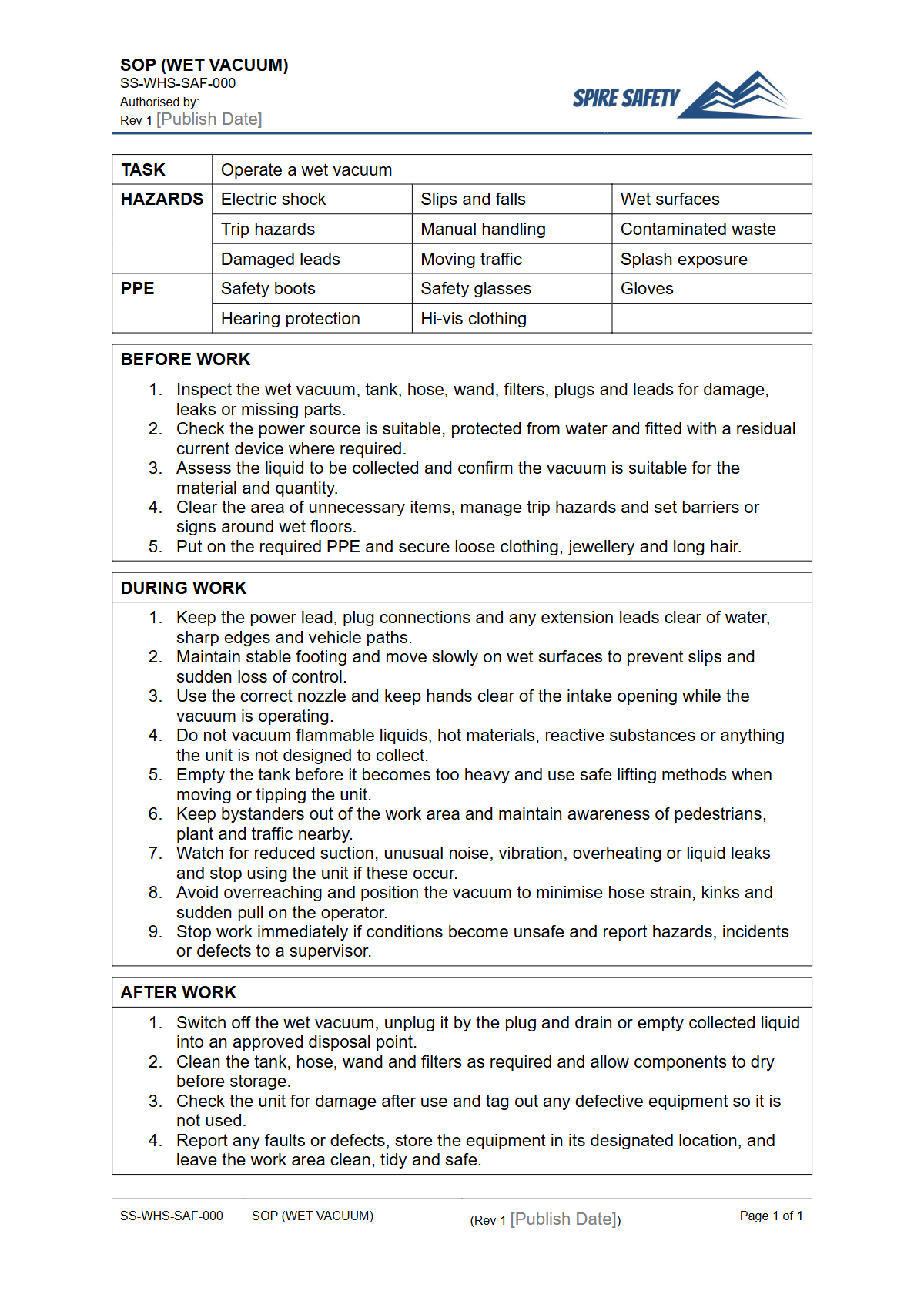
Document the safe use of wet vacuums in your workplace with our structured template. Download your free, customisable SOP to formalise procedures.
Free Safe Operating Procedure (Wet Vacuum) Template
DOCX • 126 KB + PDF
Updated Oct 2026
No signup required
Purpose of the Free Safe Operating Procedure (Wet Vacuum) Template
Using a wet vacuum cleaner introduces specific hazards, most notably the combination of electricity and water. This free Safe Operating Procedure (Wet Vacuum) template provides a structured framework for documenting the required steps to operate this equipment safely.
A comprehensive SOP helps your organisation manage risks such as electric shock, slips from wet floors, ergonomic strains from manual handling, and exposure to noise. Formalising procedures ensures that all operators receive consistent, clear instructions, which is a fundamental part of a robust safety system.
By implementing a detailed SOP, you create a reliable training tool for new employees and a reference point for experienced workers. It serves as evidence of the control measures you have in place to manage identified hazards, demonstrating a commitment to proactive WHS management.
Integrating such procedures is a critical step in developing effective WHS management systems that protect your team and support your compliance obligations.
Video walkthrough
How to use the Free Safe Operating Procedure (Wet Vacuum) Template
This document is a template and must be customised to your specific workplace. After downloading the DOCX or PDF file, consult with the workers who actually use the wet vacuums.
Their direct experience is invaluable for identifying specific risks and practical control measures. You must adapt the template to reflect the exact make and model of the equipment in use, the types of substances being cleaned, the environment it is used in, and your organisation's specific emergency procedures.
Customisation is essential
To ensure this SOP is effective, you must:
- Review and update the pre-filled risk control measures to match your operational context.
- Incorporate details about pre-start checks, including inspecting electrical cords, plugs, and filters.
- Specify procedures for safely emptying the tank, cleaning filters, and storing the unit.
- Add any site-specific rules, such as designated cleaning areas or required signage.
- Ensure the final document is reviewed and approved by a competent person before being issued.
Remember, we have developed this document as a starting point. Its effectiveness depends entirely on how you adapt it to your unique operational needs.
For other types of workshop equipment, you might find our Free Air Compressor SOP (Safe Operating Procedure) Template useful as another example of documenting machinery-specific procedures.
When to use it
A Safe Operating Procedure for a wet vacuum should be used as the primary reference document whenever the equipment is operated. It is a critical tool during worker induction and training, ensuring every new operator understands the approved method for using the machine from day one.
It should also be readily accessible in the work area for quick reference.
The SOP is also a vital document during safety reviews and after any incident or near-miss involving the equipment. Regular reviews help ensure the procedure remains current and effective.
Furthermore, these documents are a key piece of evidence examined during formal safety assessments, such as those conducted as part of a WHS compliance auditing program, to verify that safety processes are documented and implemented.
Who should use it
This Safe Operating Procedure should be used by several key groups within an organisation. Persons Conducting a Business or Undertaking (PCBUs), managers, and supervisors have a duty to provide safe systems of work, and this SOP is a tool to help fulfil that obligation.
They are responsible for ensuring the procedure is developed, implemented, and reviewed.
WHS managers and safety officers will use the template as a basis for creating a customised, site-specific document in consultation with operators. Most importantly, the workers who operate the wet vacuum cleaners are the primary end-users.
They must be trained on the contents of the SOP and follow its instructions to ensure their own safety and the safety of others. For tasks involving other common tools, our FREE Circular Saw SOP (Safe Operating Procedure) Template provides another example of a worker-focused safety document.
Safe work documents should also be tailored for specific industries. For instance, commercial kitchens face unique challenges where water and electricity are in constant proximity, making a resource like our Free Safe Operating Procedure (Deep Fryer - Standard Operation) Template equally important.
You can explore our complete free WHS resources library to find more templates to support your safety management system.
Common mistakes
Common mistakes to avoid
- Using a domestic-grade vacuum for heavy-duty commercial or industrial tasks.
- Failing to inspect electrical cords, plugs, and casing for damage before each use.
- Overfilling the collection tank, leading to spills or water being drawn into the motor.
- Operating the machine in wet mode without the correct filter or with the dust bag still installed.
Legal references
Legal considerations
The following legal requirements may be relevant to this type of work.
- Work Health and Safety Act (Harmonised) — Provides the primary duties for protecting workers and other people from work health and safety risks.
- Work Health and Safety Regulations (Harmonised) — Sets out requirements supporting the management of workplace hazards and risks.
The following codes may be relevant to this type of work.
- Managing WHS Risks Code of Practice — Provides practical guidance on identifying hazards, assessing risks and applying effective controls.
- Work Health and Safety Consultation, Cooperation and Coordination Code of Practice — Provides practical guidance on consulting workers and coordinating with other duty holders.
- Managing the Work Environment and Facilities Code of Practice — Provides practical guidance on safe work environments, workplace facilities and related controls.
Did you know
Electrical Risk
Water significantly lowers the body's electrical resistance, making contact with even low voltages far more dangerous. This is why inspecting cords and plugs for damage before every use is a critical step in any wet vacuum SOP.
Slips, Trips, and Falls
According to Safe Work Australia, slips, trips, and falls are a leading cause of workplace injury, and wet floors from cleaning activities are a major contributor. Effective signage and cord management are essential controls.
FAQ
Frequently asked questions
01What hazards should I include in a wet vacuum SOP?
02How often should a wet vacuum SOP be reviewed?
03Is a Safe Operating Procedure the same as a risk assessment?
04Can I use this wet vacuum template for a standard dry vacuum cleaner?
Share this resource
Free Safe Operating Procedure (Wet Vacuum) Template
Browse Categories
How To Use It
- 1Download and open in Word or PDF.
- 2Replace the placeholders with your business details.
- 3Get it reviewed by a WHS specialist before rollout.
Need it customised?
Our WHS consultants can adapt this template to your site, run a gap analysis, or audit what you already have in place.
Book a Free Consultation WHS consulting servicesor call 1300 156 382
Related templates
- Free Safe Operating Procedure (Wetland Cleanup) Template
- Free Safe Operating Procedure (Wheel Balancer) Template
- Free Safe Operating Procedure (Wheel Nut Torquing) Template
- Free Safe Operating Procedure (Wheel Removal) Template
- Free Safe Operating Procedure (Wheel Stud Replacement) Template
- Free Safe Operating Procedure (Wheelchair Brake Check) Template