
Free Safe Operating Procedure (Wheel Nut Torquing) Template
Standardise vehicle maintenance and control risks from incorrect wheel fitment with our structured template. Download this free Safe Operating Procedure today.
Free Safe Operating Procedure (Wheel Nut Torquing) Template
DOCX • 126 KB + PDF
Updated Oct 2026
No signup required
Purpose of the Free Safe Operating Procedure (Wheel Nut Torquing) Template
Incorrectly tightened wheel nuts pose a significant safety risk, potentially leading to wheel detachment, loss of vehicle control, and catastrophic accidents. This free Safe Operating Procedure (Wheel Nut Torquing) Template provides a structured framework for businesses to create a consistent, safe, and repeatable process for this critical task.
By implementing a formal SOP, you can minimise risks such as thread damage, stud failure, and vehicle vibration, while ensuring workers follow a clear, step-by-step guide. This document is a foundational tool for demonstrating due diligence and fostering a proactive safety culture within your organisation.
Developing a comprehensive procedure helps manage hazards associated with manual tasks and moving plant. It outlines the required personal protective equipment (PPE), pre-operational checks, and emergency responses, forming a key part of your overall safety management.
For tailored advice on embedding such procedures into your workplace, our WHS consulting services can provide expert guidance.
Video walkthrough
How to use the Free Safe Operating Procedure (Wheel Nut Torquing) Template
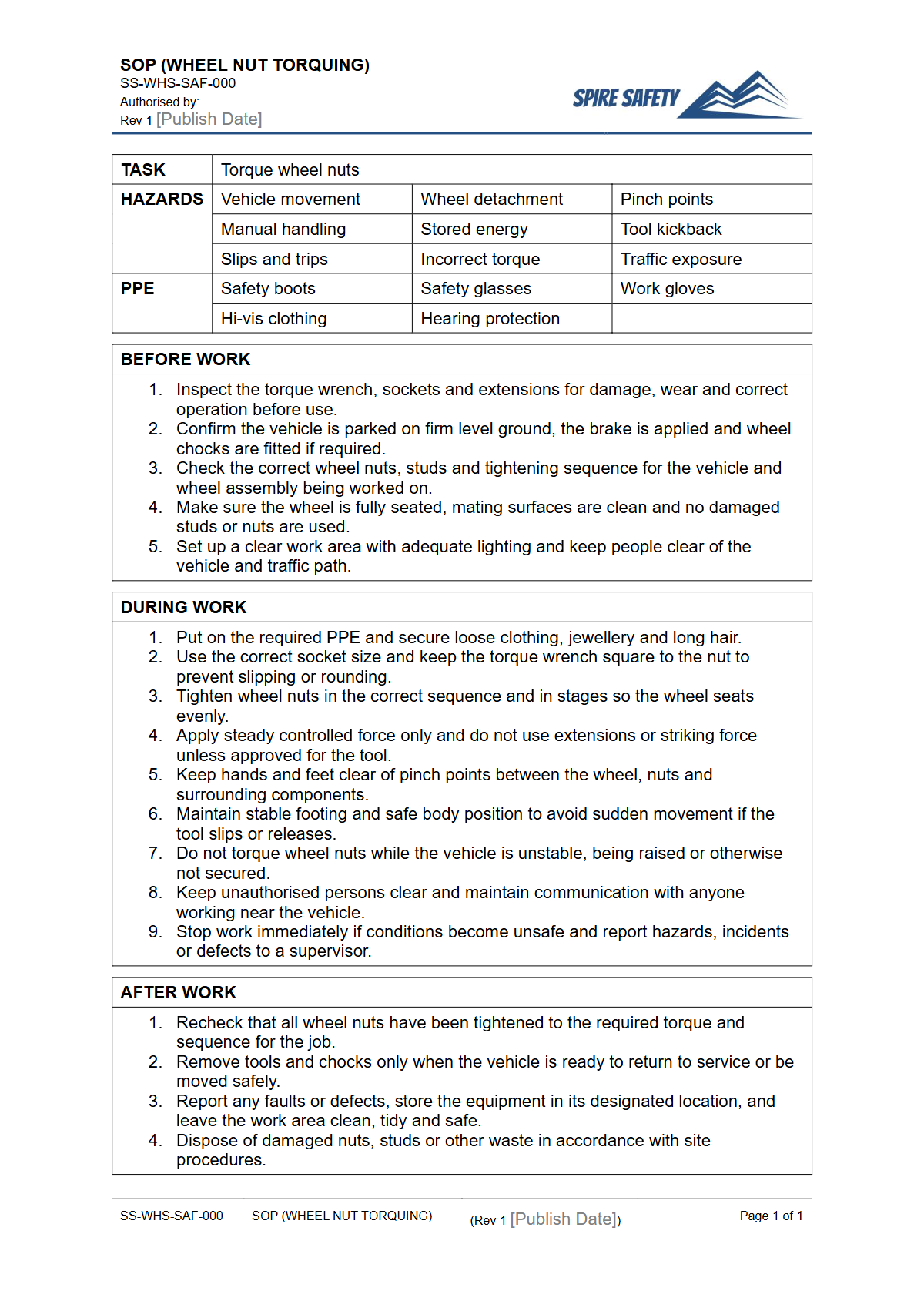
This template is available for download as both a DOCX file for easy editing and a PDF for straightforward distribution. It is designed as a comprehensive starting point, not a finished document.
You must customise the content to reflect the specific vehicles, equipment (e.g., torque wrenches, jacks), and unique environmental conditions of your workplace. Add your company name, logo, and review dates to formalise the document for your business operations.
The procedure includes sections for outlining potential hazards, required PPE, a detailed step-by-step process for torquing, and post-task clean-up. Much like our free Air Compressor SOP, this document provides a clear, structured format that guides workers safely through the task from start to finish.
We strongly recommend that a competent person reviews and approves the final, customised document before it is implemented.
When to use it
A wheel nut torquing SOP should be referenced every time a wheel is fitted to a vehicle. This includes several common scenarios in workshops and on-site maintenance operations:
- After replacing a flat or damaged tyre.
- During routine tyre rotations as part of a scheduled maintenance program.
- Whenever a wheel has been removed for servicing other components, such as brakes or suspension.
- As part of a comprehensive pre-trip inspection, especially for heavy vehicles.
- Following any incident or report that raises concerns about wheel security.
Crucially, the procedure should also mandate a re-torquing check after the vehicle has travelled a short distance (e.g., 50-100 kilometres) to account for any initial settling of the components. This verification step is a critical control measure within a robust WHS management system.
Who should use it
This Safe Operating Procedure is intended for any person whose role involves fitting wheels to light or heavy vehicles. This includes:
- Qualified Mechanics and Technicians
- Tyre Fitters
- Apprentices and Trainees (under direct supervision)
- Heavy Vehicle Operators who may perform tyre changes
- Workshop Supervisors and Managers responsible for overseeing vehicle maintenance
It is the responsibility of the Person Conducting a Business or Undertaking (PCBU) to ensure that all workers assigned this task are trained, competent, and fully understand the procedure. Just as workers require specific training for high-risk tasks documented in an Oxy Acetylene SOP, only personnel verified as competent should perform wheel nut torquing.
Key Elements of a Wheel Nut Torquing Procedure
A comprehensive SOP for this task goes beyond simply tightening nuts. This template prompts you to address several critical elements to ensure the task is performed correctly and safely every time.
Key sections to customise include the correct torque specification for each vehicle, the proper star-pattern tightening sequence to ensure even pressure, and procedures for cleaning wheel, hub, and stud surfaces. It also includes prompts for confirming the calibration of torque wrenches, as using an inaccurate tool defeats the purpose of the procedure. Regular checks on equipment and processes can be integrated into your quality assurance program or verified through periodic WHS compliance auditing.
Integrating this SOP into Your WHS System
A Safe Operating Procedure is most effective when it is part of a wider health and safety framework. This document should be used as a tool for worker training and competency assessments.
It should also be referenced in your risk assessments for vehicle maintenance. Ensure the SOP is readily accessible to all relevant workers, either in printed form in the workshop or digitally on company devices.
Regularly review and update the SOP, especially after an incident, when new equipment is introduced, or when regulations change. To discover other valuable procedural documents, explore our complete free WHS resources library for more templates and checklists.
Common mistakes
Common mistakes to avoid
- Using an impact wrench ('rattle gun') for final tightening, leading to inaccurate torque values.
- Failing to clean rust, dirt, or debris from stud threads and hub surfaces before refitting the wheel.
- Neglecting to re-torque the wheel nuts after the vehicle has travelled a short distance (typically 50–100 km).
- Tightening the nuts in a circular pattern instead of the correct star sequence, causing uneven pressure.
Legal references
Legal considerations
The following legal requirements may be relevant to this type of work.
- Work Health and Safety Act (Harmonised) — Provides the primary duties for protecting workers and other people from work health and safety risks.
- Work Health and Safety Regulations (Harmonised) — Sets out requirements supporting the management of workplace hazards and risks.
The following codes may be relevant to this type of work.
- Managing WHS Risks Code of Practice — Provides practical guidance on identifying hazards, assessing risks and applying effective controls.
- Work Health and Safety Consultation, Cooperation and Coordination Code of Practice — Provides practical guidance on consulting workers and coordinating with other duty holders.
- Managing the Work Environment and Facilities Code of Practice — Provides practical guidance on safe work environments, workplace facilities and related controls.
Did you know
Loose Wheel Nut Indicators
Many heavy vehicle fleets use plastic wheel nut indicators. These pointed tabs are fitted in a uniform pattern, making any nut that has loosened immediately obvious during a driver's daily walk-around inspection.
The Problem with Lubricant
Applying oil, grease, or anti-seize compound to wheel studs can be dangerous. It acts as a lubricant, reducing friction and causing the applied torque to result in a much higher clamping force, which can stretch and weaken the studs.
FAQ
Frequently asked questions
01What is the correct torque sequence for wheel nuts?
02How often should wheel nuts be re-torqued?
03Is a specific type of torque wrench required for this SOP?
04Why can't I just use an impact wrench (rattle gun) to tighten wheel nuts?
Share this resource
Free Safe Operating Procedure (Wheel Nut Torquing) Template
Browse Categories
How To Use It
- 1Download and open in Word or PDF.
- 2Replace the placeholders with your business details.
- 3Get it reviewed by a WHS specialist before rollout.
Need it customised?
Our WHS consultants can adapt this template to your site, run a gap analysis, or audit what you already have in place.
Book a Free Consultation WHS consulting servicesor call 1300 156 382
Related templates
- Free Safe Operating Procedure (Wheel Removal) Template
- Free Safe Operating Procedure (Wheel Stud Replacement) Template
- Free Safe Operating Procedure (Wheelchair Brake Check) Template
- Free Safe Operating Procedure (Wheelchair Charging) Template
- Free Safe Operating Procedure (Wheelchair Cushion Clean) Template
- Free Safe Operating Procedure (Wheelchair Footrest) Template