
Free Safe Operating Procedure (Wheelchair Brake Check) Template
Download our free Safe Operating Procedure (Wheelchair Brake Check) template for a structured guide. Start documenting your workplace safety processes today.
Free Safe Operating Procedure (Wheelchair Brake Check) Template
DOCX • 126 KB + PDF
Updated Oct 2026
No signup required
Purpose of the Free Safe Operating Procedure (Wheelchair Brake Check) Template
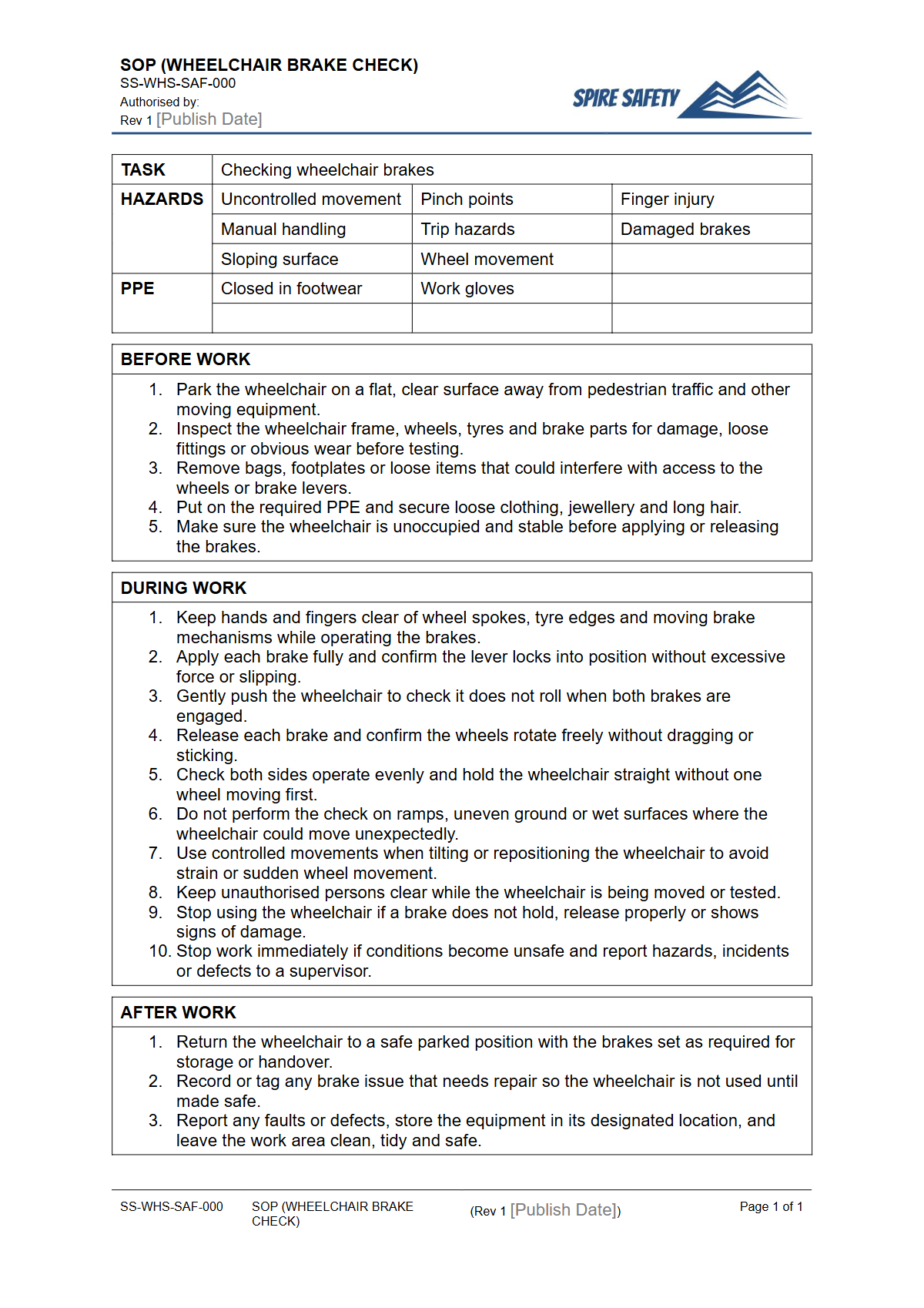
This Free Safe Operating Procedure (Wheelchair Brake Check) Template provides a clear, step-by-step framework for ensuring wheelchairs are safe for use. Regular and properly documented brake checks are critical in environments like aged care facilities, hospitals, and disability support services.
Implementing this SOP helps protect residents, patients, and clients from falls and injuries caused by equipment failure. It also safeguards your carers and staff by providing clear instructions, reducing ambiguity, and demonstrating a commitment to proactive safety management.
A documented procedure is a key part of an effective safety system. It forms a reliable record of due diligence and helps your organisation meet its primary duty of care obligations under Australian WHS laws.
By standardising the process for checking wheelchair brakes, you ensure consistency across all staff and shifts, significantly lowering the risk of incidents related to faulty equipment. This SOP is a foundational document for managing a common but critical piece of patient-handling equipment.
Video walkthrough
How to Use the Free Safe Operating Procedure (Wheelchair Brake Check) Template
Download the template in your preferred format (DOCX for easy editing or PDF) and integrate it into your existing safety management system. The document is structured to guide you through the essential steps of a wheelchair brake check, from pre-check preparations to the physical inspection and post-check actions.
It includes sections for defining responsibilities, outlining potential hazards, and listing required personal protective equipment (PPE), if any.
Important: This document is a template and must be customised for your specific workplace. We have provided a structured starting point aligned with Australian WHS practice, but you must adapt it to reflect the exact models of wheelchairs you use, the specific environmental conditions of your facility (e.g., ramps, types of flooring), and the outcomes of your own WHS consulting and risk assessments.
This ensures the procedure is relevant, practical, and effective for your team.
When to Use This Safe Operating Procedure
The wheelchair brake check SOP should be performed at regular, scheduled intervals to ensure equipment integrity. Best practice dictates that these checks are conducted:
- Before a wheelchair is used for the first time each day or at the start of each shift.
- After any maintenance, repair, or adjustment has been performed on the wheelchair.
- When a new wheelchair is first introduced into service.
- Immediately if a staff member or user reports a potential problem or unusual performance.
- As part of a scheduled periodic equipment maintenance program (e.g., weekly or monthly deep checks).
Integrating this procedure into daily routines helps foster a strong safety culture where equipment checks are second nature. Regularity is key to preventing incidents before they happen.
While this SOP is for wheelchairs, a similar structured approach is vital for other equipment. For instance, a facility's kitchen might use a Safe Operating Procedure for a deep fryer to manage its specific risks.
Who Should Use This SOP?
This procedure is designed for any person responsible for handling, moving, or maintaining wheelchairs. This typically includes:
- Aged Care Workers and Personal Carers
- Nurses and Healthcare Assistants
- Disability Support Workers
- Patient Transport Officers
- Maintenance and facilities management staff
All relevant personnel must receive adequate training on how to perform the brake check correctly as outlined in the customised SOP. Supervisors should ensure workers are competent in the procedure and that records of the checks are properly maintained.
Periodically reviewing these procedures as part of a formal WHS compliance audit can verify they are being followed correctly and remain effective.
Integrating SOPs into Broader Safety Systems
Safe Operating Procedures do not exist in isolation. They are a critical component of your organisation's overall WHS management system. The findings from these routine checks should inform your risk register, maintenance schedules, and procurement decisions.
If checks frequently identify the same fault across multiple wheelchairs of the same model, it may indicate a systemic issue that needs to be addressed with the supplier or through a change in equipment.
While the focus here is specific, the principles of documenting safe procedures apply across all industries and equipment types. A manufacturing site, for example, would follow a similar risk-based process when creating a conveyer system SOP to protect its workers.
Find more examples and templates in our comprehensive free WHS resources library to see how you can standardise safety across your operations.
The core principle is the same regardless of the machinery. Even seemingly simple equipment requires a formalised safety process.
For example, many workshops require an air compressor Safe Operating Procedure to manage risks from pressurised air and electrical hazards.
Common mistakes
Common mistakes to avoid
- Assuming brakes are working without a physical test ('it was fine yesterday').
- Failing to adapt the generic procedure to the specific wheelchair model being used.
- Forgetting to document that the check was completed, creating a gap in safety records.
- Not immediately removing a wheelchair with faulty brakes from service and clearly labelling it as 'Out of Service'.
Legal references
Legal considerations
The following legal requirements may be relevant to this type of work.
- Work Health and Safety Act (Harmonised) — Provides the primary duties for protecting workers and other people from work health and safety risks.
- Work Health and Safety Regulations (Harmonised) — Sets out requirements supporting the management of workplace hazards and risks.
The following codes may be relevant to this type of work.
- Managing WHS Risks Code of Practice — Provides practical guidance on identifying hazards, assessing risks and applying effective controls.
- Work Health and Safety Consultation, Cooperation and Coordination Code of Practice — Provides practical guidance on consulting workers and coordinating with other duty holders.
- Managing the Work Environment and Facilities Code of Practice — Provides practical guidance on safe work environments, workplace facilities and related controls.
Did you know
Equipment Failure is a Key Risk
A significant percentage of incidents resulting in injury to wheelchair users are directly linked to equipment failure. Brakes, tyres, and frames are common points of failure, making routine checks a critical preventative control.
FAQ
Frequently asked questions
01How often should wheelchair brakes be checked?
02What's the difference between a Safe Operating Procedure and a risk assessment?
03Does this SOP template apply to all types of wheelchairs?
04Who is responsible for training staff on this SOP?
Share this resource
Free Safe Operating Procedure (Wheelchair Brake Check) Template
Browse Categories
How To Use It
- 1Download and open in Word or PDF.
- 2Replace the placeholders with your business details.
- 3Get it reviewed by a WHS specialist before rollout.
Need it customised?
Our WHS consultants can adapt this template to your site, run a gap analysis, or audit what you already have in place.
Book a Free Consultation WHS consulting servicesor call 1300 156 382
Related templates
- Free Safe Operating Procedure (Wheelchair Charging) Template
- Free Safe Operating Procedure (Wheelchair Cushion Clean) Template
- Free Safe Operating Procedure (Wheelchair Footrest) Template
- Free Safe Operating Procedure (Wheelchair Handling) Template
- Free Safe Operating Procedure (Wheelchair Lap Belt) Template
- Free Safe Operating Procedure (Wheelchair Lift Use) Template