
Free Safe Operating Procedure (Wheelchair Lift Use) Template
Develop a clear process for operating wheelchair lifts with our free Safe Operating Procedure template. Download the customisable DOCX or PDF to get started.
Free Safe Operating Procedure (Wheelchair Lift Use) Template
DOCX • 126 KB + PDF
Updated Oct 2026
No signup required
Purpose of the Free Safe Operating Procedure (Wheelchair Lift Use) Template
A Safe Operating Procedure (SOP) is a formal document that provides detailed, step-by-step instructions on how to perform a task safely. For wheelchair lift use, its primary purpose is to minimise risks such as falls, crushing injuries, or equipment malfunction.
By standardising the operating process, you ensure that every user and operator follows a consistent, safe method. This document forms a crucial part of your broader safety framework and is a key component of effective WHS management systems.
Implementing a clear SOP helps your organisation meet its duty of care under Australian WHS laws by actively managing identified hazards. It provides a clear reference for training new staff, conducting refresher courses, and investigating incidents, ensuring everyone understands the expected safe behaviours and procedures.
Video walkthrough
How to use the Free Safe Operating Procedure (Wheelchair Lift Use) Template
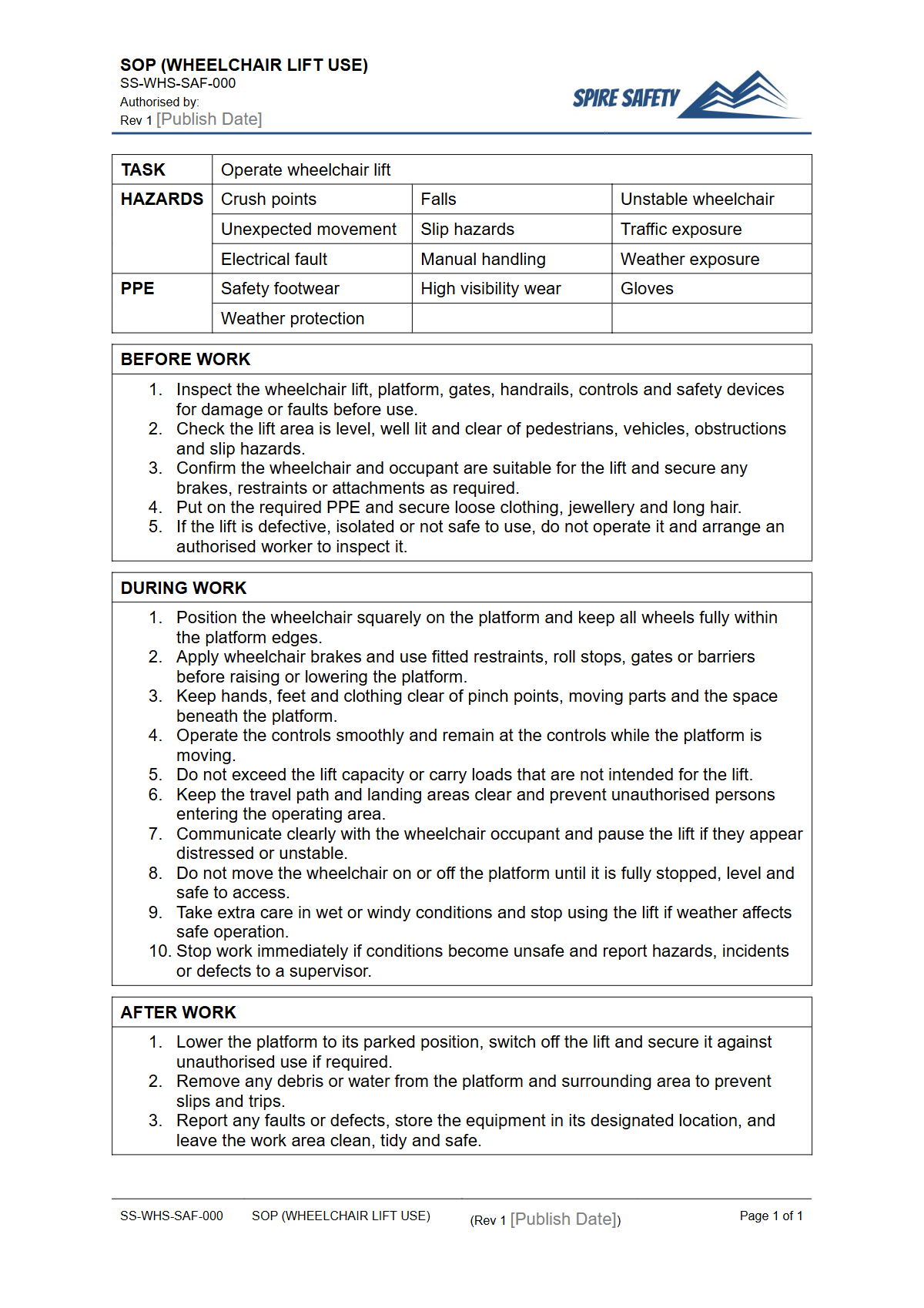
Our template is available for instant download as a DOCX file for easy editing, or as a PDF for reference. The document is logically structured to cover key areas including required personal protective equipment (PPE), pre-operational checks, step-by-step operating instructions, and post-operation procedures, similar to the format of our Conveyer System SOP.
Important: This document is a template, not a finished product. We have designed it as a comprehensive starting point aligned with Australian WHS principles, but you must customise it to your specific workplace. You need to review and edit every section to reflect the make and model of your wheelchair lift(s), the environment they are used in, and the findings from your own workplace risk assessment. Generic procedures are insufficient for managing specific site-based risks.
When to use an SOP for Wheelchair Lift Use
A documented SOP for wheelchair lift use should be a core part of your safety documentation. It is used in several key situations:
- Training: As the primary training document for new operators to ensure they learn the correct, safe method from the beginning.
- Refresher Training: For periodic retraining of existing staff to prevent procedural drift and reinforce safety standards.
- Risk Management: As a control measure identified in your risk assessment to manage hazards associated with lift operation.
- Post-Incident: As a reference point during incident investigations to determine if procedures were followed.
- Operational Reference: Kept near the equipment (where practical) for operators to quickly reference if they are unsure about a step.
Who should use this Safe Operating Procedure
This procedure is intended for several groups within an organisation. Primarily, it is for the operators of the wheelchair lift, who must be trained and deemed competent in its use.
Supervisors and managers should also use the SOP to oversee operations, conduct competency assessments, and ensure procedures are being followed correctly. Finally, WHS personnel and trainers will use the document to develop training programs and conduct workplace inspections. The structured process is similar to that required for other machinery, as seen in our FREE Telehandler SOP Template.
Key Elements to Customise
When adapting this template, pay close attention to the following sections to ensure they are specific to your context:
- Equipment Specifics: Clearly state the make, model, and capacity of the wheelchair lift.
- Pre-operational Checks: Create a detailed checklist for your specific lift. This should include checking safety barriers, control switches, hydraulic fluid levels (if applicable), and audible alarms. This process is just as important as the checks outlined in our Free Air Compressor SOP.
- Emergency Procedures: Detail the exact steps for manual lowering or emergency stops as described in the manufacturer's handbook. Include emergency contact numbers.
- Maintenance Schedule: Reference your organisation's maintenance and inspection schedule for the plant.
- Work Area: Describe the specific location, including requirements for clear space, lighting, and communication between operator and user.
By thoroughly customising this template, you create a genuinely useful tool that enhances safety and supports your compliance efforts. For more templates and safety documents, you can browse our full free WHS resources library.
Common mistakes
Common mistakes to avoid
- Failing to conduct pre-use visual inspections of the lift and its safety features.
- Not ensuring the user is positioned correctly and safely on the platform before operation.
- Neglecting regular maintenance schedules, leading to equipment failure.
- Using a generic SOP that doesn't match the specific lift model or installation environment.
Legal references
Legal considerations
The following legal requirements may be relevant to this type of work.
- Work Health and Safety Act (Harmonised) — Provides the primary duties for protecting workers and other people from work health and safety risks.
- Work Health and Safety Regulations (Harmonised) — Sets out requirements supporting the management of workplace hazards and risks.
The following codes may be relevant to this type of work.
- Managing WHS Risks Code of Practice — Provides practical guidance on identifying hazards, assessing risks and applying effective controls.
- Work Health and Safety Consultation, Cooperation and Coordination Code of Practice — Provides practical guidance on consulting workers and coordinating with other duty holders.
- Managing the Work Environment and Facilities Code of Practice — Provides practical guidance on safe work environments, workplace facilities and related controls.
Did you know
Maintenance is Key
Australian Standard AS 1735 specifies routine inspection and maintenance requirements for various types of lifts, including those for people with limited mobility. Regular servicing is not just a best practice; it's a critical safety requirement.
Not Just for Vehicles
While commonly associated with vehicles like buses and vans, wheelchair lifts are also installed in buildings, on stages, and in private residences to overcome architectural barriers. Each installation type requires its own specific risk assessment.
FAQ
Frequently asked questions
01What should a Safe Operating Procedure for a wheelchair lift include?
02How often do I need to review a wheelchair lift SOP?
03Is using a template enough for WHS compliance?
04Who is responsible for training operators on the wheelchair lift SOP?
Share this resource
Free Safe Operating Procedure (Wheelchair Lift Use) Template
Browse Categories
How To Use It
- 1Download and open in Word or PDF.
- 2Replace the placeholders with your business details.
- 3Get it reviewed by a WHS specialist before rollout.
Need it customised?
Our WHS consultants can adapt this template to your site, run a gap analysis, or audit what you already have in place.
Book a Free Consultation WHS consulting servicesor call 1300 156 382
Related templates
- Free Safe Operating Procedure (Wheelchair Ramp Setup) Template
- Free Safe Operating Procedure (Wheelchair Ramp Use) Template
- Free Safe Operating Procedure (Wheelchair Repair Check) Template
- Free Safe Operating Procedure (Wheelchair Scale Use) Template
- Free Safe Operating Procedure (Wheelchair Seat Cleaning) Template
- Free Safe Operating Procedure (Wheelchair Storage) Template