
Free Safe Operating Procedure (Wheelchair Seat Cleaning) Template
Download our free Safe Operating Procedure (Wheelchair Seat Cleaning) Template to guide routine cleaning tasks.
Free Safe Operating Procedure (Wheelchair Seat Cleaning) Template
DOCX • 126 KB + PDF
Updated Oct 2026
No signup required
Purpose of the Free Safe Operating Procedure (Wheelchair Seat Cleaning) Template
Properly cleaning wheelchair seats is a critical task in many healthcare, aged care, and community settings. This task, while seemingly simple, involves risks that must be managed to protect both the worker and the wheelchair user.
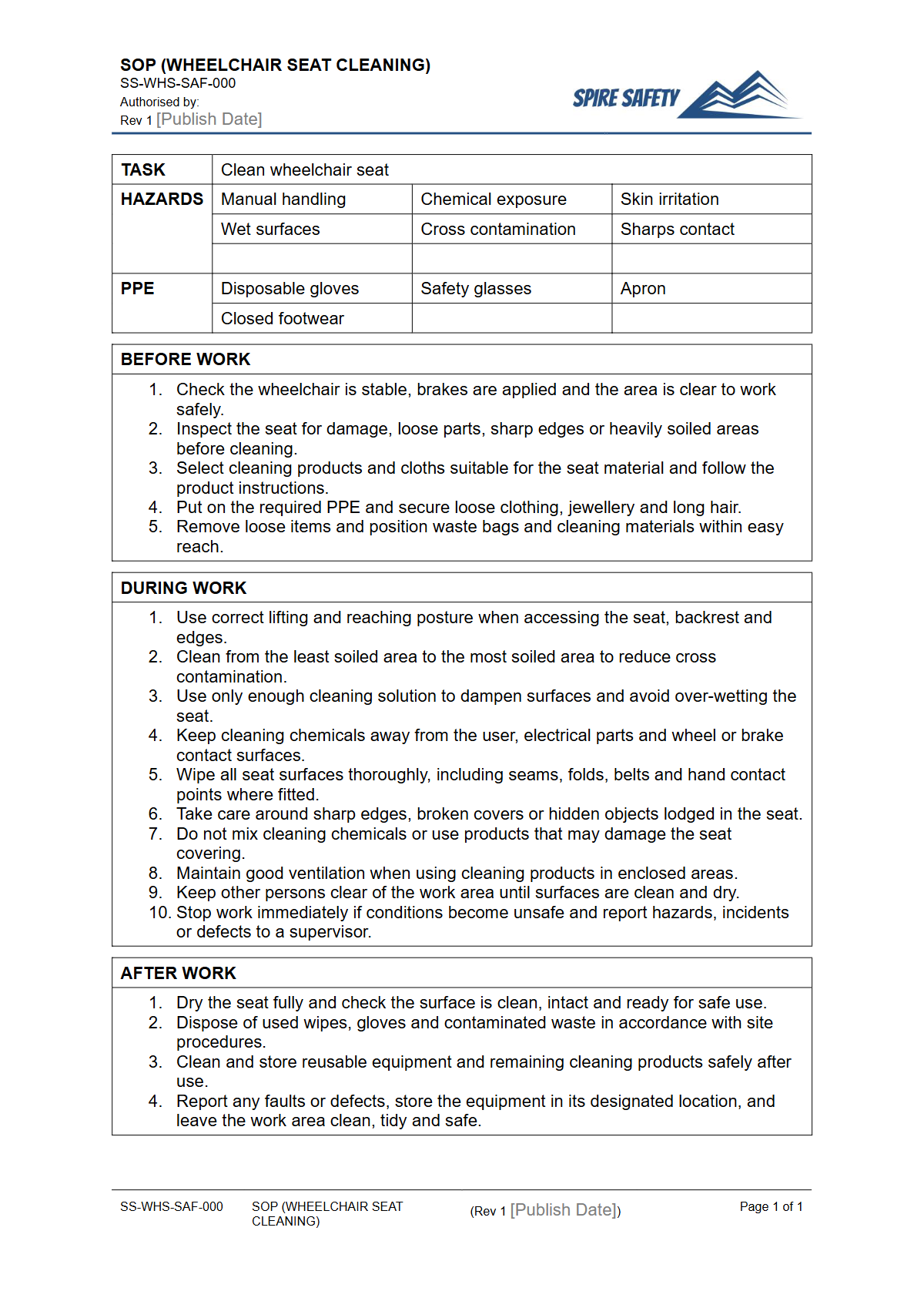
Our Free Safe Operating Procedure (Wheelchair Seat Cleaning) Template provides a structured starting point for your organisation to document a consistent and safe method for this activity. Using an SOP ensures every person performing the task follows the same steps, minimising risks associated with chemical handling, manual tasks, and infection control.
This template is designed to help you outline key safety elements, including hazard identification, required Personal Protective Equipment (PPE), step-by-step instructions, and emergency responses. Formalising your process helps meet your duty of care under Australian WHS laws and creates a valuable training resource for new and existing staff members.
A well-defined SOP demonstrates a commitment to health and safety, reducing the likelihood of incidents and ensuring equipment is maintained to a high standard of hygiene.
Video walkthrough
How to use the Free Safe Operating Procedure (Wheelchair Seat Cleaning) Template
This downloadable template is provided in both DOCX and PDF formats for your convenience. The DOCX file is fully editable, allowing you to tailor the content to the specific equipment, chemicals, and environment of your workplace.
To use the template effectively, you should systematically work through each section and replace the placeholder text with your site-specific information.
Key customisation steps include:
- Identifying the specific types of wheelchairs and seat materials (e.g., vinyl, fabric, leather) at your site.
- Listing the exact cleaning and disinfectant products used, and referencing their Safety Data Sheets (SDS).
- Detailing the required PPE, such as specific types of gloves, eye protection, or aprons.
- Adjusting the step-by-step procedure to match your established workflow.
- Adding contact details for supervisors and first aid officers.
Important: This document is a template only. We have designed it as a foundation, but it is not a complete or ready-to-use Safe Operating Procedure.
You must customise this document to reflect the unique hazards and control measures of your specific workplace, equipment, and tasks. Responsibility for creating a comprehensive and effective SOP that complies with relevant legislation rests with the user.
Integrating this SOP is a vital step, but it should form part of a holistic safety framework. A robust WHS management system ensures that procedures like this are effectively implemented, reviewed, and improved over time.
When to use a Safe Operating Procedure
A Safe Operating Procedure for wheelchair seat cleaning should be consulted every time the task is performed, especially by new or infrequent workers. It is an essential reference for scheduled routine cleaning, deep cleaning, and responding to spills or contamination incidents.
This SOP is particularly crucial in environments with high-risk or vulnerable individuals, such as hospitals, residential aged care facilities, and disability support services, where preventing cross-contamination is paramount.
Furthermore, having documented procedures is essential for demonstrating safety compliance. Formal SOPs are often reviewed during internal and external safety evaluations, such as a WHS compliance auditing process, to verify that safe systems of work are in place and being followed.
Who should use it
This SOP is intended for all personnel tasked with cleaning and maintaining wheelchairs. This may include cleaners, maintenance staff, healthcare assistants, nurses, personal care workers, and disability support workers.
It serves as a direct guide for workers performing the task, ensuring they are aware of the risks and the required controls.
Supervisors and managers should also use this document to train staff, induct new employees, and conduct competency assessments. WHS officers and managers can use it as a baseline for risk assessments and as evidence of implemented control measures.
If your team faces complex safety challenges beyond standard procedures, seeking external advice from a WHS consulting firm can provide clarity and expert guidance.
While this procedure focuses on cleaning, many facilities have other operational tasks that also require documented safe work methods. For instance, a commercial kitchen within an aged care home would need a specific deep fryer SOP to manage its unique risks.
Standardising procedures across all high-risk tasks is a hallmark of a mature safety culture.
Feel free to explore our complete free WHS resources library for more templates to support your safety management system.
Common mistakes
Common mistakes to avoid
- Using the wrong cleaning product for the seat material, causing damage like cracking or discoloration.
- Failing to allow sufficient 'dwell time' for disinfectants to work effectively.
- Neglecting to wear appropriate Personal Protective Equipment (PPE), such as gloves and eye protection.
- Using poor manual handling techniques when lifting or repositioning the wheelchair for cleaning.
Legal references
Legal considerations
The following legal requirements may be relevant to this type of work.
- Work Health and Safety Act (Harmonised) — Provides the primary duties for protecting workers and other people from work health and safety risks.
- Work Health and Safety Regulations (Harmonised) — Sets out requirements supporting the management of workplace hazards and risks.
The following codes may be relevant to this type of work.
- Managing WHS Risks Code of Practice — Provides practical guidance on identifying hazards, assessing risks and applying effective controls.
- Work Health and Safety Consultation, Cooperation and Coordination Code of Practice — Provides practical guidance on consulting workers and coordinating with other duty holders.
- Managing the Work Environment and Facilities Code of Practice — Provides practical guidance on safe work environments, workplace facilities and related controls.
Did you know
Dwell Time is Critical
For many disinfectants to be effective at killing germs, they must remain on a surface for a specific period known as 'dwell time' or 'contact time', which can range from 30 seconds to 10 minutes.
High-Touch Surfaces
Wheelchair armrests, push handles, and seat cushions are considered high-touch surfaces that can easily transmit pathogens if not cleaned and disinfected regularly and correctly.
FAQ
Frequently asked questions
01What are the main risks when cleaning wheelchair seats?
02Is this SOP template suitable for electric wheelchairs?
03How often should a Safe Operating Procedure be reviewed?
04Do I need a Safety Data Sheet (SDS) for all cleaning products?
Share this resource
Free Safe Operating Procedure (Wheelchair Seat Cleaning) Template
Browse Categories
How To Use It
- 1Download and open in Word or PDF.
- 2Replace the placeholders with your business details.
- 3Get it reviewed by a WHS specialist before rollout.
Need it customised?
Our WHS consultants can adapt this template to your site, run a gap analysis, or audit what you already have in place.
Book a Free Consultation WHS consulting servicesor call 1300 156 382
Related templates
- Free Safe Operating Procedure (Wheelchair Storage) Template
- Free Safe Operating Procedure (Wheelchair Tie-Down) Template
- Free Safe Operating Procedure (Wheelchair Tyre Check) Template
- Free Safe Operating Procedure (Wheelchair Van Loading) Template
- Free Safe Operating Procedure (Wheelchair Washdown) Template
- Free Safe Operating Procedure (Wildlife Nest Avoidance) Template