
Free Safe Operating Procedure (Wheelchair Tie-Down) Template
Secure wheelchair users safely during transport with our structured SOP template. Download this free, customisable guide to enhance your safety procedures.
Free Safe Operating Procedure (Wheelchair Tie-Down) Template
DOCX • 126 KB + PDF
Updated Oct 2026
No signup required
Purpose of the Free Safe Operating Procedure (Wheelchair Tie-Down) Template
Ensuring the safety of wheelchair users during vehicle transport is a critical responsibility. This free Safe Operating Procedure (Wheelchair Tie-Down) Template provides a clear, step-by-step framework for your workers.
The primary purpose of this document is to provide a documented, systematic approach to a high-risk task. It helps your organisation meet its primary duty of care under WHS law by establishing a safe system of work.
A well-implemented SOP minimises the chance of passenger or operator injury caused by improper restraint, sudden vehicle movements, or incidents. It serves as a vital training tool for new and existing staff and is a cornerstone of effective WHS management systems, demonstrating proactive risk management.
Video walkthrough
How to use the Free Safe Operating Procedure (Wheelchair Tie-Down) Template
Download the template in your preferred format (DOCX for easy editing or PDF). Important Note: This document is a template and must be customised for your specific workplace.
We have provided a comprehensive structure based on Australian WHS principles, but you must review and adapt it to reflect your unique environment. This includes detailing the specific types of vehicles used, the brand and model of wheelchair tie-down and occupant restraint systems (WTORS) in use, and any site-specific hazards identified in your risk assessment.
If you require assistance with tailoring procedures to your operations, our WHS consulting services can provide expert guidance.
When to use a Wheelchair Tie-Down SOP
This Safe Operating Procedure should be implemented and followed every time a person is transported while seated in their wheelchair. It is essential for a range of services, including community transport providers, non-emergency patient transport, disability support services, aged care facilities, and taxi networks with wheelchair-accessible vehicles.
The SOP should be integrated into daily operations to ensure the task is performed correctly and consistently, removing guesswork and reinforcing safety-conscious behaviour across your organisation.
Who should use this Safe Operating Procedure
This procedure is designed for all personnel involved in transporting wheelchair users. This includes drivers, transport assistants, patient care officers, and disability support workers.
Supervisors and managers also have a crucial role; they are responsible for providing training on this SOP, ensuring workers are competent in its application, and monitoring its consistent use. Competency should be verified for all high-risk tasks in the workplace, whether it's securing a passenger or operating workshop equipment based on a circular saw SOP.
Key Procedural Steps in Wheelchair Securement
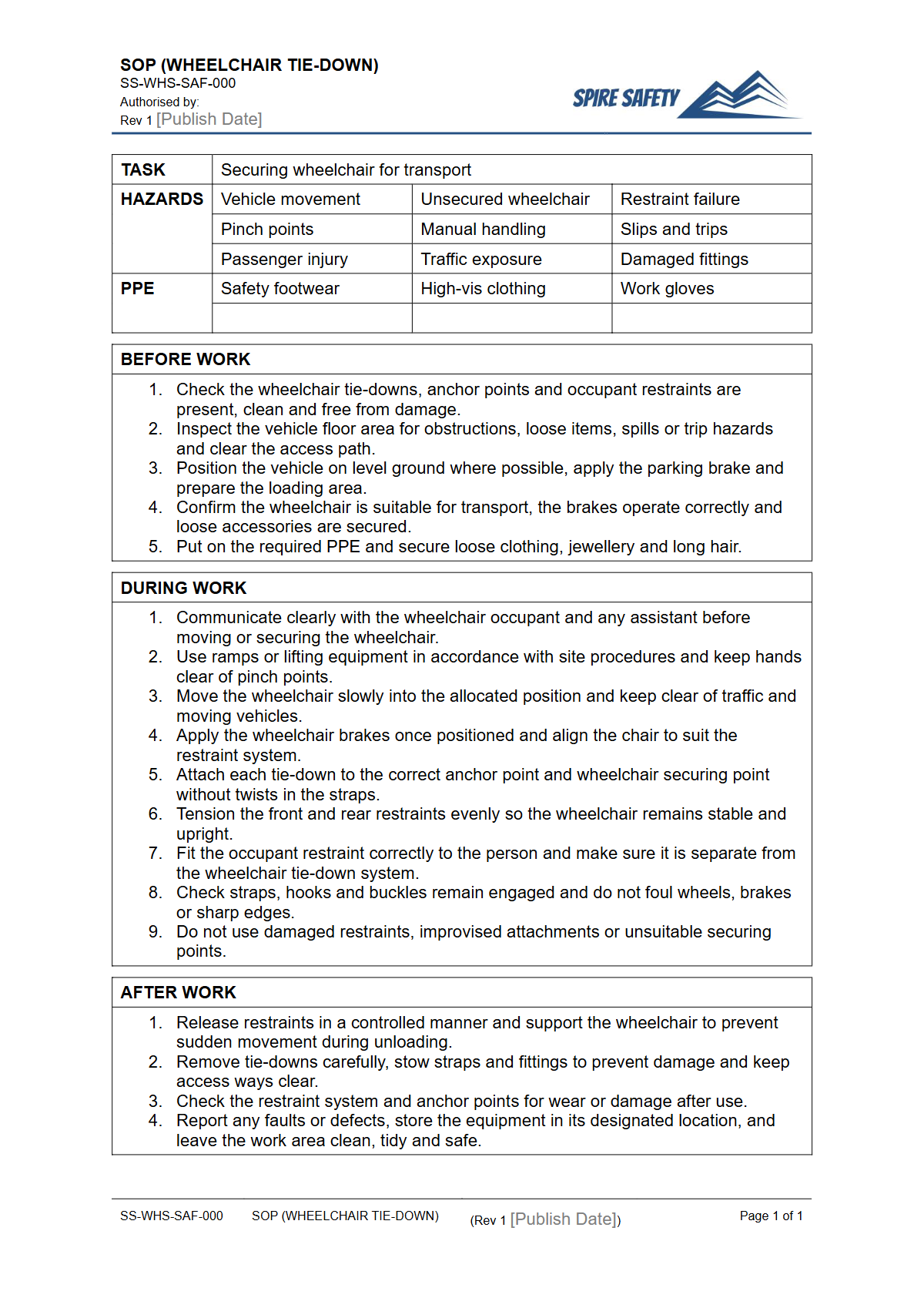
Our template guides you through the essential stages of the tie-down process. A robust procedure prevents critical steps from being missed and ensures a consistent, safe outcome for every journey. These stages typically include:
Pre-Operation Checks
- Inspecting all tie-down straps, buckles, and retractors for wear, fraying, or damage before each use.
- Ensuring vehicle floor anchor points are clean, unobstructed, and secure.
- Checking that the wheelchair itself is in good condition, with properly inflated tyres where applicable.
Securing the Wheelchair
- Positioning the wheelchair centrally within the designated station, facing forward.
- Applying the wheelchair's own parking brakes.
- Attaching the four tie-down straps to strong, structural points on the wheelchair frame, never to removable parts like armrests or wheels.
- Tensioning the straps correctly to prevent movement without over-stressing the wheelchair frame.
Securing the Occupant
- Applying the separate occupant restraint (lap and shoulder belt).
- Ensuring the belt is positioned correctly over the occupant's pelvis and shoulder, and is anchored to the vehicle structure—not the wheelchair.
Proper documentation is vital for all critical tasks, from patient handling to operating machinery as detailed in our FREE Telehandler SOP Template.
Review and Improvement
A Safe Operating Procedure is a living document. It should be reviewed regularly—at least annually—or whenever there is a change in equipment, procedures, or relevant legislation.
It must also be reviewed after any incident or near-miss involving wheelchair transport. This continuous improvement cycle, which can be verified through a WHS compliance auditing process, ensures the procedure remains effective and relevant to your operations. Find more templates and checklists to support your safety system in our extensive free WHS resources library.
Common mistakes
Common mistakes to avoid
- Attaching tie-down straps to non-structural parts of the wheelchair like wheels or armrests.
- Forgetting to apply the wheelchair's own brakes before securing it.
- Using frayed, twisted, or damaged straps and retractors.
- Attaching the occupant's seatbelt to the wheelchair itself instead of the vehicle's anchor points.
Legal references
Legal considerations
The following legal requirements may be relevant to this type of work.
- Work Health and Safety Act (Harmonised) — Provides the primary duties for protecting workers and other people from work health and safety risks.
- Work Health and Safety Regulations (Harmonised) — Sets out requirements supporting the management of workplace hazards and risks.
The following codes may be relevant to this type of work.
- Managing WHS Risks Code of Practice — Provides practical guidance on identifying hazards, assessing risks and applying effective controls.
- Work Health and Safety Consultation, Cooperation and Coordination Code of Practice — Provides practical guidance on consulting workers and coordinating with other duty holders.
- Managing the Work Environment and Facilities Code of Practice — Provides practical guidance on safe work environments, workplace facilities and related controls.
Did you know
Separate Restraints are Critical
The occupant restraint (seatbelt) must always be separate from the wheelchair tie-down system and anchor directly to the vehicle. A vehicle seatbelt is designed to handle crash forces, while a wheelchair is not.
G-Force Multiplication
In a crash at just 50 km/h, the forces acting on an unrestrained passenger or object can be more than 20 times their actual weight. This makes proper securement a life-saving procedure.
FAQ
Frequently asked questions
01Is this wheelchair tie-down SOP template compliant with Australian standards?
02What type of tie-down systems does this SOP cover?
03Who is responsible for ensuring wheelchairs are secured correctly?
04How often should we review our Wheelchair Tie-Down SOP?
Share this resource
Free Safe Operating Procedure (Wheelchair Tie-Down) Template
Browse Categories
How To Use It
- 1Download and open in Word or PDF.
- 2Replace the placeholders with your business details.
- 3Get it reviewed by a WHS specialist before rollout.
Need it customised?
Our WHS consultants can adapt this template to your site, run a gap analysis, or audit what you already have in place.
Book a Free Consultation WHS consulting servicesor call 1300 156 382
Related templates
- Free Safe Operating Procedure (Wheelchair Tyre Check) Template
- Free Safe Operating Procedure (Wheelchair Van Loading) Template
- Free Safe Operating Procedure (Wheelchair Washdown) Template
- Free Safe Operating Procedure (Wildlife Nest Avoidance) Template
- Free Safe Operating Procedure (Windblown Debris Cleanup) Template
- Free Safe Operating Procedure (Windbreak Maintenance) Template