
Free Safe Operating Procedure (Windbreak Maintenance) Template
Effectively manage hazards associated with windbreak maintenance using our free SOP template. Download this customisable document to create a robust procedure.
Free Safe Operating Procedure (Windbreak Maintenance) Template
DOCX • 126 KB + PDF
Updated Oct 2026
No signup required
Purpose of the Free Safe Operating Procedure (Windbreak Maintenance) Template
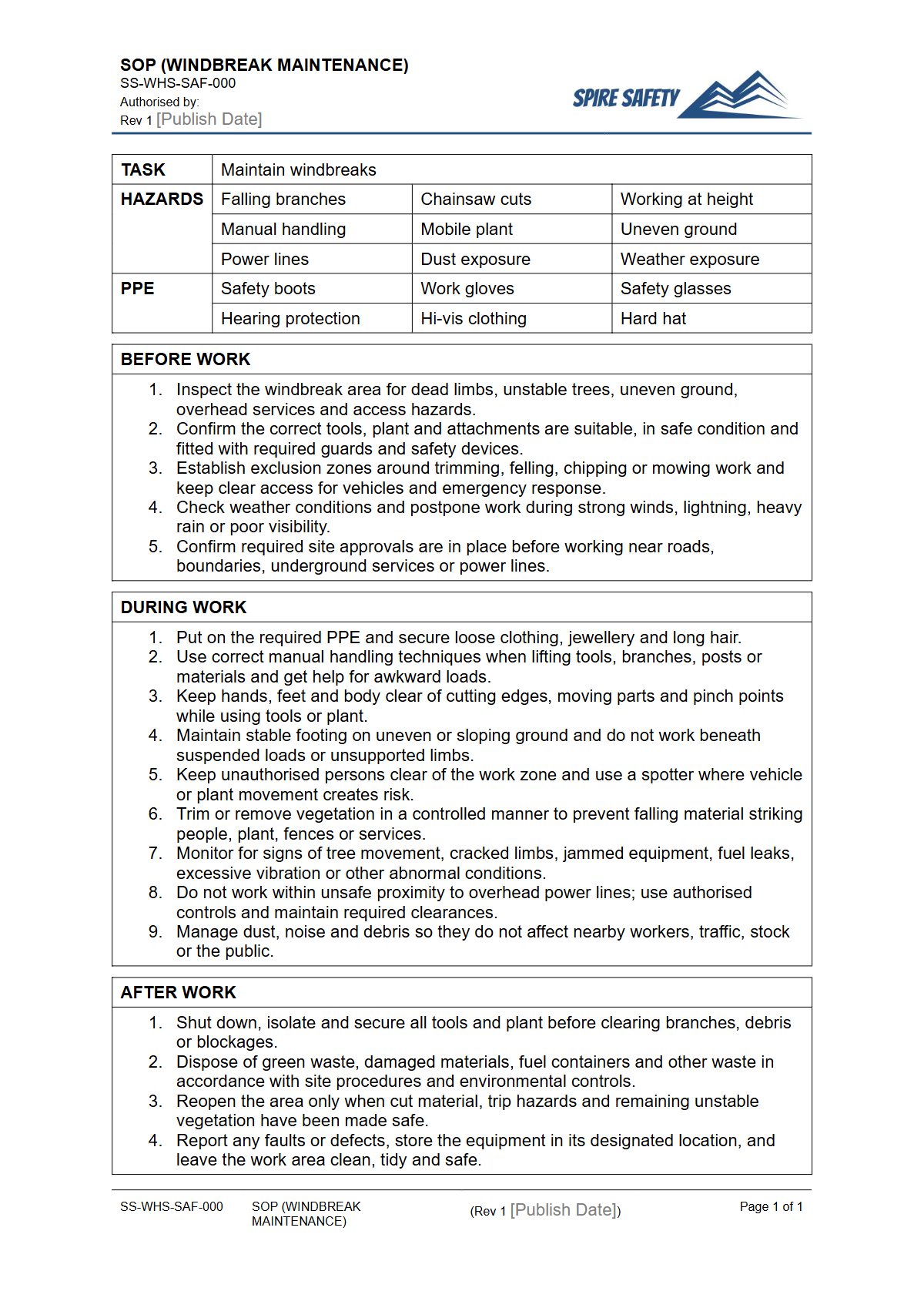
Windbreak maintenance on farms and large properties involves high-risk activities, including working at height, using chainsaws, and operating heavy machinery. This free Safe Operating Procedure (Windbreak Maintenance) Template provides a structured starting point for documenting the safest way to perform these tasks.
A well-drafted SOP is a critical tool for any person conducting a business or undertaking (PCBU) to meet their primary duty of care. It helps standardise work methods, ensures workers are aware of specific hazards and control measures, and serves as a key document for training and inductions.
By clearly outlining steps for pre-operational checks, task execution, and post-task clean-up, this template helps minimise the risk of injury from common hazards like falls, cuts, noise exposure, and manual handling strains. Integrating this procedure is a foundational step in building more comprehensive WHS management systems that protect your people and your business.
Video walkthrough
How to use the Free Safe Operating Procedure (Windbreak Maintenance) Template
To get the most value from this resource, it must be adapted to the unique conditions of your workplace. A generic document is not sufficient for compliance or safety.
Download the DOCX file and follow these steps to create a site-specific SOP.
Customisation is Essential
Consult directly with the workers who perform windbreak maintenance. Their hands-on experience is invaluable for identifying practical hazards and effective controls. Edit the template to include:
- Specific locations and types of trees or shrubs involved.
- The exact make and model of equipment used (e.g., chainsaws, wood chippers, ladders).
- Required Personal Protective Equipment (PPE) such as hard hats, hearing protection, cut-resistant chaps, and safety glasses.
- Site-specific emergency procedures, including contact numbers and first aid locations.
For tasks involving work at height, you may need to detail the use of specific plant like elevated work platforms (EWPs). Our free Telehandler SOP template can provide additional guidance if this equipment is used for lifting materials or personnel. If you are planting new windbreaks, you might also require procedures for ground preparation, which could be supported by our free Trencher SOP template.
Important Note: We provide this template as a starting point. It is your responsibility to ensure the final document is customised to reflect the specific hazards, risks, and control measures relevant to your workplace and operations.
When to use a Safe Operating Procedure
A Safe Operating Procedure for windbreak maintenance should be developed and implemented before any work begins. It is a proactive tool used throughout the work lifecycle. Use it for:
- Planning Work: Refer to the SOP when scheduling maintenance to ensure all necessary equipment, personnel, and safety controls are in place.
- Worker Training: Use the finalised SOP as a core document for inducting new workers and for refresher training to ensure consistent, safe practices.
- Risk Assessments: The SOP provides a baseline of established controls, which can be reviewed and updated as part of your ongoing WHS risk management processes.
- Incident Investigations: If an incident or near-miss occurs, the SOP can be reviewed to determine if procedures were followed and if they need improvement.
This procedure should be kept in a location where it is easily accessible to all relevant workers, whether in a site office, vehicle, or digital format on a mobile device. Standardising safety across all seasonal operations with procedural documents, such as a free Planter SOP, helps create a consistent safety culture.
Who should use it
This template is designed for use by various roles within an agricultural or property management organisation in Australia:
- PCBUs and Farm Owners: To fulfil their legal duty to provide and maintain a safe system of work.
- Managers and Supervisors: To train, instruct, and supervise workers, ensuring they follow agreed-upon safety protocols. They can also use it as a benchmark during workplace inspections.
- WHS Officers/Advisors: To develop and integrate safety procedures into the broader WHS management system and to guide risk management activities. Performing regular checks against the SOP is a key part of internal WHS compliance auditing.
- Workers and Contractors: As a practical guide to follow before and during maintenance tasks, helping them understand the risks and the steps required to stay safe.
Ultimately, everyone involved in the task is responsible for understanding and applying the SOP to create a safer working environment. When procedures are clear and consistently applied across different activities, like those outlined in our free Grain Drill SOP, overall workplace safety is significantly enhanced.
Common mistakes
Common mistakes to avoid
- Using the template as-is without customising it for specific site conditions and equipment.
- Failing to consult with and train workers on the contents of the final, customised SOP.
- Neglecting to complete pre-operational checks on all equipment, especially chainsaws and EWPs.
- Not establishing clearly marked exclusion zones to protect people from falling branches or debris.
Legal references
Legal considerations
The following legal requirements may be relevant to this type of work.
- Work Health and Safety Act (Harmonised) — Provides the primary duties for protecting workers and other people from work health and safety risks.
- Work Health and Safety Regulations (Harmonised) — Sets out requirements supporting the management of workplace hazards and risks.
The following codes may be relevant to this type of work.
- Managing WHS Risks Code of Practice — Provides practical guidance on identifying hazards, assessing risks and applying effective controls.
- Work Health and Safety Consultation, Cooperation and Coordination Code of Practice — Provides practical guidance on consulting workers and coordinating with other duty holders.
- Managing the Work Environment and Facilities Code of Practice — Provides practical guidance on safe work environments, workplace facilities and related controls.
Did you know
Working at Height Risks
Falls from height are a leading cause of fatalities in Australian workplaces. Using the right equipment, such as an EWP instead of a ladder, and having robust procedures is critical for tree maintenance safety.
Sheltering Effect
Well-designed windbreaks can reduce wind speed for a distance of up to 30 times their height, providing vital protection for crops, soil, livestock, and buildings.
FAQ
Frequently asked questions
01What are the main hazards in windbreak maintenance?
02Does this SOP template cover chainsaw operation?
03Who is responsible for developing a Safe Operating Procedure?
04How often should a windbreak maintenance SOP be reviewed?
Share this resource
Free Safe Operating Procedure (Windbreak Maintenance) Template
Browse Categories
How To Use It
- 1Download and open in Word or PDF.
- 2Replace the placeholders with your business details.
- 3Get it reviewed by a WHS specialist before rollout.
Need it customised?
Our WHS consultants can adapt this template to your site, run a gap analysis, or audit what you already have in place.
Book a Free Consultation WHS consulting servicesor call 1300 156 382
Related templates
- Free Safe Operating Procedure (Window Cleaning) Template
- Free Safe Operating Procedure (Window Frame Cleaning) Template
- Free Safe Operating Procedure (Window Sill Cleaning) Template
- Free Safe Operating Procedure (Window Track Cleaning) Template
- Free Safe Operating Procedure (Windscreen Removal) Template
- Free Safe Operating Procedure (Wine Bottle Handling) Template