
Free Safe Operating Procedure (Window Cleaning) Template
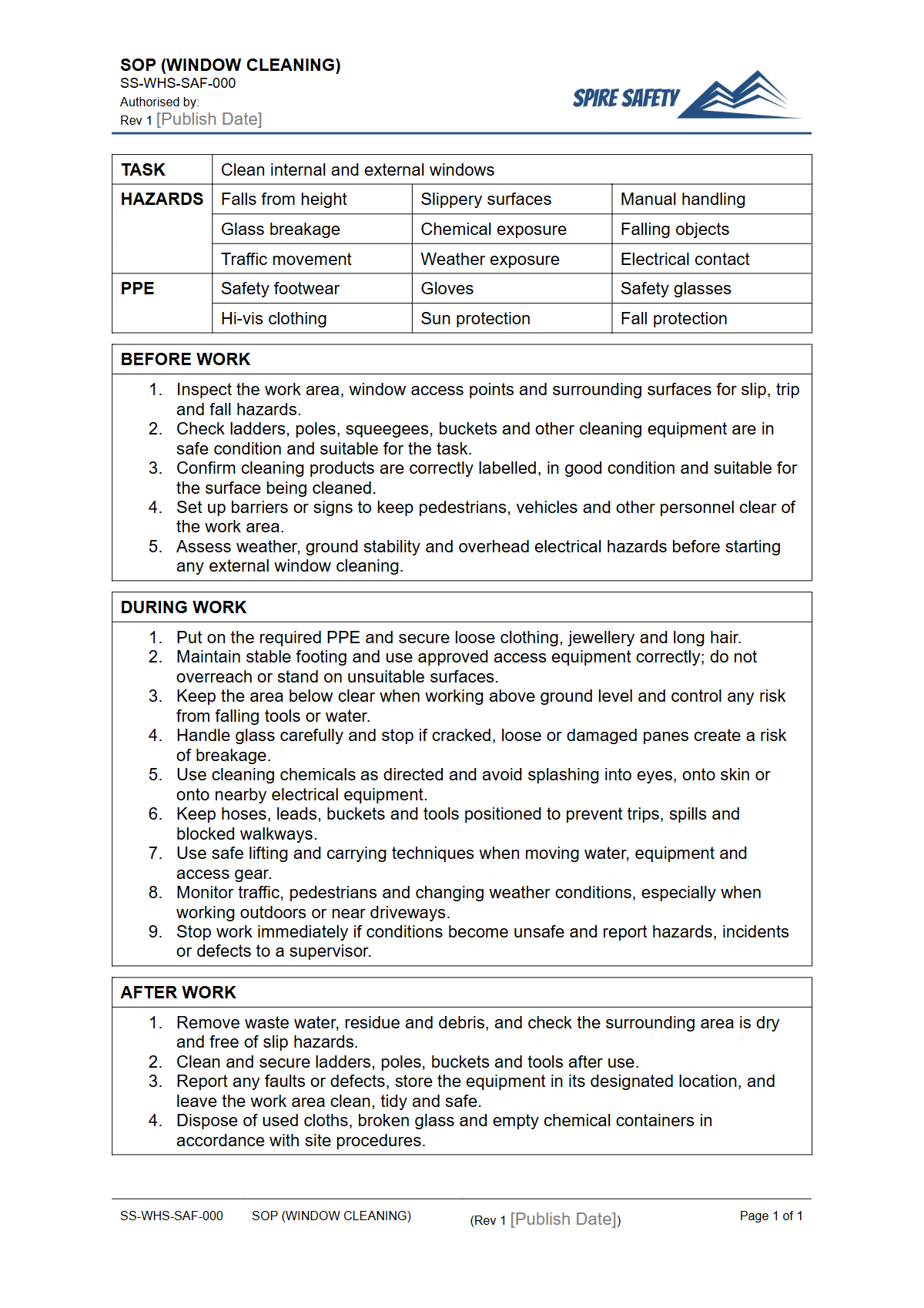
Clearly define the steps for safe window cleaning operations. Download our free Safe Operating Procedure template to get a structured starting point.
Free Safe Operating Procedure (Window Cleaning) Template
DOCX • 126 KB + PDF
Updated Oct 2026
No signup required
Purpose of the Free Safe Operating Procedure (Window Cleaning) Template
Window cleaning, especially at height, presents significant work health and safety risks, including falls, hazardous chemical exposure, and manual handling injuries. This Free Safe Operating Procedure (Window Cleaning) Template provides a structured framework for documenting a safe system of work.
Using an SOP helps standardise your processes, ensuring every worker understands the required steps, hazards, and control measures for the task. It acts as a critical training tool for new employees and a vital refresher for experienced staff, reinforcing safe work behaviours and minimising the chance of incidents.
A well-developed Safe Operating Procedure is a cornerstone of a proactive safety culture. By clearly outlining pre-start checks, personal protective equipment (PPE) requirements, and emergency responses, you create a reliable and repeatable process.
This document is a foundational component for building comprehensive WHS management systems that protect your workers and your organisation.
Video walkthrough
How to use the Free Safe Operating Procedure (Window Cleaning) Template
This resource is available for immediate download as a customisable DOCX file, with a PDF version also provided for easy distribution and printing. The template is designed as a comprehensive starting point, aligned with Australian WHS principles, to help you formalise your window cleaning processes.
It covers key areas such as risk assessment, equipment setup, task execution, and post-work cleanup.
Important: This document must be customised to your specific workplace. We've created a general template, but you are responsible for adapting it to reflect the unique hazards, equipment (e.g., specific ladders, elevating work platforms, rope access gear), chemicals, and control measures relevant to your operations.
Thoroughly review and edit each section to ensure it accurately represents your site conditions and legal obligations. For complex sites or high-risk scenarios, seeking professional advice from a WHS consulting firm can provide clarity and assurance.
While this SOP focuses on window cleaning, the principles of documenting safe work methods apply across all industries, from construction to hospitality where you might need a Safe Operating Procedure for a deep fryer.
When to use this Safe Operating Procedure
A Safe Operating Procedure for window cleaning should be a living document integrated into your daily operations. It is not a set-and-forget form. Key times to use it include:
- Worker Training and Induction: Use the SOP as the primary training document to ensure all new workers understand the established safe method before they begin work.
- Pre-Task Planning and Toolboxes: Review the SOP during pre-start meetings or toolbox talks to refresh workers on the risks and controls, especially for non-routine or high-risk cleaning jobs.
- Supervision and Monitoring: Supervisors can use the SOP as a checklist to observe work practices and confirm that procedures are being followed correctly.
- Incident Investigation: Following an incident or near miss, the SOP should be reviewed to determine if the procedure was adequate, if it was followed, and what improvements are needed.
Comprehensive site safety plans often cover a variety of tasks beyond a single activity. Maintaining clear procedures for all equipment is just as crucial, such as those detailed in our FREE Circular Saw SOP (Safe Operating Procedure) Template.
Who should use this Safe Operating Procedure
This SOP is intended for use by multiple roles within an organisation to foster a collaborative approach to safety. Primarily, it is for:
- Workers and Contractors: The individuals performing the window cleaning task must understand and follow the procedure to ensure their own safety and the safety of others around them.
- Supervisors and Team Leaders: Those responsible for overseeing the work must use the SOP to enforce safe practices, conduct inspections, and provide guidance.
- WHS Managers and Coordinators: Safety professionals should use this template as part of the risk management process, ensuring it is properly developed, implemented, and reviewed as part of the overall safety system.
Regular maintenance is also a key safety function, and procedures for associated tasks should be documented. For example, using an air compressor for cleaning debris before window track maintenance could be covered by a resource like our free Air Compressor SOP. You can find more templates like this across our free WHS resources library to help build out your documentation.
Common mistakes
Common mistakes to avoid
- Using ladders or equipment that are not rated for commercial use or are in poor condition.
- Failing to conduct a pre-start risk assessment to identify site-specific hazards like powerlines or unstable ground.
- Neglecting to wear appropriate Personal Protective Equipment (PPE), such as safety glasses, gloves, and non-slip footwear.
- Working in adverse weather conditions like high winds or rain without implementing additional control measures.
Legal references
Legal considerations
The following legal requirements may be relevant to this type of work.
- Work Health and Safety Act (Harmonised) — Provides the primary duties for protecting workers and other people from work health and safety risks.
- Work Health and Safety Regulations (Harmonised) — Sets out requirements supporting the management of workplace hazards and risks.
The following codes may be relevant to this type of work.
- Managing WHS Risks Code of Practice — Provides practical guidance on identifying hazards, assessing risks and applying effective controls.
- Work Health and Safety Consultation, Cooperation and Coordination Code of Practice — Provides practical guidance on consulting workers and coordinating with other duty holders.
- Managing the Work Environment and Facilities Code of Practice — Provides practical guidance on safe work environments, workplace facilities and related controls.
Did you know
A Significant Risk
According to Safe Work Australia, falls from height are a leading cause of workplace fatalities and serious injuries. Between 2015 and 2019, falls, trips and slips resulted in 21% of serious claims.
FAQ
Frequently asked questions
01What are the primary hazards in window cleaning?
02How often should a window cleaning SOP be reviewed?
03Is an SOP legally required for window cleaning in Australia?
04Can a generic SOP be used for all window cleaning jobs?
Share this resource
Free Safe Operating Procedure (Window Cleaning) Template
Browse Categories
How To Use It
- 1Download and open in Word or PDF.
- 2Replace the placeholders with your business details.
- 3Get it reviewed by a WHS specialist before rollout.
Need it customised?
Our WHS consultants can adapt this template to your site, run a gap analysis, or audit what you already have in place.
Book a Free Consultation WHS consulting servicesor call 1300 156 382
Related templates
- Free Safe Operating Procedure (Window Frame Cleaning) Template
- Free Safe Operating Procedure (Window Sill Cleaning) Template
- Free Safe Operating Procedure (Window Track Cleaning) Template
- Free Safe Operating Procedure (Windscreen Removal) Template
- Free Safe Operating Procedure (Wine Bottle Handling) Template
- Free Safe Operating Procedure (Wine Cellar Stocking) Template