
Free Safe Operating Procedure (Windscreen Removal) Template
Formalise your windscreen removal process with our free Safe Operating Procedure template. Download our customisable DOCX and PDF to ensure safety and consistency.
Free Safe Operating Procedure (Windscreen Removal) Template
DOCX • 126 KB + PDF
Updated Oct 2026
No signup required
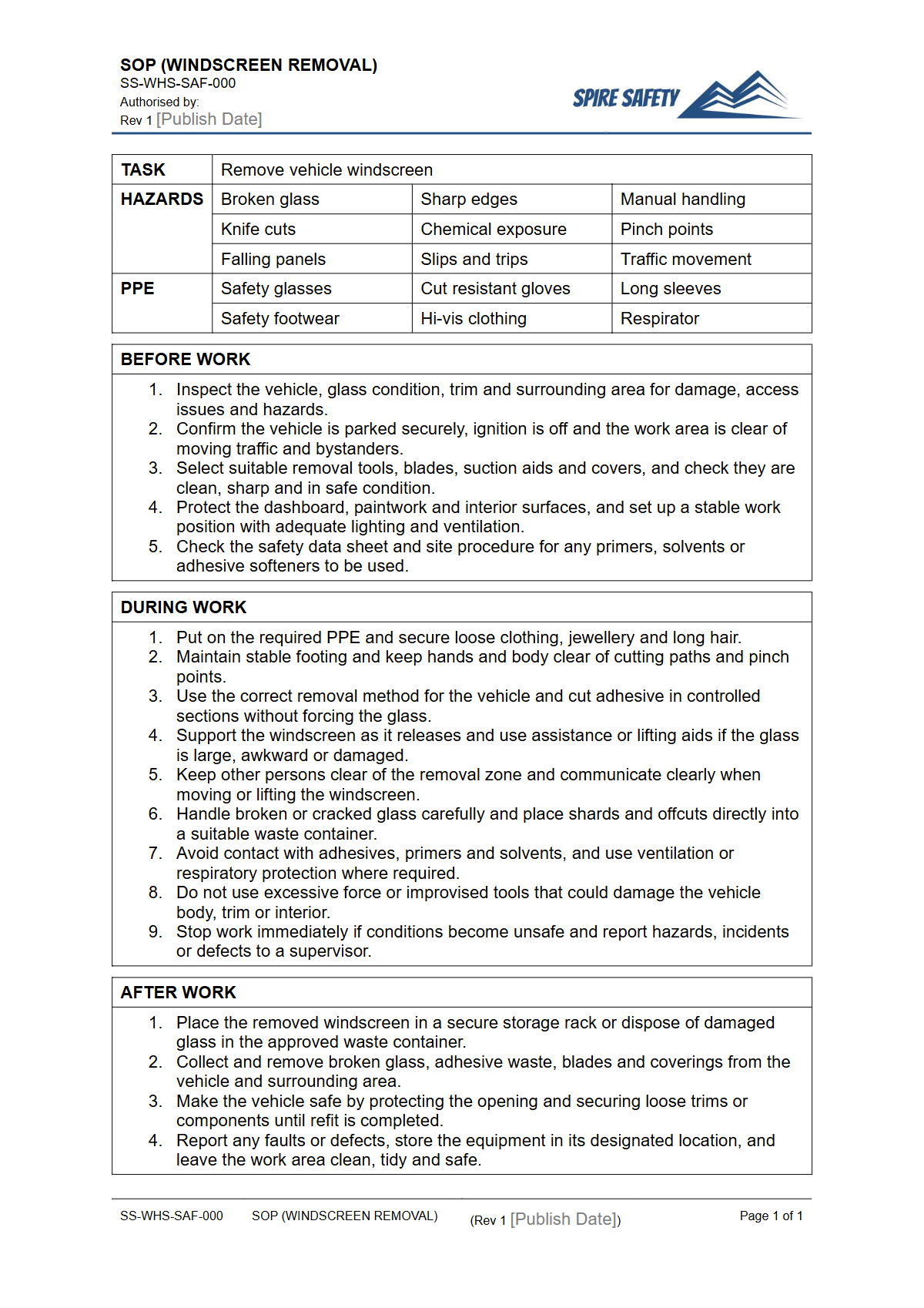
Purpose of the Free Safe Operating Procedure (Windscreen Removal) Template
Effectively managing workshop risks begins with clear, documented processes for high-risk tasks. This Free Safe Operating Procedure (Windscreen Removal) Template provides a structured framework for automotive repairers and glaziers to perform this common but hazardous job safely.
A well-drafted SOP standardises the method, ensuring every worker follows a pre-assessed, safe sequence of steps. This consistency is crucial for minimising risks such as deep cuts from glass or tools, musculoskeletal injuries from awkward postures, and exposure to hazardous chemical adhesives.
Using a formal SOP helps in systematically identifying hazards associated with the task, from manual handling strains to the use of specialised cutting tools. It serves as a vital training document for new technicians and a refresher for experienced staff, reinforcing safe work habits.
By implementing this procedure, you create a clear benchmark for expected performance and safety-conscious behaviour in your workplace. Many workshops use pneumatic tools, and having documented procedures for all equipment is key; our Free Air Compressor SOP (Safe Operating Procedure) Template can assist with this aspect of workshop safety.
Video walkthrough
How to use the Free Safe Operating Procedure (Windscreen Removal) Template
This document is a template and must be customised to reflect the specific circumstances of your workplace. To use it effectively, download the DOCX file and adapt it by incorporating details about the specific tools (e.g., cold knife, wire-out tools, power tools), equipment, and chemical products (adhesives, primers) used by your team.
You should also include site-specific emergency contacts and procedures.
We recommend a consultation process involving the workers who actually perform the task. Their direct experience is invaluable for identifying practical challenges and effective controls.
Once customised, the SOP should be integrated into your broader WHS management systems. This ensures the procedure is part of a holistic approach to workplace safety, rather than a standalone document that is easily forgotten.
Your Customisation Checklist:
- Add your company name, logo, and other identifying details.
- List the specific makes and models of equipment and tools used.
- Specify the exact Personal Protective Equipment (PPE) required.
- Incorporate details from Safety Data Sheets (SDS) for any chemicals used.
- Review the risk assessment section to ensure it covers all hazards unique to your environment.
- Obtain sign-offs from workers to confirm they have been trained and understand the procedure.
When to use a Safe Operating Procedure
An SOP for windscreen removal should be a living document, used consistently across your operations. It is essential for inducting and training new employees, ensuring they learn the safe and correct method from day one.
The procedure should also be readily available at the work area as a quick reference for all technicians. Furthermore, it is a critical document during safety audits, demonstrating that your business has a formalised process for managing a known high-risk task.
Regular WHS compliance auditing can help identify gaps where SOPs are needed.
The SOP should also be reviewed and updated whenever a new tool or chemical is introduced, after any incident or near miss, or on a scheduled basis (e.g., annually) to ensure it remains current and effective. For workshops that perform a range of fabrication or repair tasks, it's wise to have documented procedures for all high-risk activities. For instance, tasks involving hot work require their own specific controls, which can be outlined using a resource like our FREE Oxy Acetylene SOP.
Who should use it
This Safe Operating Procedure template is designed for use by any person or business involved in automotive glazing and repair. This includes
- Automotive Technicians and Mechanics
- Specialist Windscreen Fitters
- Workshop Managers and Supervisors
- Apprentices and Trainees
- Work Health and Safety (WHS) Officers and Managers
Supervisors are responsible for ensuring workers are trained on the SOP and follow it correctly. WHS personnel can use the document to facilitate risk assessments and integrate the procedure into the organisation's overall safety framework.
If you require assistance in developing and implementing SOPs as part of a wider safety strategy, our WHS consulting services can provide expert guidance. Ultimately, this template and other documents from our free WHS resources library are designed to empower your team to take a proactive approach to safety.
Common mistakes
Common mistakes to avoid
- Using an incorrect or damaged cutting tool, increasing the risk of vehicle damage or personal injury.
- Failing to wear appropriate cut-resistant gloves and safety glasses throughout the entire process.
- Poor manual handling techniques and awkward postures, leading to musculoskeletal strains and injuries.
- Not allowing sufficient curing time for the new adhesive as specified by the manufacturer, compromising the bond.
Legal references
Legal considerations
The following legal requirements may be relevant to this type of work.
- Work Health and Safety Act (Harmonised) — Provides the primary duties for protecting workers and other people from work health and safety risks.
- Work Health and Safety Regulations (Harmonised) — Sets out requirements supporting the management of workplace hazards and risks.
The following codes may be relevant to this type of work.
- Managing WHS Risks Code of Practice — Provides practical guidance on identifying hazards, assessing risks and applying effective controls.
- Work Health and Safety Consultation, Cooperation and Coordination Code of Practice — Provides practical guidance on consulting workers and coordinating with other duty holders.
- Managing the Work Environment and Facilities Code of Practice — Provides practical guidance on safe work environments, workplace facilities and related controls.
Did you know
Structural Importance
In many modern cars, the windscreen is a structural component that can provide up to 30% of the vehicle's cabin strength. An improperly bonded windscreen can compromise airbag deployment and roof-crush protection in a rollover.
Adhesive Hazards
The polyurethane adhesives used to bond windscreens are isocyanate-based. These can cause respiratory sensitisation, asthma, and skin irritation, making correct handling and PPE critical during application.
FAQ
Frequently asked questions
01What are the main hazards in windscreen removal?
02Is a Safe Operating Procedure a legal requirement for windscreen removal?
03What PPE is required for removing a windscreen?
04How often should a Windscreen Removal SOP be reviewed?
Share this resource
Free Safe Operating Procedure (Windscreen Removal) Template
Browse Categories
How To Use It
- 1Download and open in Word or PDF.
- 2Replace the placeholders with your business details.
- 3Get it reviewed by a WHS specialist before rollout.
Need it customised?
Our WHS consultants can adapt this template to your site, run a gap analysis, or audit what you already have in place.
Book a Free Consultation WHS consulting servicesor call 1300 156 382
Related templates
- Free Safe Operating Procedure (Wine Bottle Handling) Template
- Free Safe Operating Procedure (Wine Cellar Stocking) Template
- Free Safe Operating Procedure (Wine Fridge Cleaning) Template
- Free Safe Operating Procedure (Wine Rack Handling) Template
- Free Safe Operating Procedure (Wire Bender) Template
- Free Safe Operating Procedure (Wire Drawing Machine) Template