
Free Safe Operating Procedure (Wire Drawing Machine) Template
Formalise safety protocols for your wire drawing machine with our structured SOP template. Download the DOCX or PDF to begin customising it for your site.
Free Safe Operating Procedure (Wire Drawing Machine) Template
DOCX • 126 KB + PDF
Updated Oct 2026
No signup required
Purpose of the Free Safe Operating Procedure (Wire Drawing Machine) Template
Operating a wire drawing machine involves significant risks, including entanglement in moving parts, wire snap-back, and high-temperature surfaces. A formalised Safe Operating Procedure (SOP) is a critical administrative control to manage these hazards.
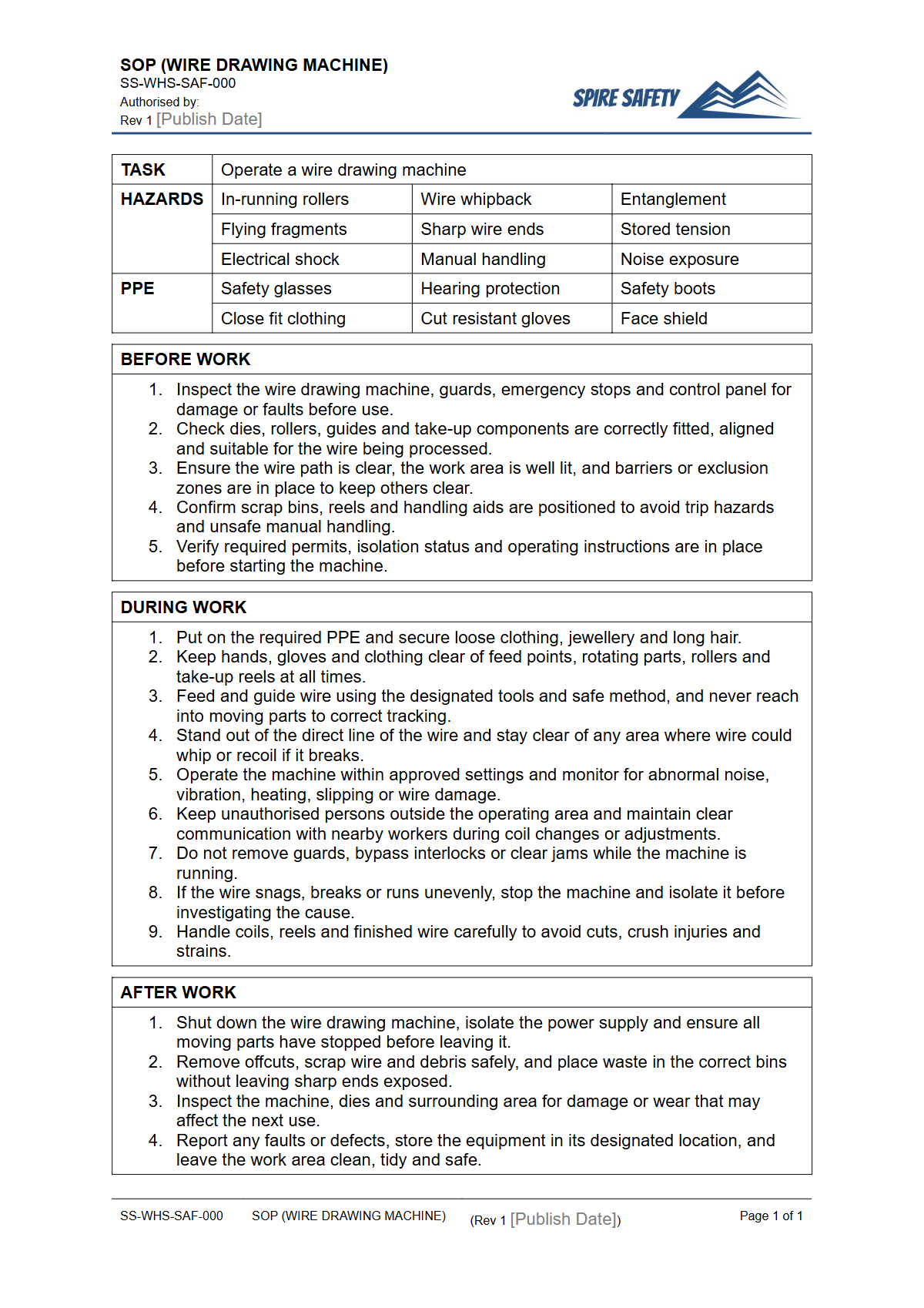
This free Safe Operating Procedure (Wire drawing machine) template provides a structured framework for documenting the required steps to perform tasks safely. It helps your organisation standardise its processes, train workers effectively, and demonstrate a commitment to risk management under Australian WHS legislation.
The template guides you through documenting key safety elements, such as required Personal Protective Equipment (PPE), pre-start checks, operational steps, shutdown procedures, and emergency responses. By systematically outlining these steps, you reduce the likelihood of incidents and create a safer working environment.
A well-developed SOP is a cornerstone of effective operational safety and is essential for tasks involving high-risk plant. It serves as a practical tool for supervisors to monitor work and for operators to reference correct procedure, ensuring consistency and diligence.
Video walkthrough
How to use the Free Safe Operating Procedure (Wire Drawing Machine) Template
This document is a template, not a finished product. To make it effective, you must customise it to reflect the specific machinery, environment, and processes in your workplace.
Download the DOCX file and begin by conducting a thorough, site-specific risk assessment for your wire drawing machine, involving the operators who use it every day. Their input is invaluable for identifying practical hazards and effective controls.
Follow these steps:
- Consult: Work with machine operators, supervisors, and maintenance personnel to gather detailed information about the machine's operation, from setup and threading to normal operation and clearing jams.
- Customise: Populate the template with the specific make and model of your machine, the identified hazards, and your agreed-upon control measures. Detail each step of the process clearly and concisely.
- Review: Have the draft procedure reviewed by a competent person and the workers who will use it to ensure it is accurate, understandable, and practical.
- Train: Induct and train all relevant workers on the final SOP. Ensure they understand the procedures and can demonstrate their competence before operating the machine unsupervised. For related machinery, a similar customisation process should be applied to documents like a Safe Operating Procedure for a conveyer system.
Important Note: We provide this template as a starting point. You must adapt it with your site-specific details.
Your final SOP should be a comprehensive document that forms a key part of your overall safety management system.
When to use a Safe Operating Procedure
A wire drawing machine SOP should be used as a primary reference document in several key situations. It is essential during the induction and training of new operators, providing a clear, step-by-step guide to safe operation.
It should also be used for refresher training for existing staff to prevent procedural drift and reinforce safety standards. The SOP is a critical tool during incident investigations, helping to determine if procedures were followed correctly.
Furthermore, SOPs should be reviewed and referenced when planning maintenance tasks, implementing changes to the machinery, or introducing new types of wire or dies. They are living documents that form an integral part of comprehensive WHS management systems, providing a benchmark for expected performance and behaviour.
Regular reviews, scheduled annually or after any significant change, ensure the SOP remains relevant and effective.
Who should use this document
This Safe Operating Procedure template is designed for use by several key roles within an organisation. WHS Managers and Safety Officers will use it to standardise procedures and ensure a documented process exists for high-risk tasks.
Production Supervisors and Team Leaders are responsible for implementing the SOP on the floor, using it for training, and ensuring operators adhere to the documented steps.
Machine operators are the primary end-users, referencing the SOP for training and as a reminder of correct, safe practices. Maintenance personnel should also be familiar with the SOP, particularly the sections on isolation, lockout-tagout, and safe shutdown before undertaking work.
Developing an SOP for each piece of major plant, such as creating a separate air compressor Safe Operating Procedure, ensures all equipment-specific risks are managed. For complex machinery or processes where you lack in-house expertise, seeking expert WHS consulting support can provide valuable guidance.
Ultimately, the Person Conducting a Business or Undertaking (PCBU) holds the primary duty of care and is responsible for ensuring such procedures are developed, implemented, and maintained. For a broader range of safety documents, you can explore our free WHS resources library. Regular reviews and checks, often conducted as part of independent WHS compliance auditing, will verify that these documented procedures are being followed correctly in practice.
Common mistakes
Common mistakes to avoid
- Using a generic template without customising it for the specific make and model of the machine.
- Failing to consult with experienced machine operators when drafting the procedure.
- Not including specific procedures for clearing blockages, changing dies, or managing wire breaks.
- Treating the SOP as a static document instead of reviewing and updating it after incidents or process changes.
Legal references
Legal considerations
The following legal requirements may be relevant to this type of work.
- Work Health and Safety Act (Harmonised) — Provides the primary duties for protecting workers and other people from work health and safety risks.
- Work Health and Safety Regulations (Harmonised) — Sets out requirements supporting the management of workplace hazards and risks.
The following codes may be relevant to this type of work.
- Managing WHS Risks Code of Practice — Provides practical guidance on identifying hazards, assessing risks and applying effective controls.
- Work Health and Safety Consultation, Cooperation and Coordination Code of Practice — Provides practical guidance on consulting workers and coordinating with other duty holders.
- Managing the Work Environment and Facilities Code of Practice — Provides practical guidance on safe work environments, workplace facilities and related controls.
Did you know
Drawing vs. Extrusion
Wire drawing reduces the diameter of wire by pulling it through a die, which places the material under tension. This differs from extrusion, which pushes material through a die, placing it under compression.
Work Hardening
The process of drawing wire makes it stronger and harder but also less ductile. This physical change, caused by plastic deformation, is known as work hardening or strain hardening.
FAQ
Frequently asked questions
01What are the main hazards of a wire drawing machine?
02Is this SOP template enough for WHS compliance?
03How often should a Safe Operating Procedure be reviewed?
04Who needs to be trained on this SOP?
Share this resource
Free Safe Operating Procedure (Wire Drawing Machine) Template
Browse Categories
How To Use It
- 1Download and open in Word or PDF.
- 2Replace the placeholders with your business details.
- 3Get it reviewed by a WHS specialist before rollout.
Need it customised?
Our WHS consultants can adapt this template to your site, run a gap analysis, or audit what you already have in place.
Book a Free Consultation WHS consulting servicesor call 1300 156 382
Related templates
- Free Safe Operating Procedure (Wire Rope Sling) Template
- Free Safe Operating Procedure (Wire Straightener) Template
- Free Safe Operating Procedure (Wood Chipper Operation) Template
- Free Safe Operating Procedure (Wood Floor Cleaning) Template
- Free Safe Operating Procedure (Wood Jointer) Template
- Free Safe Operating Procedure (Wood Lathe) Template