
Free Safe Operating Procedure (Wire Straightener) Template
Download our free Safe Operating Procedure (Wire Straightener) template to manage risks associated with this equipment. Get your customisable DOCX and PDF now.
Free Safe Operating Procedure (Wire Straightener) Template
DOCX • 126 KB + PDF
Updated Oct 2026
No signup required
Purpose of the Free Safe Operating Procedure (Wire Straightener) Template
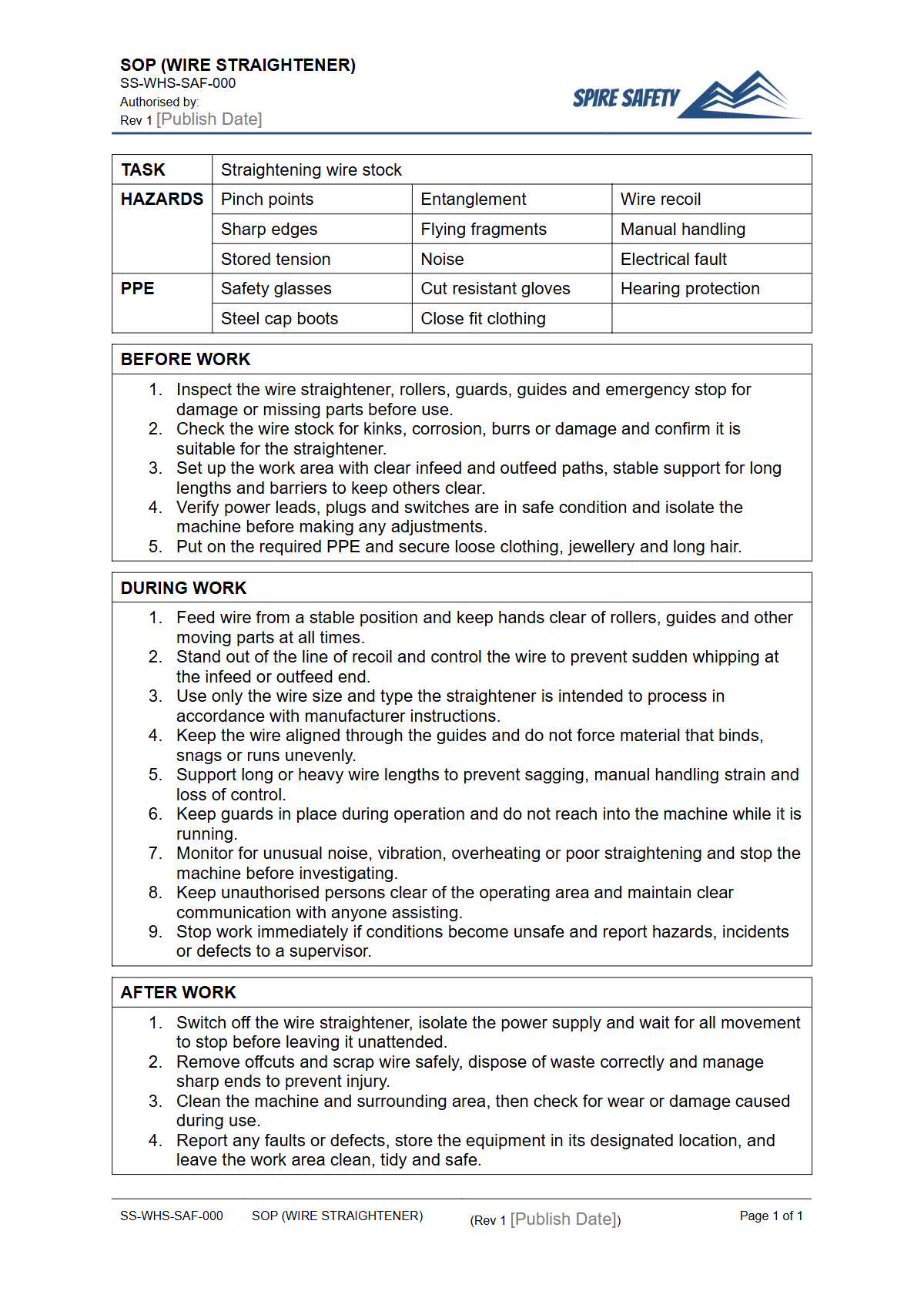
This free Safe Operating Procedure (Wire Straightener) template provides a structured framework for documenting the safest way to operate wire straightening machinery. Its primary purpose is to minimise the risk of injury to operators by providing clear, step-by-step instructions for all phases of operation, from pre-start checks to shutdown.
Using a standardised SOP helps ensure that every operator performs the task consistently and safely, reducing the chance of incidents caused by procedural errors or forgotten steps. It serves as a critical control measure within your risk management process and is a fundamental part of building effective WHS management systems.
Key Objectives of this Safe Operating Procedure
- Hazard Identification: Clearly outlines potential hazards associated with wire straighteners, such as entanglement, crushing, cuts, and manual handling risks.
- Control Measures: Documents the specific controls required to mitigate identified risks, including machine guarding, personal protective equipment (PPE), and emergency stop procedures.
- Training and Competency: Acts as a key training document for new operators and a reference for experienced personnel, ensuring everyone is aware of the established safe work method.
- Organisational Compliance: Helps your organisation demonstrate its commitment to meeting its duties under Australian WHS legislation by providing workers with necessary information, instruction, and training.
Video walkthrough
How to use the Free Safe Operating Procedure (Wire Straightener) Template
Our template is provided in both DOCX and PDF formats for your convenience. The DOCX version is fully editable, allowing you to tailor the content to the specific make and model of the wire straightener used in your workplace, as well as your site-specific procedures and environment.
To effectively implement this SOP, you should consult with the workers who actually operate the machinery. Their direct experience is invaluable for identifying practical hazards and refining the steps to ensure they are clear and workable. For guidance on customising technical documents and facilitating worker consultation, consider engaging expert WHS consulting services.
Important Customisation Note
This document is a template and not a complete Safe Operating Procedure. It must be customised to suit the specific equipment, processes, and risks in your workplace.
We are not liable for any incidents that may occur from the use of this document. It is the responsibility of the Person Conducting a Business or Undertaking (PCBU) to ensure the final SOP is accurate, comprehensive, and effectively implemented.
What to Include in Your Wire Straightener SOP
When customising the template, ensure you address all relevant aspects of the task. Your final SOP should include detailed sections covering:
- Required PPE: Specify mandatory personal protective equipment, such as safety glasses, steel-capped boots, and cut-resistant gloves.
- Pre-Operational Checks: List all visual and functional checks that must be completed before starting the machine, including verifying that guards are in place and emergency stops are functional.
- Operating Steps: Provide a clear, sequential guide for safely feeding, straightening, and cutting wire.
- Shutdown and Cleaning: Outline the correct procedure for powering down, isolating, and cleaning the machine.
- Emergency Procedures: Detail the steps to take in case of an emergency, such as entanglement or machine malfunction, including locations of E-stops and first aid stations.
For a complete example of a machinery-specific procedure, you can review our free Conveyer System SOP, which follows a similar structured approach.
When to use it
A Safe Operating Procedure is a dynamic document that should be used throughout the lifecycle of the equipment in your workplace. It is essential during the induction and training of new operators to establish a baseline of safe behaviour.
The SOP should also be used for regular refresher training to prevent complacency among experienced workers. It serves as a practical on-the-job reference tool that operators can consult before starting work.
Furthermore, the SOP becomes a critical document for review during incident investigations and as part of periodic WHS compliance auditing to verify that documented procedures are being followed.
Who should use it
This Safe Operating Procedure for a wire straightener is intended for use by several key roles within an organisation. Operators are the primary users, relying on it for step-by-step guidance to perform their tasks safely.
Supervisors and managers use the SOP to conduct training, oversee work, and ensure procedures are correctly followed. WHS and safety personnel use it as part of the overall safety management system, assisting with risk assessments, training development, and compliance monitoring.
The principles of creating clear, task-specific instructions apply to all types of plant, as demonstrated in other resources like our free Air Compressor SOP. This template provides a starting point for any business looking to formalise its operational safety protocols. This template is just one of many tools available in our comprehensive free WHS resources library.
Common mistakes
Common mistakes to avoid
- Failing to customise the template for the specific machine and workplace risks.
- Not involving experienced operators in the drafting and review process.
- Neglecting to provide practical training on the SOP's contents.
- Treating the SOP as a one-time task and failing to review or update it after changes or incidents.
Legal references
Legal considerations
The following legal requirements may be relevant to this type of work.
- Work Health and Safety Act (Harmonised) — Provides the primary duties for protecting workers and other people from work health and safety risks.
- Work Health and Safety Regulations (Harmonised) — Sets out requirements supporting the management of workplace hazards and risks.
The following codes may be relevant to this type of work.
- Managing WHS Risks Code of Practice — Provides practical guidance on identifying hazards, assessing risks and applying effective controls.
- Work Health and Safety Consultation, Cooperation and Coordination Code of Practice — Provides practical guidance on consulting workers and coordinating with other duty holders.
- Managing the Work Environment and Facilities Code of Practice — Provides practical guidance on safe work environments, workplace facilities and related controls.
Did you know
Entanglement Risk
Entanglement in moving machinery is a leading cause of serious workplace injuries. Even a brief moment of contact with a rotating shaft or roller can result in severe harm, highlighting the critical importance of machine guarding and lock-out tag-out procedures.
Procedural Memory
Documented procedures like SOPs help combat procedural drift, where workers slowly and unintentionally deviate from the original safe process over time. Regular reference to the SOP helps reset and reinforce correct, safe behaviour.
FAQ
Frequently asked questions
01What are the main hazards of using a wire straightener?
02How often should a Safe Operating Procedure for a wire straightener be reviewed?
03Is training required before a person can use a wire straightener?
04Can a generic SOP be used for all types of wire straighteners?
Share this resource
Free Safe Operating Procedure (Wire Straightener) Template
Browse Categories
How To Use It
- 1Download and open in Word or PDF.
- 2Replace the placeholders with your business details.
- 3Get it reviewed by a WHS specialist before rollout.
Need it customised?
Our WHS consultants can adapt this template to your site, run a gap analysis, or audit what you already have in place.
Book a Free Consultation WHS consulting servicesor call 1300 156 382
Related templates
- Free Safe Operating Procedure (Wood Chipper Operation) Template
- Free Safe Operating Procedure (Wood Floor Cleaning) Template
- Free Safe Operating Procedure (Wood Jointer) Template
- Free Safe Operating Procedure (Wood Lathe) Template
- Free Safe Operating Procedure (Woodchip Path Care) Template
- Free Safe Operating Procedure (Wool Bale Handling) Template