
Free Safe Operating Procedure (Wine Bottle Handling) Template
Download our free Safe Operating Procedure for wine bottle handling. This template helps you document safe work practices for your team in minutes.
Free Safe Operating Procedure (Wine Bottle Handling) Template
DOCX • 126 KB + PDF
Updated Oct 2026
No signup required
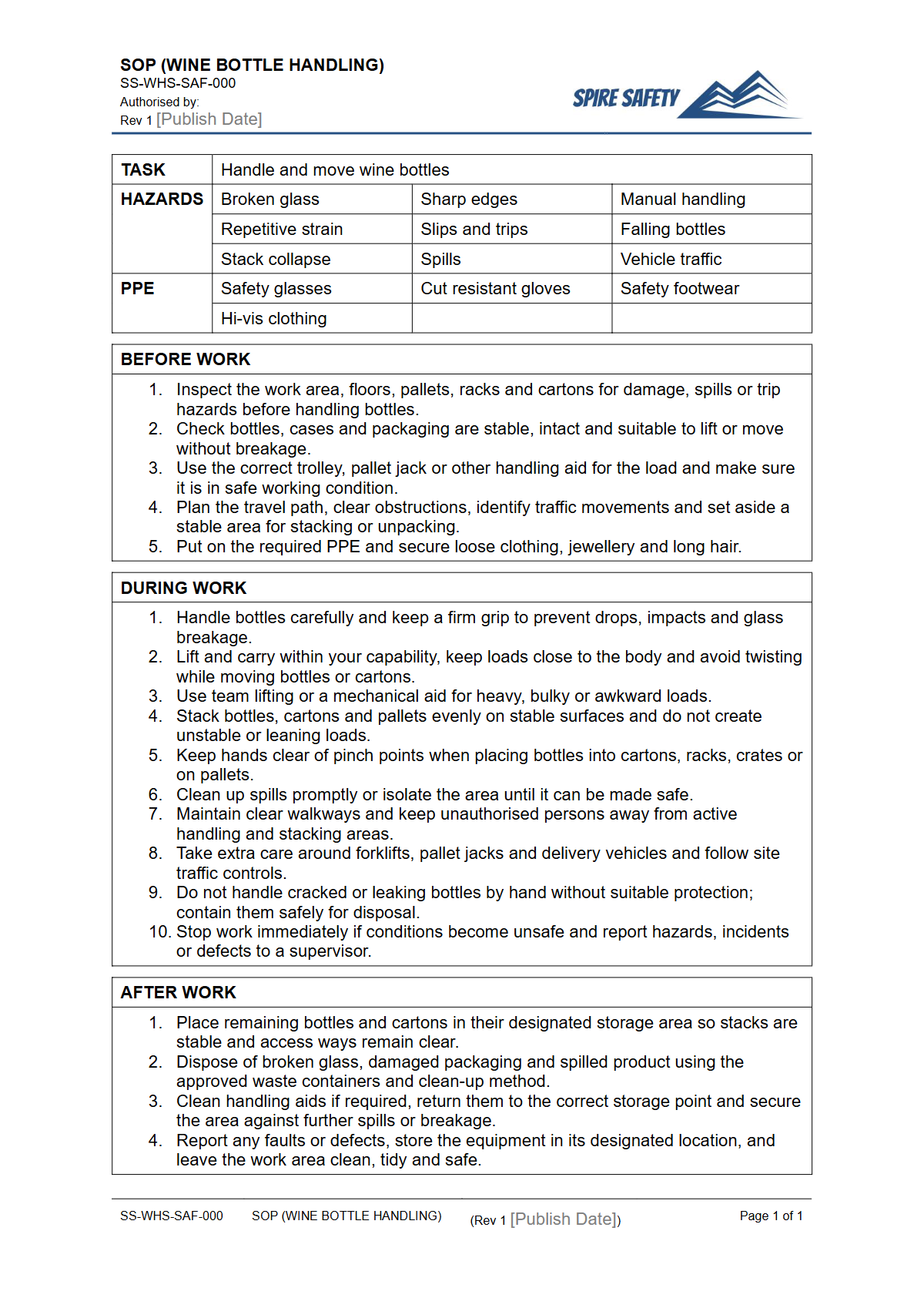
Purpose of the Free Safe Operating Procedure (Wine Bottle Handling) Template
This Free Safe Operating Procedure (Wine Bottle Handling) Template provides a structured starting point for documenting the risks and controls associated with handling glass wine bottles in environments like wineries, cellars, hospitality venues, and retail outlets. The primary hazards involve manual tasks leading to musculoskeletal injuries and lacerations from broken glass.
This SOP helps you establish and communicate safe work methods to your team, forming a critical part of your overall safety framework. Properly documented procedures are essential for building comprehensive WHS management systems that protect workers and ensure operational consistency.
Video walkthrough
How to use the Free Safe Operating Procedure (Wine Bottle Handling) Template
Our template is available as a fully editable DOCX file, allowing for easy customisation, as well as a print-ready PDF. To use it effectively, download the document and methodically work through each section.
You must consult with workers who handle wine bottles to identify all specific hazards present in your workplace, such as the type of storage racks used, the weight of cartons, and the process for dealing with breakages. This collaboration ensures the final SOP is practical and relevant.
We've provided a structured starting point aligned with Australian WHS principles, but it is your responsibility to ensure it reflects your unique operational risks and controls. If you require assistance with this customisation process, consider seeking professional WHS consulting.
Key Hazards in Wine Bottle Handling
While this is not an exhaustive list, common hazards include:
- Lacerations and Punctures: Caused by broken or chipped bottles during handling, packing, or opening.
- Musculoskeletal Injuries: Strains and sprains from lifting, carrying, or stacking heavy cartons of wine.
- Slips, Trips, and Falls: Resulting from liquid spills from broken bottles creating a slippery surface.
- Pressurisation Hazards: Specific to sparkling wine, where corks can eject forcefully or bottles can shatter if mishandled or exposed to temperature shocks.
When to use this Safe Operating Procedure
A Safe Operating Procedure for wine bottle handling should be used as a key training document for all new and existing employees who perform this task. It is a vital resource during worker induction and for conducting refresher training sessions to reinforce safe behaviours.
It should also be readily accessible in the work area for quick reference. This SOP is particularly important to review with staff before tasks involving high-volume movements, such as restocking a cellar or preparing large orders.
In a busy hospitality kitchen, it complements other procedural documents like a deep fryer SOP template by reinforcing a culture of safety across all tasks.
Who should use it
This template is designed for use by any person or business where wine bottles are handled. Key users include:
- Managers and Supervisors: To train staff, verify competency, and investigate incidents.
- Winery and Cellar Door Staff: For tasks ranging from bottling and labelling to stock movement and sales.
- Hospitality Workers: Including bar staff, sommeliers, and floor staff who open, serve, and clear wine bottles.
- Retail and Warehouse Employees: For stocking shelves, managing inventory, and picking orders.
On a bottling line, handling bottles is often part of a larger automated process. Staff overseeing this equipment may also need procedures for specific machinery, such as a conveyer system SOP, to manage associated risks.
Implementing the SOP Effectively
Once customised, the SOP must be formally implemented. This involves communicating the procedure to all relevant workers and providing practical training on the steps involved, especially emergency procedures for breakages and spills.
Supervisors must monitor work practices to ensure the SOP is being followed correctly. The effectiveness of the procedure should be periodically reviewed and, if necessary, updated.
Regular reviews can be integrated into your safety schedule, similar to conducting formal WHS compliance auditing services to ensure your systems remain effective over time.
This document is just one of many tools designed to help you build a safer workplace. For more templates, checklists, and guides covering a wide range of tasks and equipment, browse our complete free WHS resources library.
Common mistakes
Common mistakes to avoid
- Using a generic template without customising it for site-specific hazards and equipment.
- Failing to adequately train workers on the SOP and confirm their understanding before they perform the task.
- Neglecting to include specific procedures for cleaning up broken glass and liquid spills safely.
- Forgetting to review and update the SOP after an incident, near miss, or change in process.
Legal references
Legal considerations
The following legal requirements may be relevant to this type of work.
- Work Health and Safety Act (Harmonised) — Provides the primary duties for protecting workers and other people from work health and safety risks.
- Work Health and Safety Regulations (Harmonised) — Sets out requirements supporting the management of workplace hazards and risks.
The following codes may be relevant to this type of work.
- Managing WHS Risks Code of Practice — Provides practical guidance on identifying hazards, assessing risks and applying effective controls.
- Work Health and Safety Consultation, Cooperation and Coordination Code of Practice — Provides practical guidance on consulting workers and coordinating with other duty holders.
- Managing the Work Environment and Facilities Code of Practice — Provides practical guidance on safe work environments, workplace facilities and related controls.
Did you know
Glass Strength
A standard 750ml wine bottle is designed to withstand significant internal pressure. Sparkling wine bottles are even stronger, built to hold up to 6 atmospheres of pressure—around three times that of a typical car tyre.
Manual Handling Risk
Musculoskeletal disorders from manual tasks are a leading cause of serious workers' compensation claims in Australia. Documented procedures for repetitive tasks like moving cartons of wine are a key control measure.
FAQ
Frequently asked questions
01What should an SOP for handling wine bottles include?
02Is this template suitable for both still and sparkling wine?
03How often should a Safe Operating Procedure be reviewed?
04Who is responsible for creating a Safe Operating Procedure?
Share this resource
Free Safe Operating Procedure (Wine Bottle Handling) Template
Browse Categories
How To Use It
- 1Download and open in Word or PDF.
- 2Replace the placeholders with your business details.
- 3Get it reviewed by a WHS specialist before rollout.
Need it customised?
Our WHS consultants can adapt this template to your site, run a gap analysis, or audit what you already have in place.
Book a Free Consultation WHS consulting servicesor call 1300 156 382
Related templates
- Free Safe Operating Procedure (Wine Cellar Stocking) Template
- Free Safe Operating Procedure (Wine Fridge Cleaning) Template
- Free Safe Operating Procedure (Wine Rack Handling) Template
- Free Safe Operating Procedure (Wire Bender) Template
- Free Safe Operating Procedure (Wire Drawing Machine) Template
- Free Safe Operating Procedure (Wire Rope Sling) Template