
Free Safe Operating Procedure (Wine Cellar Stocking) Template
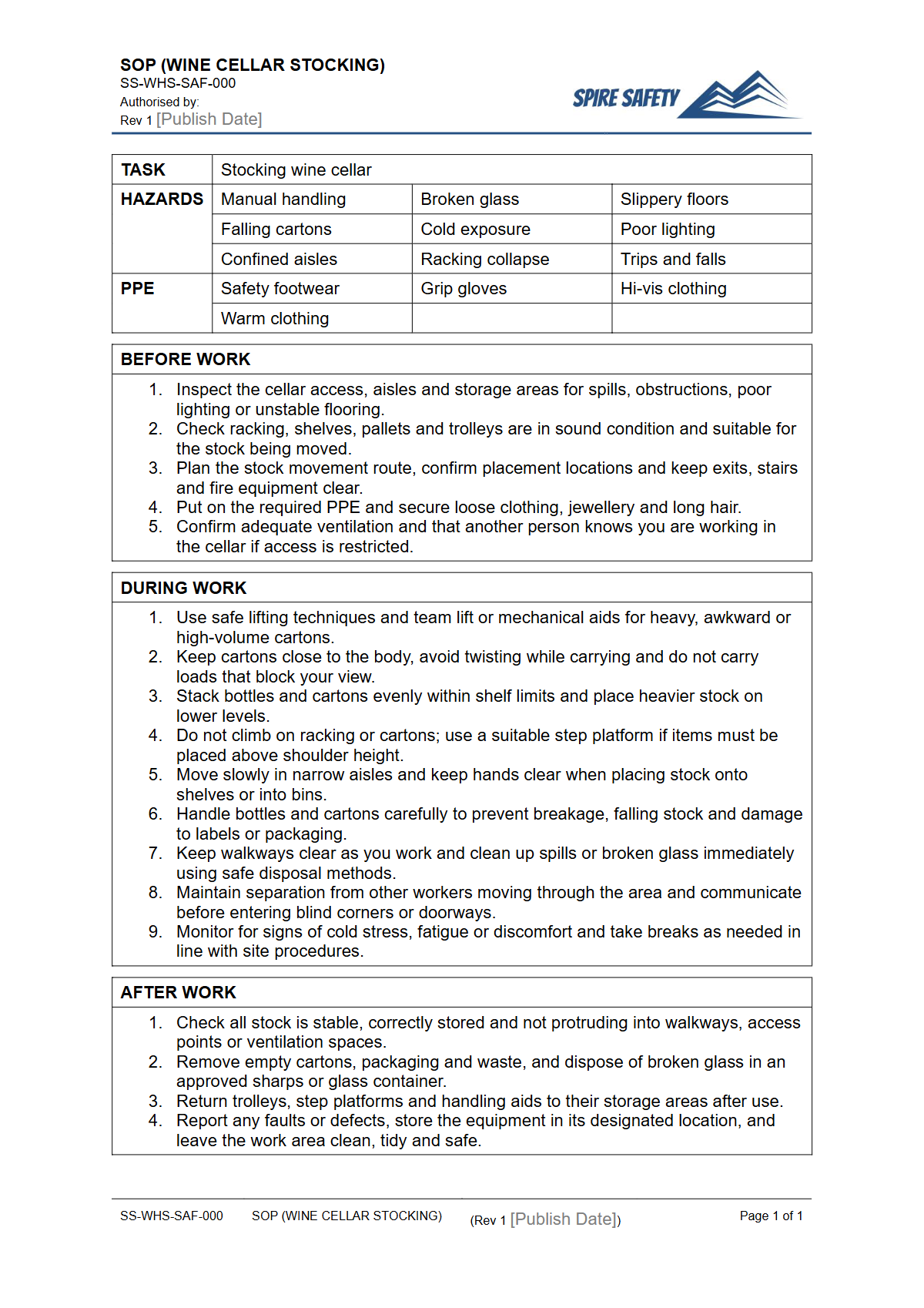
Download our Free Safe Operating Procedure (Wine Cellar Stocking) Template to manage risks associated with manual handling and confined spaces.
Free Safe Operating Procedure (Wine Cellar Stocking) Template
DOCX • 126 KB + PDF
Updated Oct 2026
No signup required
Purpose of the Free Safe Operating Procedure (Wine Cellar Stocking) Template
Stocking a wine cellar involves more than just careful placement of bottles; it presents genuine workplace health and safety risks. Our Free Safe Operating Procedure (Wine Cellar Stocking) Template provides a structured framework for identifying and controlling these hazards.
It addresses common risks such as musculoskeletal injuries from manual handling of heavy cases, slips and trips on stairs or uneven surfaces, and potential issues related to working in confined or poorly lit spaces. Using this SOP helps create a formal, documented process for the task, ensuring all workers follow a consistent and safe method.
Integrating this procedure into your safety framework demonstrates a commitment to proactive risk management. A documented SOP is a critical component of the operational controls within comprehensive WHS management systems, providing clear instructions to workers and a tangible record of your control measures.
It serves as a practical tool for meeting your duty of care under Australian WHS legislation.
Video walkthrough
How to use the Free Safe Operating Procedure (Wine Cellar Stocking) Template
This template is provided in both DOCX and PDF formats to serve as a starting point. To implement it effectively in your workplace, follow these steps:
- Download and Customise: Open the DOCX file and insert your company’s name, logo, and specific details about your wine cellar, including its layout, access points, and any equipment used (e.g., trolleys, hoists).
- Consult and Review: Engage with the workers who perform the task. Their direct experience is invaluable for identifying practical risks and effective controls. A site-specific risk assessment should inform the final procedure.
- Finalise and Approve: Once customised, the SOP should be reviewed and approved by a manager or person with responsibility for WHS.
- Train Your Team: Ensure all relevant staff are trained on the contents of the final SOP. This includes induction for new employees and refresher training for existing staff. Keep records of this training.
Please note: This is a template only. The responsibility for health and safety rests with the PCBU (Person Conducting a Business or Undertaking).
We have provided this document as a guide, and you must adapt it to the specific hazards and risks present in your workplace. A regular WHS compliance auditing schedule can help verify that your documented procedures are being followed correctly in practice.
When to use this Safe Operating Procedure
A Safe Operating Procedure for wine cellar stocking should be used consistently as a reference and training tool. It is most critical in several key situations: before any cellar stocking tasks are undertaken by new or existing staff, during the induction and onboarding of new employees, and as a core part of any refresher training programs.
It should also be reviewed and referenced immediately following any incident or near-miss to identify procedural gaps. Furthermore, the SOP must be updated whenever there is a change in the work environment, such as the introduction of new types of stock, different handling equipment, or modifications to the cellar itself.
This document should exist alongside other key safety documents in your venue. For example, in a hospitality setting, it would complement procedures like a deep fryer standard operation SOP to build a complete safety picture for all workplace tasks.
Who should use this Safe Operating Procedure
This SOP is designed for use by a range of personnel within any organisation that operates a wine cellar, particularly in the hospitality, retail, and wholesale industries. This includes Venue Managers and Supervisors, who are responsible for implementing and enforcing safe work practices.
WHS Officers and representatives can use it as a tool for risk assessment, training, and compliance activities. Most importantly, the workers who perform the task—such as cellar hands, sommeliers, and general bar or floor staff—must understand and follow the procedure to ensure their own safety and the safety of their colleagues.
If your organisation lacks in-house expertise to properly assess risks and customise this document, seeking external guidance is a prudent step. Our specialist WHS consulting services can assist in tailoring safety documents to your specific operational needs. For more templates and safety guides, you can browse our complete free WHS resources library.
Common mistakes
Common mistakes to avoid
- Using the template 'as-is' without customising it for the specific workplace layout and stock.
- Failing to consult with and train the workers who actually perform the stocking task.
- Neglecting to review and update the SOP after a near-miss or when cellar conditions change.
- Creating an impractical procedure that workers ignore because it's too complex or doesn't reflect how the job is really done.
Legal references
Legal considerations
The following legal requirements may be relevant to this type of work.
- Work Health and Safety Act (Harmonised) — Provides the primary duties for protecting workers and other people from work health and safety risks.
- Work Health and Safety Regulations (Harmonised) — Sets out requirements supporting the management of workplace hazards and risks.
The following codes may be relevant to this type of work.
- Managing WHS Risks Code of Practice — Provides practical guidance on identifying hazards, assessing risks and applying effective controls.
- Work Health and Safety Consultation, Cooperation and Coordination Code of Practice — Provides practical guidance on consulting workers and coordinating with other duty holders.
- Managing the Work Environment and Facilities Code of Practice — Provides practical guidance on safe work environments, workplace facilities and related controls.
Did you know
Manual Handling Strain
In Australia, injuries from manual handling are a leading cause of serious workers' compensation claims, accounting for a significant portion of all work-related injuries.
Is a Cellar a Confined Space?
A wine cellar may be legally defined as a confined space if it's not designed for continuous human occupancy and has restricted entry/exit, potentially requiring specific permits and safety protocols before entry.
FAQ
Frequently asked questions
01What are the main hazards of stocking a wine cellar?
02Is a Safe Operating Procedure legally required for stocking a wine cellar in Australia?
03How often should I review my wine cellar stocking SOP?
04Can I use this template for stocking other beverages like beer kegs?
Share this resource
Free Safe Operating Procedure (Wine Cellar Stocking) Template
Browse Categories
How To Use It
- 1Download and open in Word or PDF.
- 2Replace the placeholders with your business details.
- 3Get it reviewed by a WHS specialist before rollout.
Need it customised?
Our WHS consultants can adapt this template to your site, run a gap analysis, or audit what you already have in place.
Book a Free Consultation WHS consulting servicesor call 1300 156 382
Related templates
- Free Safe Operating Procedure (Wine Fridge Cleaning) Template
- Free Safe Operating Procedure (Wine Rack Handling) Template
- Free Safe Operating Procedure (Wire Bender) Template
- Free Safe Operating Procedure (Wire Drawing Machine) Template
- Free Safe Operating Procedure (Wire Rope Sling) Template
- Free Safe Operating Procedure (Wire Straightener) Template