
Free Safe Operating Procedure (Window Sill Cleaning) Template
Download our free Safe Operating Procedure for window sill cleaning to formalise your safety processes. This template helps you outline key steps and controls.
Free Safe Operating Procedure (Window Sill Cleaning) Template
DOCX • 126 KB + PDF
Updated Oct 2026
No signup required
Purpose of the Free Safe Operating Procedure (Window Sill Cleaning) Template
Even seemingly simple tasks like cleaning window sills carry potential risks that must be managed. This Free Safe Operating Procedure (Window Sill Cleaning) Template provides a structured framework for documenting the agreed-upon safe method for completing this common maintenance task.
Using an SOP ensures that every worker follows the same process, minimising risks related to dust exposure, chemical handling, ergonomic strain, and slips or trips. Formalising these procedures helps demonstrate a commitment to a proactive safety culture and is a fundamental component of effective WHS management systems.
By clearly outlining steps, required PPE, and potential hazards, this template helps your organisation meet its duty of care. It transforms assumed knowledge into a reliable, trainable, and auditable process, ensuring consistency across all staff and shifts.
This is vital for maintaining a clean and safe work environment for both the cleaning staff and other building occupants.
Video walkthrough
How to use the Free Safe Operating Procedure (Window Sill Cleaning) Template
This resource is available as a fully editable DOCX file for easy customisation and a print-ready PDF for immediate use. To use the template effectively, download the DOCX version and begin customising it to align with your specific workplace.
This involves identifying the particular cleaning agents used, the types of surfaces being cleaned, the specific tools provided, and the unique environmental factors of your site.
Important: This document is a template, not a finished product. We have developed it to be aligned with Australian WHS standards, but for it to be effective, you must adapt it to your specific operational context.
The effectiveness and compliance of the final document depend entirely on the site-specific information you add. The implementation and use of these procedures are often reviewed during WHS compliance auditing to ensure they are practical and being followed correctly by workers.
What's included in the template?
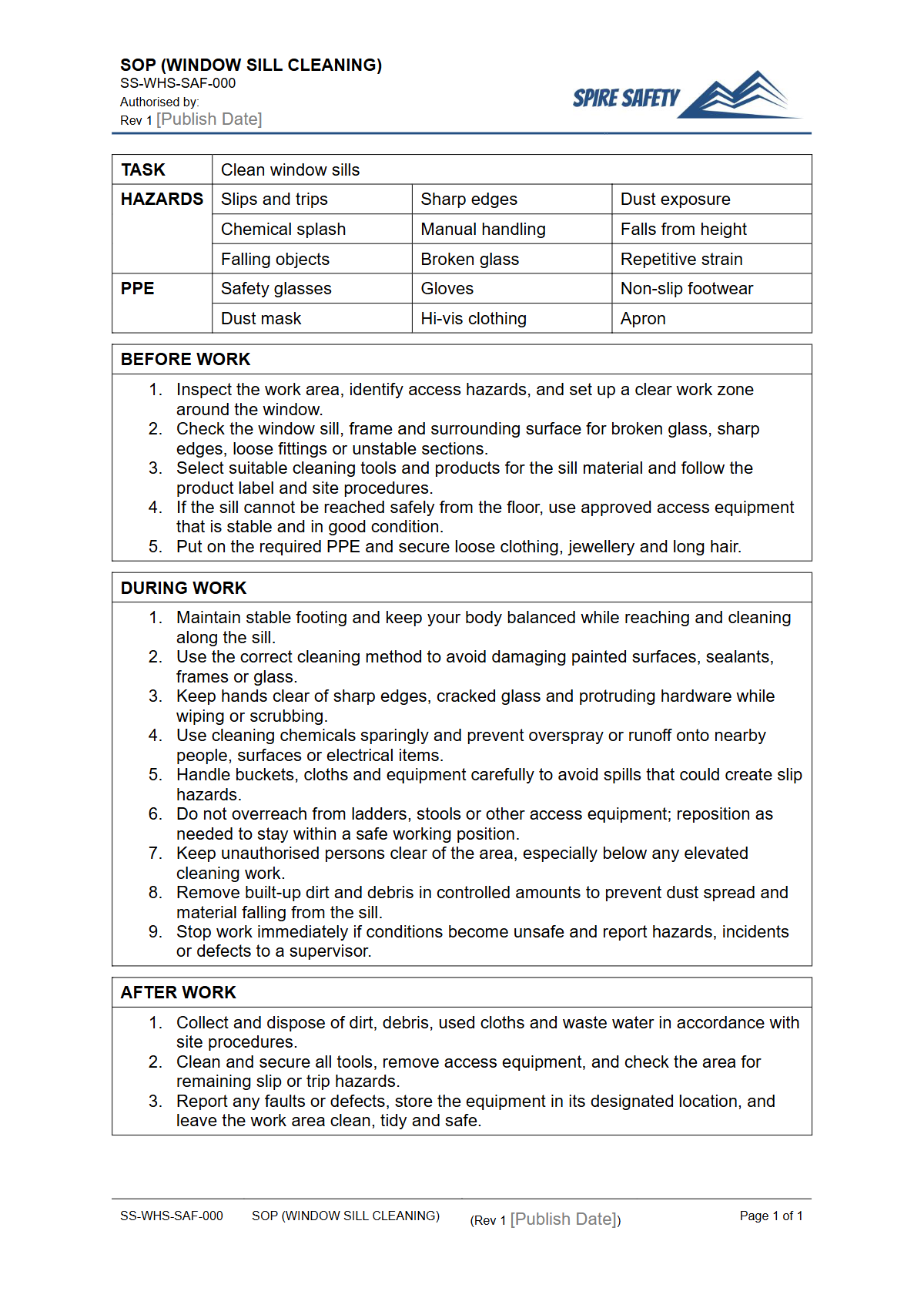
Our template provides a clear, structured layout that prompts you to include all necessary safety information. Key sections include:
- Hazards and Risks: A section to list potential dangers such as chemical exposure, dust inhalation, slips, and ergonomic injuries.
- Personal Protective Equipment (PPE): Specifies the required PPE, such as gloves, safety glasses, or dust masks.
- Step-by-Step Instructions: A logical sequence of actions from preparation to clean-up and waste disposal.
- Emergency Procedures: Outlines the response to incidents like chemical spills or adverse reactions.
When should you use a Window Sill Cleaning SOP?
A Safe Operating Procedure for window sill cleaning should be used as a primary training document for new employees or those assigned to cleaning duties for the first time. It serves as an essential reference tool to be kept in an accessible location for workers to review as needed.
The SOP should also be referenced during regular safety meetings or toolbox talks, especially when reinforcing procedures or discussing a related near miss. Documenting procedures for all workplace tasks is crucial for consistency, just as you would with our free SOP for deep fryer operation in a commercial kitchen.
Who should use this Safe Operating Procedure?
This SOP is intended for a range of personnel within an organisation. Persons Conducting a Business or Undertaking (PCBUs) and managers can use it to fulfil their duty of care by implementing a formal safe system of work.
Supervisors and Team Leaders should use it to train workers and monitor their performance to ensure the procedure is being followed correctly. Finally, the workers performing the cleaning task are the end-users who must understand and adhere to the SOP to protect their own health and safety and that of others.
Just as an operator needs a procedure for specific machinery, like the one in our free Air Compressor SOP template, cleaners need clear guidance for their tasks.
Integrating SOPs Across Your Business
Integrating clear, task-specific SOPs across all areas of your business creates a robust and consistent approach to safety. Whether for administrative tasks, general maintenance, or complex machinery operation, documented procedures eliminate guesswork and reduce the likelihood of incidents.
A well-organised library of SOPs makes training more efficient and provides a solid foundation for your overall safety framework. If you need help developing more complex or specialised procedures, our WHS consulting services can provide expert assistance tailored to your industry.
You can find more templates to build out your safety systems in our free WHS resources library, covering a wide range of equipment and common work tasks.
Common mistakes
Common mistakes to avoid
- Assuming the task is 'common sense' and doesn't need a documented procedure.
- Failing to specify the exact cleaning chemicals and the location of their Safety Data Sheets (SDS).
- Not including steps for the safe disposal of waste, such as used cloths or contaminated water.
- Forgetting to train workers on the finalised procedure or confirm their understanding before work begins.
Legal references
Legal considerations
The following legal requirements may be relevant to this type of work.
- Work Health and Safety Act (Harmonised) — Provides the primary duties for protecting workers and other people from work health and safety risks.
- Work Health and Safety Regulations (Harmonised) — Sets out requirements supporting the management of workplace hazards and risks.
The following codes may be relevant to this type of work.
- Managing WHS Risks Code of Practice — Provides practical guidance on identifying hazards, assessing risks and applying effective controls.
- Work Health and Safety Consultation, Cooperation and Coordination Code of Practice — Provides practical guidance on consulting workers and coordinating with other duty holders.
- Managing the Work Environment and Facilities Code of Practice — Provides practical guidance on safe work environments, workplace facilities and related controls.
Did you know
Indoor Air Quality
Dust on surfaces like window sills can contribute significantly to poor indoor air quality, potentially triggering allergies and respiratory issues for building occupants. Regular, systematic cleaning helps control these airborne particulates.
Procedural Memory
Documenting even 'simple' tasks in an SOP helps build procedural memory and ensures consistency, especially in workplaces with high staff turnover or where tasks are performed infrequently.
FAQ
Frequently asked questions
01What hazards are associated with window sill cleaning?
02Is a Safe Operating Procedure legally required for cleaning tasks?
03How often should an SOP for window sill cleaning be reviewed?
04Can I use this template for cleaning windows at height?
Share this resource
Free Safe Operating Procedure (Window Sill Cleaning) Template
Browse Categories
How To Use It
- 1Download and open in Word or PDF.
- 2Replace the placeholders with your business details.
- 3Get it reviewed by a WHS specialist before rollout.
Need it customised?
Our WHS consultants can adapt this template to your site, run a gap analysis, or audit what you already have in place.
Book a Free Consultation WHS consulting servicesor call 1300 156 382
Related templates
- Free Safe Operating Procedure (Window Track Cleaning) Template
- Free Safe Operating Procedure (Windscreen Removal) Template
- Free Safe Operating Procedure (Wine Bottle Handling) Template
- Free Safe Operating Procedure (Wine Cellar Stocking) Template
- Free Safe Operating Procedure (Wine Fridge Cleaning) Template
- Free Safe Operating Procedure (Wine Rack Handling) Template