
Free Safe Operating Procedure (Windblown Debris Cleanup) Template
Effectively manage the hazards of post-storm cleanup with our customisable template. Download your free Safe Operating Procedure to get started today.
Free Safe Operating Procedure (Windblown Debris Cleanup) Template
DOCX • 126 KB + PDF
Updated Oct 2026
No signup required
Purpose of the Free Safe Operating Procedure (Windblown Debris Cleanup) Template
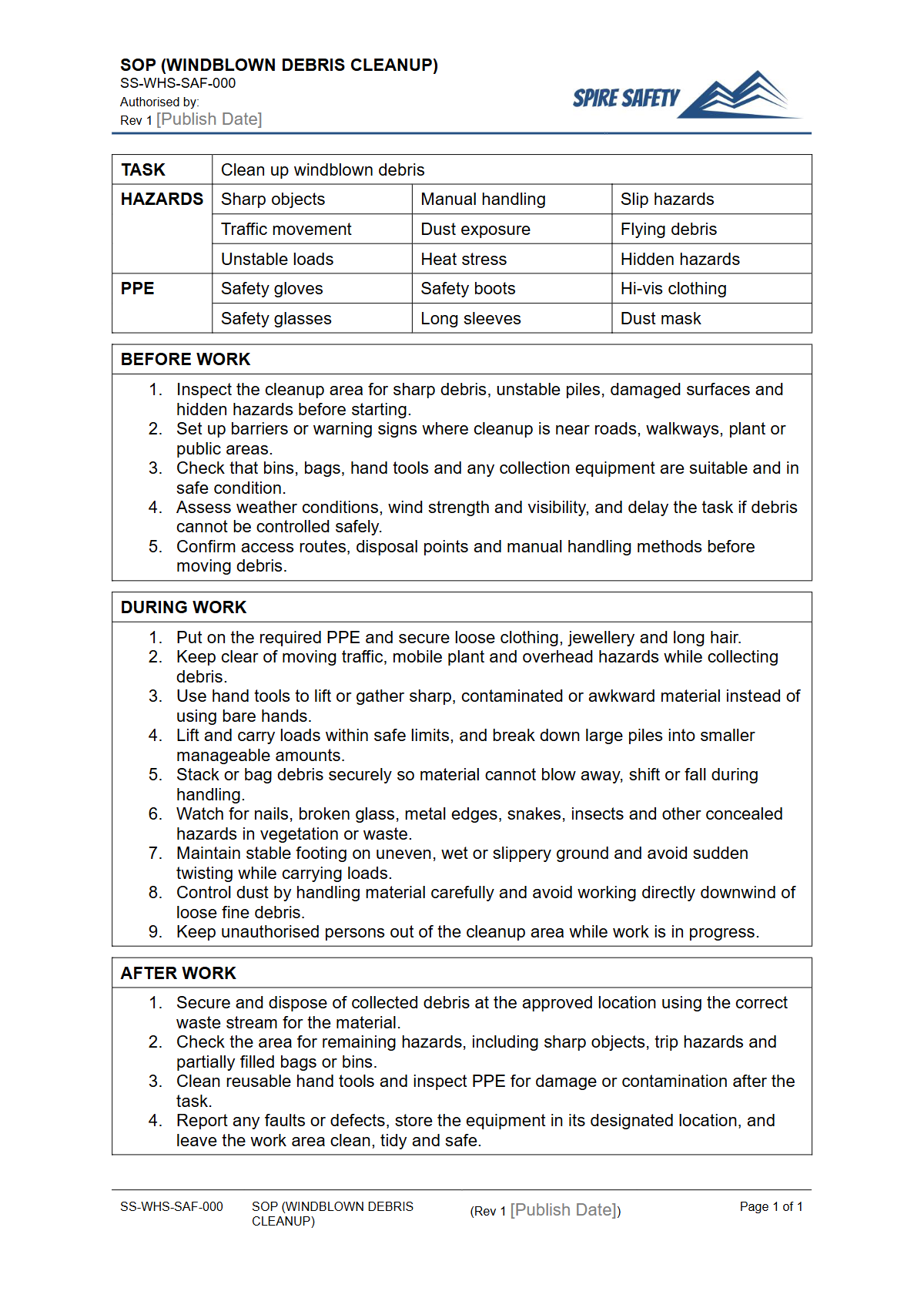
After a storm, cyclone, or significant weather event, the task of cleaning up windblown debris presents numerous health and safety risks. This Free Safe Operating Procedure (Windblown Debris Cleanup) Template provides a structured framework for businesses to formalise their approach to these cleanup operations.
It helps identify hazards and establish clear, step-by-step instructions for workers to follow, minimising the risk of injury. The document prompts you to consider risks such as sharp objects, unstable structures, trip hazards, hazardous materials, and musculoskeletal injuries from manual tasks.
By implementing a formal SOP, a Person Conducting a Business or Undertaking (PCBU) can demonstrate a commitment to worker safety and create a more controlled work environment. This procedure is a critical component of a proactive safety culture, ensuring that cleanup tasks are performed consistently and safely every time.
Formalising your processes is a key part of building robust WHS management systems that protect both your people and your business.
Video walkthrough
How to use the Free Safe Operating Procedure (Windblown Debris Cleanup) Template
This document is a template and is not a substitute for a site-specific risk assessment. It must be customised to reflect the unique environment, equipment, and tasks at your workplace.
We recommend a collaborative approach to customisation.
Follow these steps for effective implementation:
- Download: Start by downloading the DOCX or PDF version of the template.
- Review and Customise: Read through the entire document. Adapt the steps, required PPE, and emergency procedures to match your specific operational needs. Add details about the types of debris commonly encountered and the specific equipment used for cleanup. For example, if chainsaws or cutting tools are used, you may need to reference your FREE Circular Saw SOP (Safe Operating Procedure) Template to ensure all related procedures are aligned.
- Consult: Discuss the draft procedure with the workers who will be performing the task. Their direct experience is invaluable for identifying practical hazards and effective controls.
- Approve: Have the final SOP reviewed and approved by a competent person, such as a manager or WHS advisor.
- Train: Induct and train all relevant workers on the finalised Safe Operating Procedure. Ensure they understand the steps and have an opportunity to ask questions. Keep training records.
- Review Regularly: Review the SOP periodically, and always after an incident or when a new hazard is identified.
Engaging a professional for periodic reviews can help maintain high safety standards. A formal WHS compliance auditing process can identify gaps in your procedures before they lead to an incident.
When should this Safe Operating Procedure be used?
This SOP is designed for planned cleanup activities following any event that results in scattered or hazardous debris. This includes:
- Post-storm or cyclone cleanups on commercial, industrial, or agricultural properties.
- Clearing sites after floods or high-wind events.
- Managing debris from damaged buildings or structures.
- Routine cleanup of large outdoor areas where windblown materials accumulate.
It is not intended for use during an active emergency. The procedure should be implemented once the area has been declared safe to enter and a risk assessment for the cleanup task has been completed.
If large-scale earthmoving or material handling is required, a specific FREE Scraper SOP (Safe Operating Procedure) Template may also be necessary to manage machinery-related risks.
Who is this resource for?
This template is beneficial for anyone responsible for planning, managing, or executing debris cleanup in a commercial or industrial setting. This includes:
- Work Health and Safety (WHS) Managers and Advisors: To standardise procedures and ensure alignment with Australian WHS principles.
- Site and Facility Managers: To provide clear, actionable instructions to their teams.
- Team Leaders and Supervisors: To use as a tool for pre-start meetings and ongoing supervision.
- Workers: As a clear guide on how to perform their tasks safely.
It is particularly relevant for industries such as construction, agriculture, property management, local government, and manufacturing. When heavy or awkwardly positioned debris is involved, it's also important to have procedures for mechanical aids, which can be supported by documents like our FREE Telehandler SOP (Safe Operating Procedure) Template. For more documentation to support your safety system, browse our complete free WHS resources library.
Common mistakes
Common mistakes to avoid
- Assuming the area is safe without conducting a thorough initial inspection.
- Using incorrect manual handling techniques, leading to musculoskeletal injuries.
- Failing to use or properly inspect Personal Protective Equipment (PPE) before starting.
- Neglecting to identify and control overhead hazards like unstable tree branches or damaged structures.
Legal references
Legal considerations
The following legal requirements may be relevant to this type of work.
- Work Health and Safety Act (Harmonised) — Provides the primary duties for protecting workers and other people from work health and safety risks.
- Work Health and Safety Regulations (Harmonised) — Sets out requirements supporting the management of workplace hazards and risks.
The following codes may be relevant to this type of work.
- Managing WHS Risks Code of Practice — Provides practical guidance on identifying hazards, assessing risks and applying effective controls.
- Work Health and Safety Consultation, Cooperation and Coordination Code of Practice — Provides practical guidance on consulting workers and coordinating with other duty holders.
- Managing the Work Environment and Facilities Code of Practice — Provides practical guidance on safe work environments, workplace facilities and related controls.
Did you know
Manual Handling Risk
The most common injuries during cleanup operations are sprains and strains from lifting, carrying, or moving awkward objects. These are often preventable with proper technique and the use of mechanical aids.
Hidden Dangers
After a storm, downed power lines can be hidden under debris or in pools of water, posing a severe electrocution risk. All downed power lines should be treated as live until confirmed otherwise by a qualified electrical authority.
FAQ
Frequently asked questions
01What PPE is required for windblown debris cleanup?
02How do you handle potentially hazardous materials during cleanup?
03Is this Safe Operating Procedure a substitute for a risk assessment?
04Can this template be used for residential cleanup activities?
Share this resource
Free Safe Operating Procedure (Windblown Debris Cleanup) Template
Browse Categories
How To Use It
- 1Download and open in Word or PDF.
- 2Replace the placeholders with your business details.
- 3Get it reviewed by a WHS specialist before rollout.
Need it customised?
Our WHS consultants can adapt this template to your site, run a gap analysis, or audit what you already have in place.
Book a Free Consultation WHS consulting servicesor call 1300 156 382
Related templates
- Free Safe Operating Procedure (Windbreak Maintenance) Template
- Free Safe Operating Procedure (Window Cleaning) Template
- Free Safe Operating Procedure (Window Frame Cleaning) Template
- Free Safe Operating Procedure (Window Sill Cleaning) Template
- Free Safe Operating Procedure (Window Track Cleaning) Template
- Free Safe Operating Procedure (Windscreen Removal) Template