
Free Safe Operating Procedure (Wheelchair Van Loading) Template
Download our Free Safe Operating Procedure for Wheelchair Van Loading template to formalise safety steps for this high-risk task. Get your DOCX and PDF now.
Free Safe Operating Procedure (Wheelchair Van Loading) Template
DOCX • 126 KB + PDF
Updated Oct 2026
No signup required
Purpose of the Free Safe Operating Procedure (Wheelchair Van Loading) Template
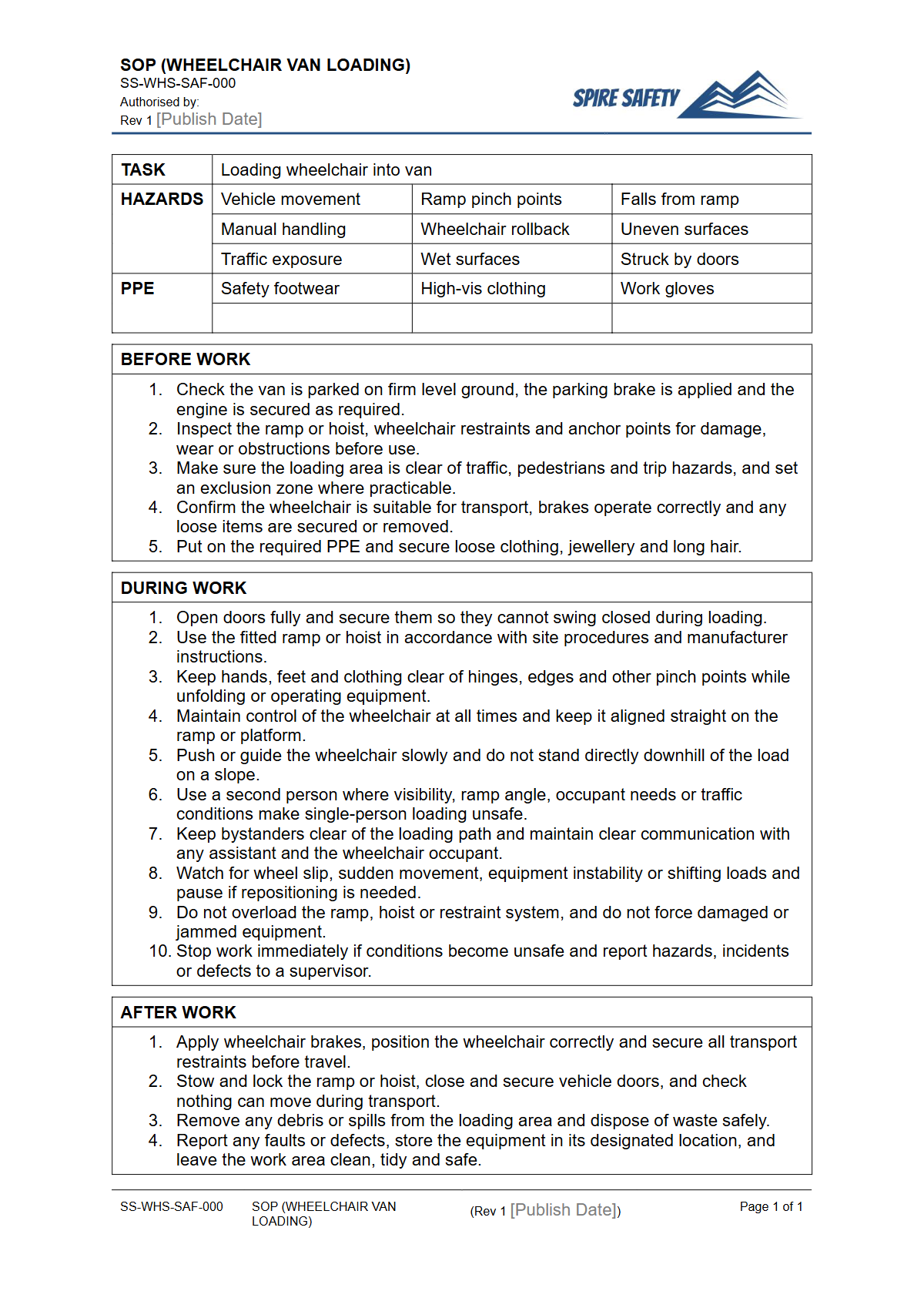
This Free Safe Operating Procedure (Wheelchair Van Loading) Template provides a structured framework for documenting the required safety steps for using vehicle lifts, ramps, and restraint systems. Loading and unloading passengers in wheelchairs is a high-risk activity that exposes both the operator and the passenger to potential harm if not performed correctly.
This SOP helps organisations mitigate risks such as musculoskeletal injuries from awkward postures, falls from ramps or lifts, and equipment-related incidents.
By clearly defining the process, you ensure a consistent, safe, and repeatable method is followed by all staff. Formalising these steps is a fundamental part of managing workplace health and safety obligations.
An effective SOP is a critical component of broader WHS management systems, demonstrating a commitment to proactive risk control and due diligence in protecting workers and clients.
Video walkthrough
How to Use the Free Safe Operating Procedure (Wheelchair Van Loading) Template
Our Safe Operating Procedure for wheelchair van loading is available as a fully editable DOCX file and a static PDF. The DOCX version is designed for easy customisation, allowing you to add your company branding and modify the content to suit your specific operational needs.
The PDF version can be used as a quick reference or for immediate distribution once your procedure is finalised.
Important: It is essential to customise this template for your specific workplace. You must review and adapt the content to reflect your unique vehicles, equipment (lifts, ramps, restraints), personnel, and operational environment.
We cannot guarantee that this template meets your legal obligations as-is; its effectiveness depends on your thorough customisation and implementation. We recommend consulting with the workers who perform the task to ensure the procedure is practical and accurate.
A well-customised SOP is a key document reviewed during formal WHS compliance auditing to verify that safe work practices are defined and implemented correctly across your organisation.
When to Use This Safe Operating Procedure
A Safe Operating Procedure for wheelchair van loading should be developed and implemented before any worker is assigned the task. It serves as a primary training document for new employees, ensuring they learn the correct, safe method from the outset.
It should also be used for periodic refresher training to reinforce safe behaviour and introduce any updates to the procedure or equipment.
Furthermore, the SOP should be readily accessible in the work environment—such as kept within the vehicle—so that staff can reference it as needed to confirm steps, especially for non-routine situations. For organisations seeking certification, integrating task-specific SOPs like this into the operational controls is a core requirement of safety management standards, a process our ISO 45001 consulting services can assist with.
Who Should Use This Safe Operating Procedure
This SOP is intended for a range of personnel within an organisation:
- Primary Users: Transport officers, community care workers, patient transport staff, disability support workers, and any other employees directly responsible for operating the wheelchair van and its loading equipment.
- Supervisors and Managers: Team leaders and managers must use the SOP to supervise work, enforce safety standards, and conduct competency assessments. They are responsible for ensuring the procedure is understood and followed.
- WHS and Training Personnel: Health and safety advisors and training coordinators use the SOP as a benchmark for risk assessments, incident investigations, and the development of training programs.
Supervisors and managers responsible for implementing these procedures can benefit from expert guidance to ensure they are practical and effective; our WHS consulting team specialises in bridging the gap between documentation and safe practice. Once you have adapted this procedure, explore our comprehensive free WHS resources library for other templates that can help strengthen your safety framework.
Common mistakes
Common mistakes to avoid
- Failing to perform a pre-operational inspection of the ramp, lift, and restraints.
- Positioning the van on uneven or sloping ground, creating an unstable loading platform.
- Not applying the vehicle's handbrake and placing it in 'Park' before operating the lift.
- Forgetting to secure the wheelchair and occupant with all required safety restraints before moving the vehicle.
- Poor communication with the passenger during the loading and unloading process.
Legal references
Legal considerations
The following legal requirements may be relevant to this type of work.
- Work Health and Safety Act (Harmonised) — Provides the primary duties for protecting workers and other people from work health and safety risks.
- Work Health and Safety Regulations (Harmonised) — Sets out requirements supporting the management of workplace hazards and risks.
The following codes may be relevant to this type of work.
- Managing WHS Risks Code of Practice — Provides practical guidance on identifying hazards, assessing risks and applying effective controls.
- Work Health and Safety Consultation, Cooperation and Coordination Code of Practice — Provides practical guidance on consulting workers and coordinating with other duty holders.
- Managing the Work Environment and Facilities Code of Practice — Provides practical guidance on safe work environments, workplace facilities and related controls.
Did you know
Manual Handling Risk
The healthcare and social assistance industry has one of the highest rates of serious workers' compensation claims in Australia, with body stressing and manual handling being the primary cause of injuries.
Vehicle Modification Standards
In Australia, modifications to vehicles to install wheelchair hoists and restraints must comply with specific Australian Design Rules (ADRs) and may require engineering certification to ensure they are roadworthy and safe.
FAQ
Frequently asked questions
01What are the main hazards when loading a wheelchair into a van?
02Is specific training required to operate a wheelchair van lift?
03How often should a wheelchair van's loading equipment be inspected?
04Can a generic vehicle safety checklist replace this specific SOP?
Share this resource
Free Safe Operating Procedure (Wheelchair Van Loading) Template
Browse Categories
How To Use It
- 1Download and open in Word or PDF.
- 2Replace the placeholders with your business details.
- 3Get it reviewed by a WHS specialist before rollout.
Need it customised?
Our WHS consultants can adapt this template to your site, run a gap analysis, or audit what you already have in place.
Book a Free Consultation WHS consulting servicesor call 1300 156 382
Related templates
- Free Safe Operating Procedure (Wheelchair Washdown) Template
- Free Safe Operating Procedure (Wildlife Nest Avoidance) Template
- Free Safe Operating Procedure (Windblown Debris Cleanup) Template
- Free Safe Operating Procedure (Windbreak Maintenance) Template
- Free Safe Operating Procedure (Window Cleaning) Template
- Free Safe Operating Procedure (Window Frame Cleaning) Template