
Free Safe Operating Procedure (Wheelchair Storage) Template
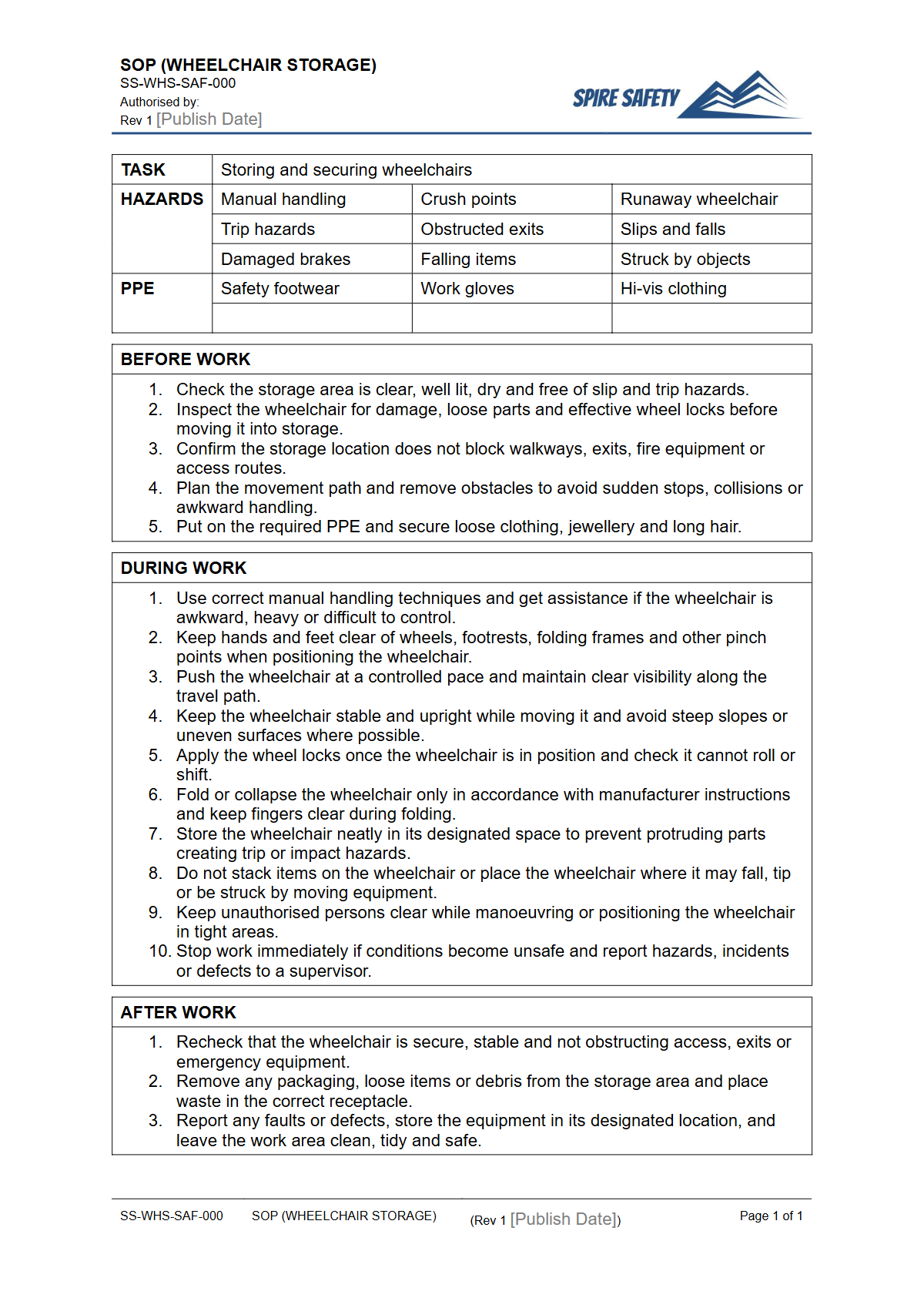
Formalise procedures for safely storing wheelchairs to prevent manual handling injuries and trip hazards. Download our Free Safe Operating Procedure Template.
Free Safe Operating Procedure (Wheelchair Storage) Template
DOCX • 126 KB + PDF
Updated Oct 2026
No signup required
Purpose of the Free Safe Operating Procedure (Wheelchair Storage) Template
Properly managing the storage of wheelchairs is a critical but often overlooked aspect of workplace health and safety, particularly in healthcare, aged care, and public-facing venues. This Free Safe Operating Procedure (Wheelchair Storage) Template provides a structured framework for documenting the safe handling, movement, and placement of wheelchairs.
Its primary purpose is to help organisations control key risks, including manual handling injuries to staff, trip hazards from improperly stored equipment, and damage to the wheelchairs themselves. By implementing a clear, repeatable process, you can ensure wheelchairs are stored in a designated, secure, and accessible manner, fulfilling your duty of care to both employees and patrons.
A well-defined SOP is a fundamental building block of effective safety practices. It translates risk assessment findings into practical, step-by-step instructions that workers can follow consistently.
Integrating this procedure is a key part of developing comprehensive WHS management systems that proactively manage hazards across all operational tasks, not just high-risk activities.
Video walkthrough
How to use the Free Safe Operating Procedure (Wheelchair Storage) Template
This template is provided in both DOCX and PDF formats for your convenience. The DOCX version is fully editable, allowing you to tailor the content to the specific context of your workplace.
To effectively use this Safe Operating Procedure, download the document and methodically work through each section. You will need to insert site-specific information, such as designated storage locations, the types of wheelchairs in use (e.g., manual, bariatric, powered), responsible personnel, and emergency contact details.
It is essential that you adapt this document to reflect the unique environment and tasks at your facility. A generic procedure is not sufficient to ensure safety.
We recommend conducting a specific risk assessment for wheelchair storage at your site and using its findings to inform the final SOP. Once customised, the procedure should be used to train all relevant staff, ensuring they understand the correct techniques for folding, lifting, and securing wheelchairs.
A Note on Customisation
This document is a template and not a complete Safe Operating Procedure. It is your responsibility to customise it to the specific equipment, personnel, and conditions of your workplace.
A generic SOP does not meet WHS requirements; you must undertake a risk assessment and consult with your workers to create a procedure that is specific to your site's needs. Spire Safety accepts no liability for any loss or damage resulting from the use of this template.
When to use a Safe Operating Procedure for Wheelchair Storage
A formal SOP for wheelchair storage should be a core part of your daily operational safety. It should be used as the primary training document for new employees during their induction process, especially those in patient services, facilities management, or porter roles.
The procedure should also be referenced during regular refresher training and toolbox talks to reinforce correct practices and address any complacency. Furthermore, this SOP is a critical tool for incident investigation; if an injury or near-miss occurs related to wheelchair handling, the procedure should be reviewed and updated to prevent recurrence.
Implementing regular WHS compliance auditing can help verify that procedures like this are being consistently followed by all staff.
For organisations looking to standardise their safety documentation, this SOP can serve as a model for other tasks. The structured approach used here can be applied to other equipment, such as that detailed in our Air Compressor Safe Operating Procedure, creating consistency across your safety library.
Who should use this SOP
This Safe Operating Procedure is designed for a broad range of personnel who are responsible for creating, implementing, and following workplace safety protocols. Key users include:
- WHS Managers and Safety Officers: To develop and integrate the procedure into the broader safety management system.
- Facility and Operations Managers: To ensure designated storage areas are maintained and staff have the resources to follow the SOP.
- Team Leaders and Supervisors: To conduct training, enforce the procedure, and monitor compliance on a day-to-day basis.
- Workers: Including porters, patient care assistants, nurses, grounds staff, and customer service personnel who physically handle and store wheelchairs.
Ultimately, anyone involved in managing public spaces or healthcare environments where wheelchairs are present will benefit from this template. If you require assistance in adapting this document or developing other complex safety procedures, consider seeking specialist WHS consulting support to ensure your documentation is robust and fit for purpose.
You can also explore our complete free WHS resources library for more templates and guides.
Common mistakes
Common mistakes to avoid
- Leaving wheelchairs in corridors or walkways, creating trip hazards.
- Failing to engage the brakes when the wheelchair is stationary or stored.
- Using incorrect lifting techniques, leading to back or shoulder injuries.
- Not having clearly marked, designated storage areas for wheelchairs.
Legal references
Legal considerations
The following legal requirements may be relevant to this type of work.
- Work Health and Safety Act (Harmonised) — Provides the primary duties for protecting workers and other people from work health and safety risks.
- Work Health and Safety Regulations (Harmonised) — Sets out requirements supporting the management of workplace hazards and risks.
The following codes may be relevant to this type of work.
- Managing WHS Risks Code of Practice — Provides practical guidance on identifying hazards, assessing risks and applying effective controls.
- Work Health and Safety Consultation, Cooperation and Coordination Code of Practice — Provides practical guidance on consulting workers and coordinating with other duty holders.
- Managing the Work Environment and Facilities Code of Practice — Provides practical guidance on safe work environments, workplace facilities and related controls.
Did you know
Manual Handling Risk
Injuries from handling people and equipment are a leading cause of workers' compensation claims in the Australian healthcare and social assistance industry. A clear SOP is a key control measure.
Accessibility is Law
Under the Disability Discrimination Act 1992, organisations have a legal obligation to provide equitable access. Improperly stored wheelchairs that block paths of travel can breach these requirements.
FAQ
Frequently asked questions
01What are the main hazards when storing wheelchairs?
02Does this SOP template cover powered and bariatric wheelchairs?
03How often should a Safe Operating Procedure for wheelchair storage be reviewed?
04Why is a dedicated SOP needed just for storing wheelchairs?
Share this resource
Free Safe Operating Procedure (Wheelchair Storage) Template
Browse Categories
How To Use It
- 1Download and open in Word or PDF.
- 2Replace the placeholders with your business details.
- 3Get it reviewed by a WHS specialist before rollout.
Need it customised?
Our WHS consultants can adapt this template to your site, run a gap analysis, or audit what you already have in place.
Book a Free Consultation WHS consulting servicesor call 1300 156 382
Related templates
- Free Safe Operating Procedure (Wheelchair Tie-Down) Template
- Free Safe Operating Procedure (Wheelchair Tyre Check) Template
- Free Safe Operating Procedure (Wheelchair Van Loading) Template
- Free Safe Operating Procedure (Wheelchair Washdown) Template
- Free Safe Operating Procedure (Wildlife Nest Avoidance) Template
- Free Safe Operating Procedure (Windblown Debris Cleanup) Template