
Free Safe Operating Procedure (Wheelchair Ramp Use) Template
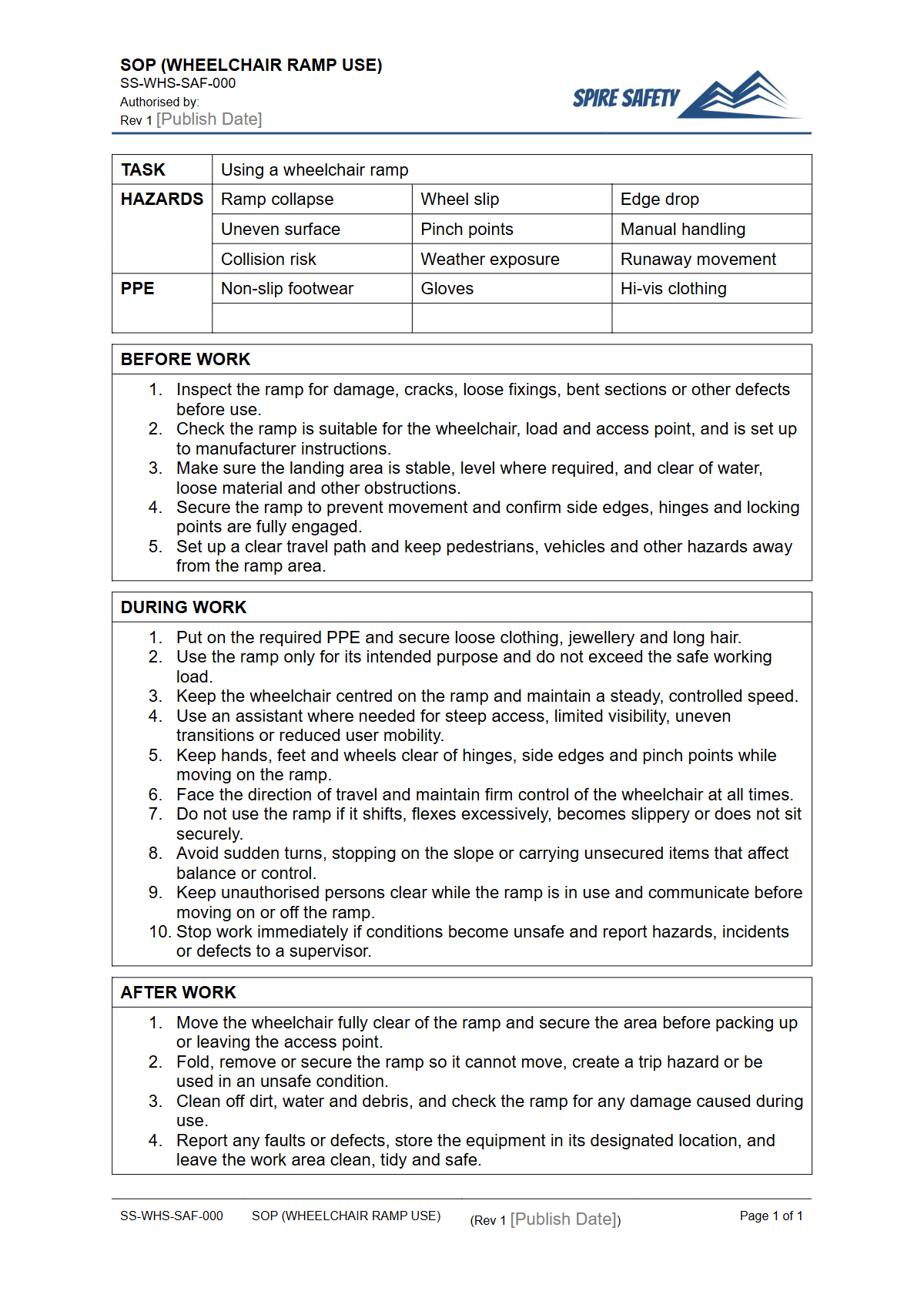
Download our free Safe Operating Procedure (Wheelchair Ramp Use) Template. This customisable document provides a structured starting point for your workplace safety.
Free Safe Operating Procedure (Wheelchair Ramp Use) Template
DOCX • 126 KB + PDF
Updated Oct 2026
No signup required
Purpose of the Free Safe Operating Procedure (Wheelchair Ramp Use) Template
Ensuring safe access for everyone is a fundamental part of workplace health and safety. This free Safe Operating Procedure (Wheelchair Ramp Use) Template provides a structured framework for documenting the key steps, hazards, and controls associated with using portable or fixed wheelchair ramps.
Implementing a clear SOP helps to manage risks such as musculoskeletal injuries for assistants, falls for users, and damage to equipment. By standardising the process, you create a safer environment for employees, visitors, and clients, while also providing a reliable tool for worker training and induction.
Video walkthrough
How to use the Free Safe Operating Procedure (Wheelchair Ramp Use) Template
This template is available for download as a DOCX file for easy customisation or as a PDF for immediate reference. To effectively use this document, you must adapt it to your specific workplace context.
It is critical to tailor this template to the exact types of ramps used (portable and fixed), the environmental conditions of your site, and the specific needs of the users. We have provided a comprehensive starting point, but you must complete the site-specific risk assessment and detail the precise procedures relevant to your operations.
Involving your workers in this customisation process is crucial for creating a practical and effective procedure.
Integrating this Safe Operating Procedure into your broader WHS management systems ensures a consistent approach to safety across all organisational activities. A well-documented procedure is a cornerstone of a proactive safety culture, demonstrating a clear commitment to managing risks and protecting individuals.
When to Use a Wheelchair Ramp SOP
A formal SOP for wheelchair ramp use should be implemented in any workplace where ramps provide access or facilitate movement. This includes a wide range of environments such as healthcare facilities, aged care homes, community centres, offices, retail stores, and event venues.
It is essential for tasks involving patient or client transfers, daily access for employees or visitors with mobility needs, and receiving deliveries. A documented procedure is vital for both permanent ramps that are part of the building's structure and portable ramps used for temporary access, ensuring consistent safety standards are met every time.
A comprehensive safety framework requires formalised procedures for all identified risks, not just those involving heavy machinery. The same level of diligence applied to a deep fryer SOP in a commercial kitchen should be applied to ensuring safe building access for all.
Who Should Use This Procedure?
This Safe Operating Procedure is a tool for multiple roles within an organisation. Persons Conducting a Business or Undertaking (PCBUs), managers, and supervisors are responsible for implementing it to meet their WHS duties.
They can use this template to ensure a standardised, safe process is in place and to facilitate training. For workers who perform the task—such as support workers, healthcare professionals, facilities staff, and event personnel—the SOP provides clear, step-by-step instructions on how to use ramps safely, both for themselves and the person they may be assisting.
For organisations requiring expert guidance on developing a full suite of safety documentation for a complex environment, engaging external WHS consulting services can provide valuable support and oversight. This ensures all procedures are robust, integrated, and aligned with best practice.
Key Elements of a Wheelchair Ramp SOP
A robust SOP for wheelchair ramp use should be comprehensive and clear. While our template provides a solid foundation, ensure your final document includes these critical elements tailored to your site:
- Pre-Use Checks: A checklist for inspecting the ramp for damage, defects, or contamination before each use. This includes checking the surface grip, side barriers (kerbs), and locking pins on portable ramps.
- Site Assessment: Instructions for evaluating the deployment area, ensuring the ground surfaces at the top and bottom are stable, level, and clear of obstructions.
- Step-by-Step Deployment: Clear, sequential instructions for safely setting up and securing portable ramps, specifying the correct gradient or slope.
- Safe Use Protocol: Guidelines for the person using the ramp and any assistant. This covers speed, communication, braking on powered wheelchairs, and techniques for pushing and guiding manual wheelchairs to prevent strain.
- Load Capacity: Clearly stating the maximum weight capacity (user, mobility device, and assistant combined) and ensuring it is never exceeded.
- Post-Use Procedures: Instructions for the safe removal, cleaning, and storage of portable ramps to prevent damage and ensure they remain in good condition.
The principles of documenting pre-start checks and operational steps are universal across all well-written SOPs, whether for access equipment or for industrial machinery detailed in our FREE Conveyer System SOP.
Further Steps and Continuous Improvement
Implementing an SOP is the first step. To ensure it remains effective, you must provide training to all relevant workers, ensuring they understand the procedures and can demonstrate competency.
Regular supervision and spot-checks confirm that the SOP is being followed correctly. Schedule periodic reviews of the SOP—at least annually or after any incident—to ensure it remains current with your operational practices and any changes in equipment or legislation.
You can explore our extensive free WHS resources library for more templates and guides to support your safety management system.
Common mistakes
Common mistakes to avoid
- Using a ramp with a gradient that is too steep for the situation.
- Failing to secure a portable ramp, leading to slipping or movement during use.
- Overlooking the ramp's specified maximum load capacity.
- Neglecting to train assistants on proper pushing, guiding, and communication techniques.
Legal references
Legal considerations
The following legal requirements may be relevant to this type of work.
- Work Health and Safety Act (Harmonised) — Provides the primary duties for protecting workers and other people from work health and safety risks.
- Work Health and Safety Regulations (Harmonised) — Sets out requirements supporting the management of workplace hazards and risks.
The following codes may be relevant to this type of work.
- Managing WHS Risks Code of Practice — Provides practical guidance on identifying hazards, assessing risks and applying effective controls.
- Work Health and Safety Consultation, Cooperation and Coordination Code of Practice — Provides practical guidance on consulting workers and coordinating with other duty holders.
- Managing the Work Environment and Facilities Code of Practice — Provides practical guidance on safe work environments, workplace facilities and related controls.
Did you know
The Gradient Matters
Australian Standards (AS 1428.1) recommend a maximum gradient of 1:14 for ramps where full circulation space isn't available, but a gentler 1:20 slope is preferred to reduce exertion and increase safety.
FAQ
Frequently asked questions
01What should be included in a wheelchair ramp SOP?
02Are portable wheelchair ramps covered by WHS laws in Australia?
03Who is responsible for training staff on wheelchair ramp use?
04How often should we review our Safe Operating Procedure for wheelchair ramps?
Share this resource
Free Safe Operating Procedure (Wheelchair Ramp Use) Template
Browse Categories
How To Use It
- 1Download and open in Word or PDF.
- 2Replace the placeholders with your business details.
- 3Get it reviewed by a WHS specialist before rollout.
Need it customised?
Our WHS consultants can adapt this template to your site, run a gap analysis, or audit what you already have in place.
Book a Free Consultation WHS consulting servicesor call 1300 156 382
Related templates
- Free Safe Operating Procedure (Wheelchair Repair Check) Template
- Free Safe Operating Procedure (Wheelchair Scale Use) Template
- Free Safe Operating Procedure (Wheelchair Seat Cleaning) Template
- Free Safe Operating Procedure (Wheelchair Storage) Template
- Free Safe Operating Procedure (Wheelchair Tie-Down) Template
- Free Safe Operating Procedure (Wheelchair Tyre Check) Template