
Free Safe Operating Procedure (Wheelchair Repair Check) Template
Ensure safety during wheelchair maintenance with our structured template. Download our free Safe Operating Procedure for wheelchair repair checks today.
Free Safe Operating Procedure (Wheelchair Repair Check) Template
DOCX • 126 KB + PDF
Updated Oct 2026
No signup required
Purpose of the Free Safe Operating Procedure (Wheelchair Repair Check) Template
Effectively managing health and safety during maintenance activities is a core responsibility for any organisation. This Free Safe Operating Procedure (Wheelchair Repair Check) Template provides a structured starting point for developing a documented process for your workplace.
It is designed to help you standardise the inspection and repair of manual and powered wheelchairs, identifying potential hazards and implementing essential control measures. By formalising these steps, you can significantly reduce risks such as musculoskeletal injuries from manual handling, crush hazards from moving parts, and electrical shocks from powered models.
A well-drafted SOP is a critical component of a comprehensive WHS management system. It serves as a clear guide for workers, ensures consistency in how tasks are performed, and acts as a valuable tool for training and competency verification. This template helps formalise your commitment to a safe work environment by outlining pre-operational checks, the sequence of tasks, and emergency procedures, aligning with Australian WHS principles.
Video walkthrough
How to use the Free Safe Operating Procedure (Wheelchair Repair Check) Template
This resource is available as an editable DOCX file and a print-ready PDF. The template is designed as a foundational document that must be adapted to reflect the specific context of your operations.
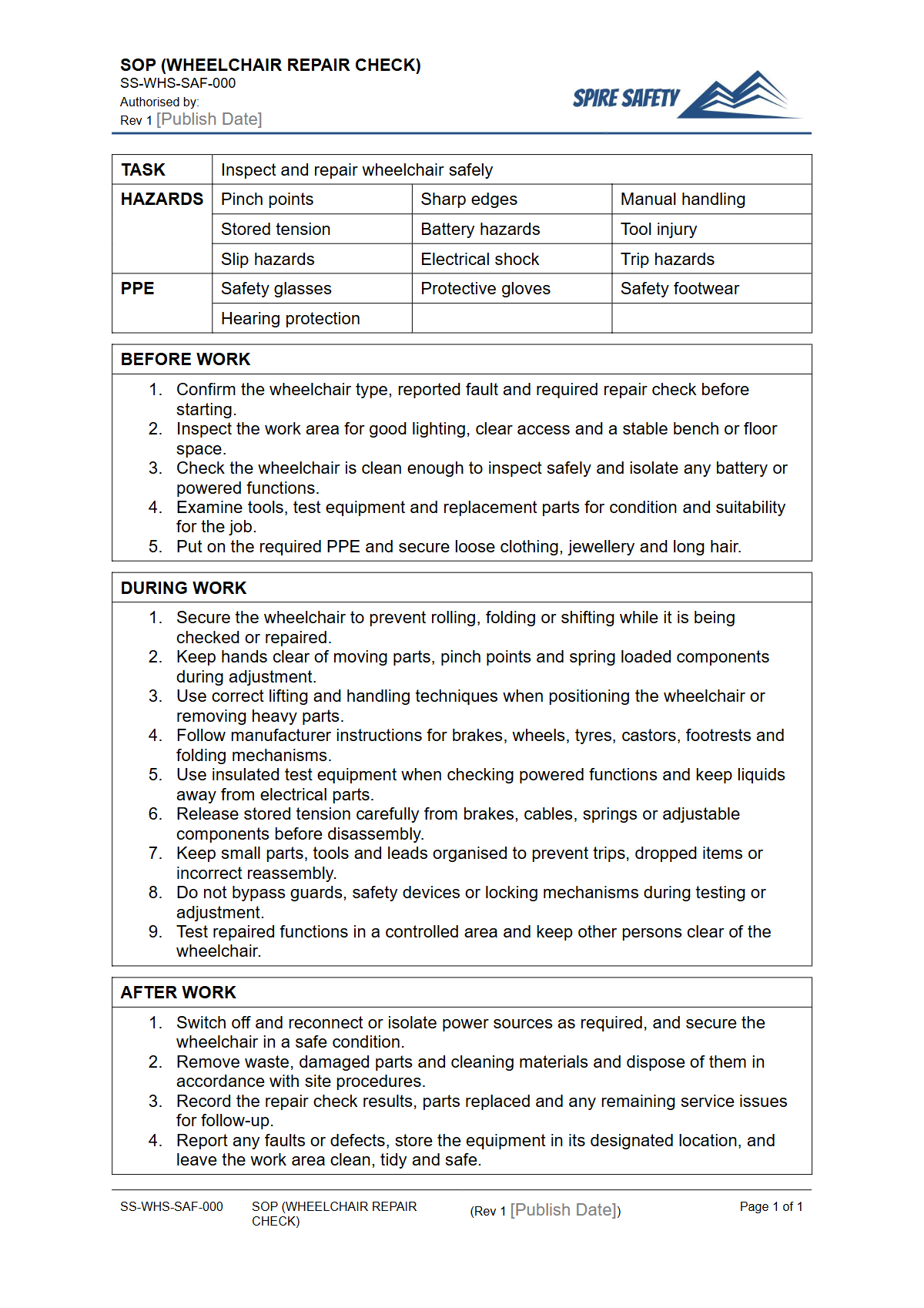
It includes sections for detailing the task, identifying hazards, specifying PPE, and outlining the step-by-step procedure.
Important: This document is a template only. You must customise it to suit your specific workplace, including the exact models of wheelchairs you service, the tools and equipment used, the chemicals involved (like cleaners or lubricants), and your unique site conditions.
We are not responsible for any incidents that may occur. A thorough risk assessment should be conducted to inform the final SOP, ensuring all identified hazards are controlled.
Your final document should be reviewed, approved, and communicated to all relevant personnel before implementation.
When to use it
This Safe Operating Procedure should be used by technicians and maintenance staff before commencing any repair or scheduled check on a wheelchair. It is applicable for a range of activities, from routine maintenance and pre-use inspections to more complex repairs involving disassembly.
Integrating this SOP into your regular maintenance schedule ensures that safety protocols are consistently front-of-mind. It should also be reviewed and referenced during worker induction, refresher training, or after any related incident or near miss occurs to reinforce safe work practices.
Who should use it
This SOP is intended for use by qualified maintenance technicians, aged care facility maintenance staff, disability support workers, and any other personnel responsible for the upkeep and safety of wheelchairs. It is also a valuable resource for supervisors and WHS managers who are responsible for implementing and overseeing safe work systems.
Using a standardised procedure ensures that every person performing the task follows the same approved, safe method, regardless of their individual experience level. Consistency achieved through an SOP is a key factor verified during regular WHS compliance auditing.
Integrating with Other Workshop Procedures
A wheelchair repair workshop often contains various pieces of equipment, each requiring its own safe work procedure. For example, if tyre inflation is part of the job, you should have procedures documented in our free Air Compressor SOP. For more extensive frame repairs, a separate procedure for welding, such as an Oxy Acetylene SOP, would be necessary.
Similarly, if any custom fabrication is required, a specific Circular Saw SOP might be needed. Ensuring all tasks have a corresponding SOP creates a robust safety framework.
Explore our free WHS resources library for more templates to support your operations.
Common mistakes
Common mistakes to avoid
- Forgetting to add procedures for isolating power and handling batteries on electric wheelchairs.
- Using a generic SOP without customising it for specific wheelchair models and workshop tools.
- Failing to list specific Personal Protective Equipment (PPE) required for tasks like cleaning or handling lubricants.
- Neglecting to adequately train all relevant workers on the finalised and approved Safe Operating Procedure.
Legal references
Legal considerations
The following legal requirements may be relevant to this type of work.
- Work Health and Safety Act (Harmonised) — Provides the primary duties for protecting workers and other people from work health and safety risks.
- Work Health and Safety Regulations (Harmonised) — Sets out requirements supporting the management of workplace hazards and risks.
The following codes may be relevant to this type of work.
- Managing WHS Risks Code of Practice — Provides practical guidance on identifying hazards, assessing risks and applying effective controls.
- Work Health and Safety Consultation, Cooperation and Coordination Code of Practice — Provides practical guidance on consulting workers and coordinating with other duty holders.
- Managing the Work Environment and Facilities Code of Practice — Provides practical guidance on safe work environments, workplace facilities and related controls.
Did you know
Maintenance Matters
The Therapeutic Goods Administration (TGA) regulates most wheelchairs as medical devices in Australia, underscoring the critical importance of proper maintenance for user safety and device performance.
Ergonomic Risks
Wheelchair repair often involves awkward postures and manual handling, making musculoskeletal disorders a significant risk for technicians if not managed through proper ergonomic assessments and controls.
FAQ
Frequently asked questions
01What should be included in a wheelchair repair SOP?
02Is this wheelchair repair SOP template suitable for electric wheelchairs?
03How often should we review our Safe Operating Procedures?
04Who is responsible for implementing a wheelchair repair SOP?
Share this resource
Free Safe Operating Procedure (Wheelchair Repair Check) Template
Browse Categories
How To Use It
- 1Download and open in Word or PDF.
- 2Replace the placeholders with your business details.
- 3Get it reviewed by a WHS specialist before rollout.
Need it customised?
Our WHS consultants can adapt this template to your site, run a gap analysis, or audit what you already have in place.
Book a Free Consultation WHS consulting servicesor call 1300 156 382
Related templates
- Free Safe Operating Procedure (Wheelchair Scale Use) Template
- Free Safe Operating Procedure (Wheelchair Seat Cleaning) Template
- Free Safe Operating Procedure (Wheelchair Storage) Template
- Free Safe Operating Procedure (Wheelchair Tie-Down) Template
- Free Safe Operating Procedure (Wheelchair Tyre Check) Template
- Free Safe Operating Procedure (Wheelchair Van Loading) Template