
Free Safe Operating Procedure (Wheelchair Lap Belt) Template
Download our free Safe Operating Procedure (Wheelchair Lap Belt) Template to formalise safety steps for patient and resident transport. Get your DOCX today.
Free Safe Operating Procedure (Wheelchair Lap Belt) Template
DOCX • 126 KB + PDF
Updated Oct 2026
No signup required
Purpose of the Free Safe Operating Procedure (Wheelchair Lap Belt) Template
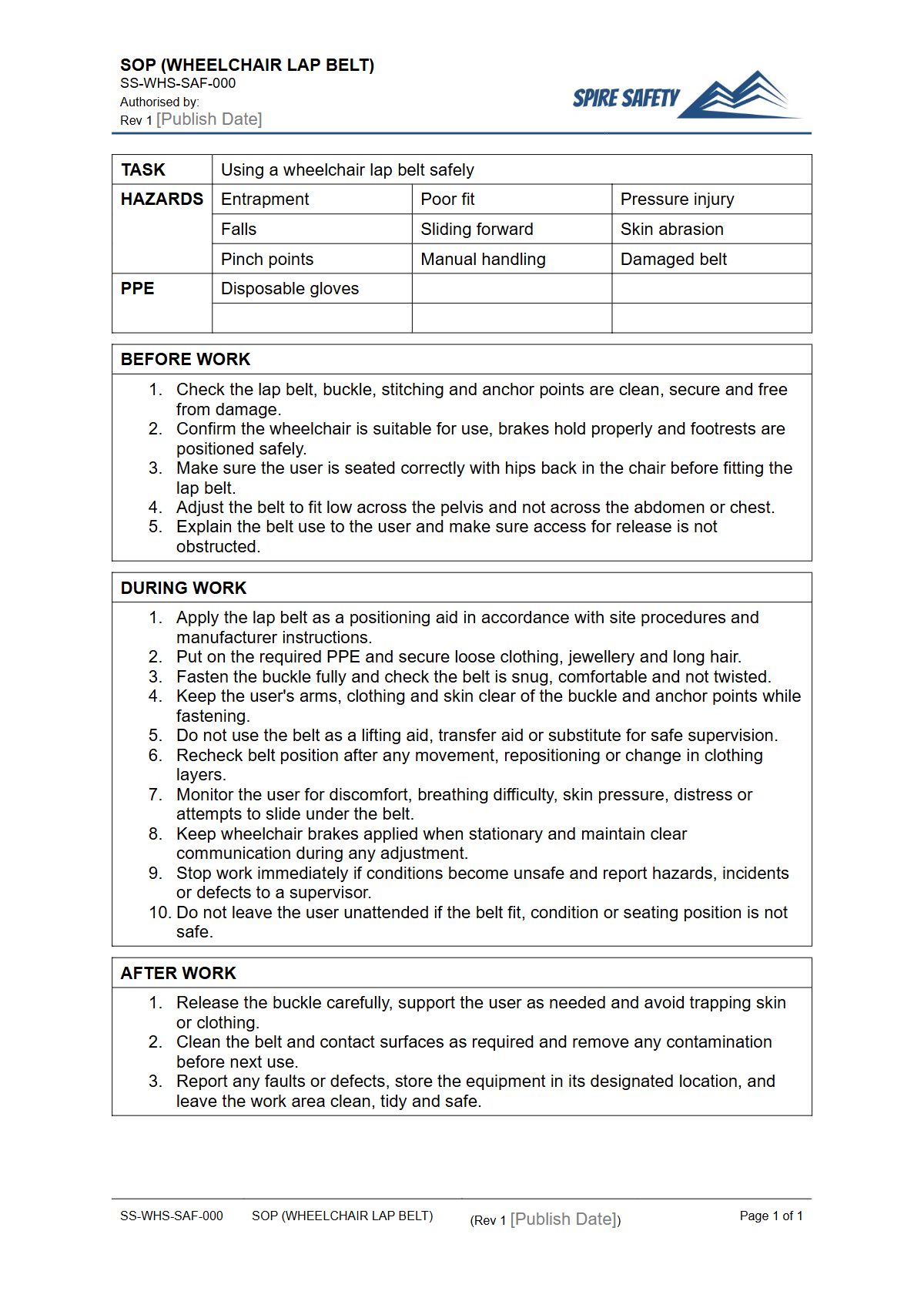
Ensuring the safety of individuals who use wheelchairs is a critical responsibility in healthcare, aged care, and disability support settings. Our Free Safe Operating Procedure (Wheelchair Lap Belt) Template provides a structured framework for correctly and safely applying a wheelchair lap belt.
This document helps organisations standardise the process, reducing the risk of falls, slips, and other injuries to residents or patients during movement and transport. By implementing a formal SOP, you create a clear, consistent guide for all staff, which is essential for training, competency assessment, and demonstrating due diligence under Australian WHS laws.
A documented procedure ensures that every caregiver, nurse, and support worker follows the same approved steps, minimising variations in practice that could lead to unsafe situations. It forms a key part of managing risks associated with patient handling and mobility, promoting a culture of safety and care for vulnerable individuals.
Video walkthrough
How to use the Free Safe Operating Procedure (Wheelchair Lap Belt) Template
This Safe Operating Procedure for wheelchair lap belt use is provided in both DOCX and PDF formats. The DOCX file is fully editable, allowing you to adapt it to your organisation's specific needs.
The PDF version is ready for immediate printing and use once you are satisfied with your customisations. It is crucial to integrate this procedure into your broader WHS management systems to ensure it aligns with your overall safety strategy.
Before implementing this SOP, you must conduct a site-specific risk assessment to identify all hazards associated with wheelchair use and patient transfers in your environment. The SOP should be reviewed and approved by a competent person within your organisation.
Important Customisation Note
This document is a template and is not a substitute for professional WHS advice. We have designed it as a starting point, but you MUST customise it to reflect the specific types of wheelchairs and lap belts used, your facility's layout, personnel roles, training procedures, and the unique needs of the individuals in your care.
Consultation with your workers is a vital part of this process.
When to Use This Safe Operating Procedure
This SOP should be used whenever a wheelchair lap belt is required to secure a person safely. Common situations include:
- Preparing a resident or patient for transport within the facility, such as moving them from their room to a dining hall or activity area.
- Securing an individual in their wheelchair before it is loaded into a vehicle.
- During therapeutic activities where additional stability is necessary to prevent falls.
- Any time a risk assessment determines that a lap belt is a necessary control measure to ensure the person's safety and postural support.
The procedure should be readily accessible to all relevant staff in the areas where these tasks are performed. Regular reviews should occur to ensure the SOP remains current with equipment changes or new information about best practice.
For guidance on complex safety scenarios, engaging expert WHS consulting can provide valuable clarity.
Who Should Use This Procedure
This SOP is designed for use by all personnel responsible for the mobility and care of individuals who use wheelchairs. This includes, but is not limited to:
- Personal Care Assistants (PCAs) and Aged Care Workers
- Registered and Enrolled Nurses
- Allied Health Professionals (e.g., Physiotherapists, Occupational Therapists)
- Patient Transport Officers
- Disability Support Workers
Supervisors and WHS managers should also use this document to inform training programs, conduct competency assessments, and perform workplace inspections. The effectiveness of the SOP can be verified through processes like WHS compliance auditing, which helps confirm that procedures are being followed correctly in practice.
Integrating This SOP into Your Safety Framework
A Safe Operating Procedure does not exist in isolation. To be effective, it must be part of a comprehensive safety system.
This involves linking it to other key WHS processes such as hazard identification, risk assessment (particularly for hazardous manual tasks), incident reporting, and regular equipment inspection and maintenance schedules. Embedding this SOP within a certified framework like ISO 45001 consulting can help ensure a systematic and robust approach to managing health and safety risks.
Make sure this SOP is included in induction programs for new staff and in regular refresher training for existing employees. Keeping clear records of this training is essential for demonstrating compliance. For more templates and safety documents, browse our complete free WHS resources library.
Common mistakes
Common mistakes to avoid
- Using a generic SOP without customising it for the specific workplace and equipment.
- Failing to regularly inspect lap belts for signs of wear, fraying, or damage to buckles.
- Neglecting to train staff on the procedure or assess their competency in applying it.
- Not considering the individual's comfort, medical condition, or dignity when applying the belt.
Legal references
Legal considerations
The following legal requirements may be relevant to this type of work.
- Work Health and Safety Act (Harmonised) — Provides the primary duties for protecting workers and other people from work health and safety risks.
- Work Health and Safety Regulations (Harmonised) — Sets out requirements supporting the management of workplace hazards and risks.
The following codes may be relevant to this type of work.
- Managing WHS Risks Code of Practice — Provides practical guidance on identifying hazards, assessing risks and applying effective controls.
- Work Health and Safety Consultation, Cooperation and Coordination Code of Practice — Provides practical guidance on consulting workers and coordinating with other duty holders.
- Managing the Work Environment and Facilities Code of Practice — Provides practical guidance on safe work environments, workplace facilities and related controls.
Did you know
Hierarchy of Controls
In WHS, using a lap belt is an 'administrative control'. It relies on human behaviour and procedure, so it should be combined with higher-level controls like providing suitable wheelchairs (engineering control) and minimising manual handling where possible (elimination/substitution).
Person-Centred Care
The use of any restraint, including a lap belt, must be based on an individual assessment of need and be the least restrictive option. The decision should always involve the person or their representative, respecting their dignity and rights.
FAQ
Frequently asked questions
01Is a Safe Operating Procedure for a wheelchair lap belt legally required in Australia?
02How often should training on this SOP be conducted?
03Can this template be used for all types of wheelchair lap belts?
04What's the difference between an SOP and a risk assessment?
Share this resource
Free Safe Operating Procedure (Wheelchair Lap Belt) Template
Browse Categories
How To Use It
- 1Download and open in Word or PDF.
- 2Replace the placeholders with your business details.
- 3Get it reviewed by a WHS specialist before rollout.
Need it customised?
Our WHS consultants can adapt this template to your site, run a gap analysis, or audit what you already have in place.
Book a Free Consultation WHS consulting servicesor call 1300 156 382
Related templates
- Free Safe Operating Procedure (Wheelchair Lift Use) Template
- Free Safe Operating Procedure (Wheelchair Ramp Setup) Template
- Free Safe Operating Procedure (Wheelchair Ramp Use) Template
- Free Safe Operating Procedure (Wheelchair Repair Check) Template
- Free Safe Operating Procedure (Wheelchair Scale Use) Template
- Free Safe Operating Procedure (Wheelchair Seat Cleaning) Template