
Free Safe Operating Procedure (Wheelchair Charging) Template
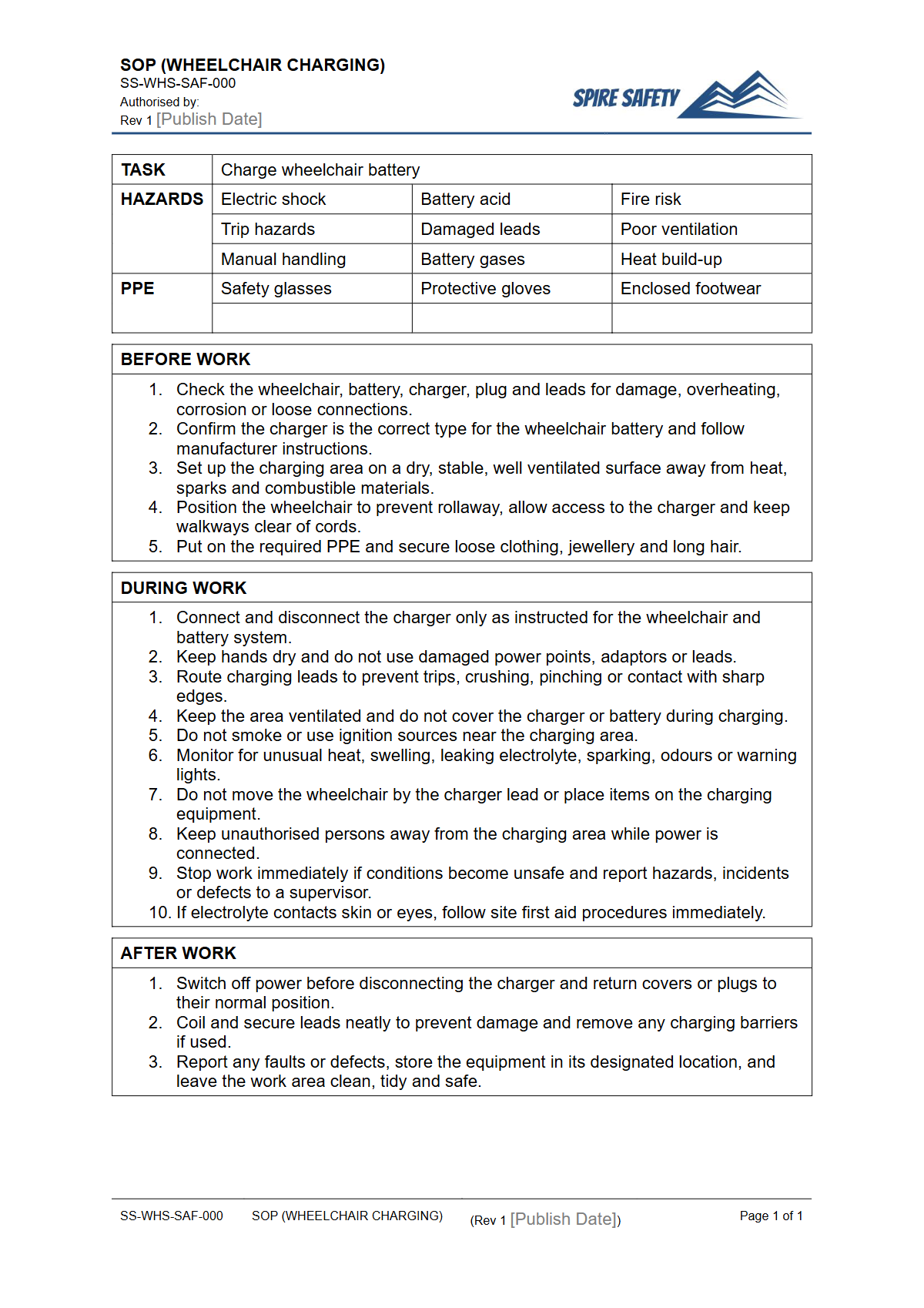
Properly managing wheelchair charging is crucial for preventing electrical and fire hazards. Download our free Safe Operating Procedure template to get started.
Free Safe Operating Procedure (Wheelchair Charging) Template
DOCX • 126 KB + PDF
Updated Oct 2026
No signup required
Purpose of the Free Safe Operating Procedure (Wheelchair Charging) Template
Managing the charging of electric wheelchairs and mobility scooters is a critical task in many workplaces, particularly in healthcare, aged care, and disability support settings. Without a formal process, organisations are exposed to significant risks, including electrical shock, fire, and trip hazards.
This Free Safe Operating Procedure (Wheelchair Charging) Template provides a structured framework for documenting the safe, step-by-step process required to minimise these risks.
A well-developed Safe Operating Procedure (SOP) is a fundamental component of your safety management system. It clearly outlines responsibilities, required personal protective equipment (PPE), and emergency actions, ensuring all workers perform the task consistently and safely.
By implementing this SOP, you create a verifiable record of the safe work practices you have established to control hazards associated with charging electrical equipment. This is a key part of building robust WHS management systems that protect both people and property.
Video walkthrough
How to use the Free Safe Operating Procedure (Wheelchair Charging) Template
This template is provided in both DOCX and PDF formats to serve as a comprehensive starting point. It is designed to be adapted to the specific context of your workplace, including the types of wheelchairs in use, the layout of your facility, and the specific personnel involved.
It is not a complete, out-of-the-box solution.
Important: You must customise this document to align with your own operational risks and control measures. We've provided a solid foundation based on Australian WHS principles, but you must adapt this document to reflect the unique equipment, environment, and procedures of your organisation.
A generic document that doesn't match your reality offers little practical protection.
Key Sections to Customise
- Equipment Specifics: List the makes and models of wheelchairs and chargers used at your site.
- Battery Types: Specify procedures for the different battery types you manage (e.g., Sealed Lead-Acid, Gel, Lithium-ion), as handling and charging requirements can vary.
- Designated Charging Areas: Detail the approved locations for charging, ensuring they are well-ventilated, clear of combustible materials, and away from emergency exits.
- Pre-use Inspections: Customise the checklist for inspecting chargers, cords, plugs, and battery terminals for signs of damage, wear, or corrosion. The principles of pre-start checks are common across many types of powered equipment, as seen in our free Air Compressor SOP.
- Emergency Procedures: Input site-specific emergency contacts and procedures for incidents like electrical shock, battery spills, or fire.
When to use a Safe Operating Procedure
An SOP for wheelchair charging should be a living document integrated into your daily operations. It is essential during the induction and training of new employees who will be responsible for the task.
It should also be used for regular refresher training to ensure competency is maintained and bad habits do not develop. The procedure should be readily accessible near all designated charging stations for easy reference.
Furthermore, this document serves as crucial evidence during safety inspections or audits. It demonstrates that you have identified a known hazard and implemented a formal, systematic process to control the associated risks, which is a key focus of any WHS compliance auditing process.
Who should use it
This Safe Operating Procedure should be developed and reviewed by a person with the necessary knowledge and authority, such as a WHS Manager, Facility Manager, or Maintenance Supervisor. The end-users of the procedure are any workers tasked with charging wheelchairs, including:
- Aged care and healthcare workers
- Disability support workers
- Maintenance and facilities staff
- Therapy assistants and allied health professionals
Supervisors and managers should also be thoroughly familiar with the SOP to ensure they can effectively monitor its implementation and enforce safe work practices. For facilities with diverse operational risks, such as those with commercial kitchens, other specific procedures like a Safe Operating Procedure for a deep fryer will also be necessary to ensure comprehensive safety coverage.
Training on the SOP is not just about reading a document; it involves demonstrating competency. For tasks involving specific equipment, ensuring operators are trained and competent is a cornerstone of WHS compliance, a principle that also applies to more complex machinery covered in resources like our FREE Telehandler SOP Template.
By standardising your approach to this common but hazardous task, you actively contribute to a stronger safety culture. For more templates and guidance documents to support your safety system, browse our complete free WHS resources library.
Common mistakes
Common mistakes to avoid
- Using damaged, frayed, or non-compliant chargers and extension cords.
- Charging batteries in poorly ventilated spaces, cluttered areas, or near flammable materials.
- Ignoring the specific manufacturer's instructions for different battery types (e.g., gel vs. lithium-ion).
- Failing to regularly inspect charging equipment, plugs, and cables for wear and tear.
Legal references
Legal considerations
The following legal requirements may be relevant to this type of work.
- Work Health and Safety Act (Harmonised) — Provides the primary duties for protecting workers and other people from work health and safety risks.
- Work Health and Safety Regulations (Harmonised) — Sets out requirements supporting the management of workplace hazards and risks.
The following codes may be relevant to this type of work.
- Managing WHS Risks Code of Practice — Provides practical guidance on identifying hazards, assessing risks and applying effective controls.
- Work Health and Safety Consultation, Cooperation and Coordination Code of Practice — Provides practical guidance on consulting workers and coordinating with other duty holders.
- Managing the Work Environment and Facilities Code of Practice — Provides practical guidance on safe work environments, workplace facilities and related controls.
Did you know
Battery Fires
Lithium-ion battery fires, common in modern mobility devices, can be particularly intense and hard to extinguish. They may experience 'thermal runaway,' a self-sustaining chemical reaction that produces extreme heat and toxic gases.
Cord Management
A significant number of trips and falls in healthcare and residential settings are caused by poorly managed cords and cables, including those from charging equipment.
FAQ
Frequently asked questions
01What are the main hazards of charging an electric wheelchair?
02Does this SOP template cover all types of wheelchair batteries?
03Where should wheelchair charging stations be located?
04How often should staff be trained on this Safe Operating Procedure?
Share this resource
Free Safe Operating Procedure (Wheelchair Charging) Template
Browse Categories
How To Use It
- 1Download and open in Word or PDF.
- 2Replace the placeholders with your business details.
- 3Get it reviewed by a WHS specialist before rollout.
Need it customised?
Our WHS consultants can adapt this template to your site, run a gap analysis, or audit what you already have in place.
Book a Free Consultation WHS consulting servicesor call 1300 156 382
Related templates
- Free Safe Operating Procedure (Wheelchair Cushion Clean) Template
- Free Safe Operating Procedure (Wheelchair Footrest) Template
- Free Safe Operating Procedure (Wheelchair Handling) Template
- Free Safe Operating Procedure (Wheelchair Lap Belt) Template
- Free Safe Operating Procedure (Wheelchair Lift Use) Template
- Free Safe Operating Procedure (Wheelchair Ramp Setup) Template