
Free Safe Operating Procedure (Wheelchair Footrest) Template
Manage risks associated with wheelchair footrests in healthcare and aged care settings with our template. Download the free DOCX and PDF to start now.
Free Safe Operating Procedure (Wheelchair Footrest) Template
DOCX • 126 KB + PDF
Updated Oct 2026
No signup required
Purpose of the Free Safe Operating Procedure (Wheelchair Footrest) Template
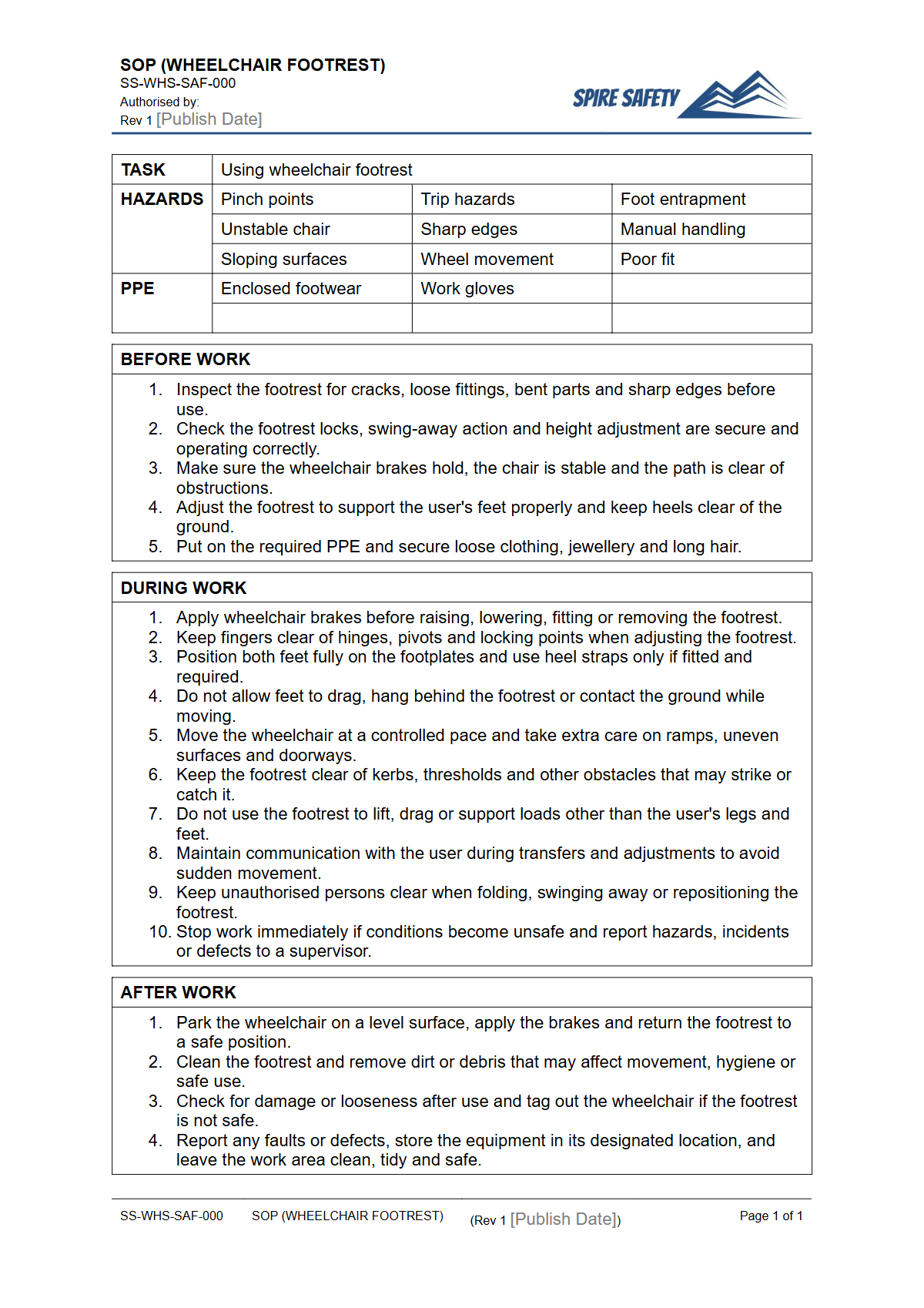
This Safe Operating Procedure (SOP) template provides a structured framework for outlining the safe steps involved in attaching, detaching, adjusting, and handling wheelchair footrests. Incorrect management of footrests is a common but preventable cause of injury in healthcare, aged care, and disability support settings.
These incidents can include trips and falls affecting carers and clients, strain injuries from awkward handling, or pressure injuries and discomfort for the wheelchair user due to improper positioning. Using a formalised procedure helps to standardise the task, minimise identified risks, and provide a clear training tool for all workers.
A documented SOP is a fundamental component of a proactive safety culture. It demonstrates an organisation's commitment to managing risks and serves as a key document within broader WHS management systems. By clearly defining the accepted, safe method for a routine task, you create a baseline for performance, supervision, and incident investigation.
This procedure helps ensure every worker, regardless of experience, understands the hazards and the required control measures to protect themselves and the people they care for.
Video walkthrough
How to use the Free Safe Operating Procedure (Wheelchair Footrest) Template
Our free template for a wheelchair footrest SOP is provided in both DOCX and PDF formats for your convenience. It is designed as a comprehensive starting point, pre-filled with common steps, hazards, and controls relevant to this task.
However, it is essential that you customise the document to reflect the specific equipment, environment, and operational needs of your workplace. Different wheelchair models may have unique mechanisms, and your facility layout may present specific hazards that need to be addressed.
To effectively use this template, a Person Conducting a Business or Undertaking (PCBU) should lead a consultation process with workers who regularly perform the task. This ensures the final SOP is practical, accurate, and reflects on-the-ground experience.
During customisation, review each step, add site-specific details, and insert photographs of your equipment where appropriate. The effectiveness of your documented procedures is often reviewed during a WHS compliance auditing process, making it vital to ensure they are fit-for-purpose and actively used.
When to use a Wheelchair Footrest SOP
This Safe Operating Procedure should be used and referenced whenever a worker needs to interact with wheelchair footrests. The procedure is applicable across several key tasks, including preparing a wheelchair for a client transfer, stowing a wheelchair after use, or making adjustments for user comfort and postural support.
It should be a primary reference document during new employee induction and regular refresher training sessions to reinforce safe work practices.
Furthermore, the SOP serves as a valuable tool for risk assessments and incident investigations. If an incident involving a footrest occurs, the procedure can be used to analyse whether the established process was followed and if the process itself needs revision.
While this document is specific to wheelchair footrests, a robust safety framework includes procedures for all workplace equipment. For example, many care facilities also need procedures for kitchen equipment, which is why we offer a template for deep fryer operation to manage risks in other departments.
Who should use this SOP
This Safe Operating Procedure is intended for all workers whose roles involve assisting wheelchair users. This primarily includes personal care assistants, aged care workers, nurses, disability support workers, and allied health professionals such as physiotherapists and occupational therapists.
It is also relevant for maintenance staff who may service the wheelchairs and volunteers who assist with client mobility. Essentially, anyone who might push, store, or help a person into or out of a wheelchair should be trained and deemed competent in this procedure.
Competency goes beyond just reading the document; it involves practical demonstration and understanding of the risks. Supervisors and managers are responsible for ensuring their teams are adequately trained and that the SOP is readily accessible in the work area.
Standardising procedures for all equipment is a key principle of workplace safety. For maintenance teams, even simple machinery requires clear guidance, which is why we also provide resources like our free Air Compressor SOP template that can be adapted for workshop use.
Key Elements of a Wheelchair Footrest SOP
A comprehensive SOP for this task should cover several critical areas to be effective. Ensure your customised document includes:
- Pre-operational Checks: A quick inspection to ensure the footrest locking mechanisms, plates, and straps are intact and functional before use.
- Step-by-Step Instructions: A clear, sequential guide for removing, swinging away, re-attaching, and adjusting the footrests. Using photos of your specific wheelchair models can greatly improve clarity.
- Key Hazards and Control Measures: Explicitly list potential risks (e.g., trip hazards, pinch points, user falls) and the corresponding controls for each step (e.g., 'always remove footrests before transfers', 'ensure locking pin is fully engaged').
- Personal Protective Equipment (PPE): While minimal for this task, it may include non-slip, enclosed footwear.
- Emergency Procedures: Instructions on what to do in case of an incident, such as a user fall or equipment failure.
By covering these elements, your SOP becomes a robust tool for managing safety. For larger facilities managing varied risks, from patient handling to complex machinery, having a library of standardised procedures is essential.
Our Conveyer System SOP template provides a framework for these more complex industrial scenarios, demonstrating the scalability of the SOP concept. For more templates, you can browse our complete free WHS resources library.
Common mistakes
Common mistakes to avoid
- Forgetting to remove or swing away footrests before a user transfers in or out of the chair.
- Leaving detached footrests on the floor, creating a significant trip hazard in the immediate area.
- Failing to check that footrests are securely locked in place after attachment or adjustment.
- Not adjusting the footrest height to the user's leg length, leading to poor posture, pressure risks, and discomfort.
Legal references
Legal considerations
The following legal requirements may be relevant to this type of work.
- Work Health and Safety Act (Harmonised) — Provides the primary duties for protecting workers and other people from work health and safety risks.
- Work Health and Safety Regulations (Harmonised) — Sets out requirements supporting the management of workplace hazards and risks.
The following codes may be relevant to this type of work.
- Managing WHS Risks Code of Practice — Provides practical guidance on identifying hazards, assessing risks and applying effective controls.
- Work Health and Safety Consultation, Cooperation and Coordination Code of Practice — Provides practical guidance on consulting workers and coordinating with other duty holders.
- Managing the Work Environment and Facilities Code of Practice — Provides practical guidance on safe work environments, workplace facilities and related controls.
Did you know
A Common Hazard
Incorrectly positioned or non-removed footrests are one of the most common causes of falls during wheelchair transfers for both the user and the assisting worker.
Design Variations
Wheelchair footrests are not universal. They come in various designs, including swing-away, detachable, and elevating models, each with a unique locking mechanism that workers must be trained to operate correctly.
FAQ
Frequently asked questions
01What is a Safe Operating Procedure for a wheelchair footrest?
02Why is an SOP important for something as simple as a footrest?
03Who is responsible for creating and implementing this SOP in a workplace?
04Can this template be used for all types of wheelchairs?
Share this resource
Free Safe Operating Procedure (Wheelchair Footrest) Template
Browse Categories
How To Use It
- 1Download and open in Word or PDF.
- 2Replace the placeholders with your business details.
- 3Get it reviewed by a WHS specialist before rollout.
Need it customised?
Our WHS consultants can adapt this template to your site, run a gap analysis, or audit what you already have in place.
Book a Free Consultation WHS consulting servicesor call 1300 156 382
Related templates
- Free Safe Operating Procedure (Wheelchair Handling) Template
- Free Safe Operating Procedure (Wheelchair Lap Belt) Template
- Free Safe Operating Procedure (Wheelchair Lift Use) Template
- Free Safe Operating Procedure (Wheelchair Ramp Setup) Template
- Free Safe Operating Procedure (Wheelchair Ramp Use) Template
- Free Safe Operating Procedure (Wheelchair Repair Check) Template