
Free Safe Operating Procedure (Wheel Stud Replacement) Template
Clearly outline the steps for safely replacing wheel studs on vehicles and equipment. Download our free Safe Operating Procedure template to get started.
Free Safe Operating Procedure (Wheel Stud Replacement) Template
DOCX • 126 KB + PDF
Updated Oct 2026
No signup required
Purpose of the Free Safe Operating Procedure (Wheel Stud Replacement) Template
This Free Safe Operating Procedure (Wheel Stud Replacement) Template provides a structured framework for documenting the required steps to safely remove and replace wheel studs on light vehicles, heavy vehicles, or mobile plant. Replacing wheel studs is a critical maintenance task that, if performed incorrectly, can lead to catastrophic wheel detachment, causing serious injury or fatality.
This SOP helps businesses establish and communicate a standardised, safe method for the task, ensuring workers understand the hazards and control measures involved.
A well-drafted SOP is a fundamental component of a safe system of work. It assists in meeting primary duties of care by formalising risk management processes for specific tasks.
Integrating this procedure into your safety framework helps demonstrate a commitment to worker safety and operational consistency. If you need assistance embedding these documents into a broader safety strategy, our expert WHS consulting services can provide tailored guidance.
Video walkthrough
How to use the Free Safe Operating Procedure (Wheel Stud Replacement) Template
This template is designed as a starting point. It must be customised to reflect the specific equipment, tools, and environmental conditions of your workplace.
Download the DOCX file and adapt the content to align with your existing safety policies, the types of vehicles you service, and the specific tools your team uses (e.g., hydraulic presses, torque wrenches, impact guns).
Important Note: We have created this template to be a helpful starting point. To make it your own, you must review and customise all sections to suit your specific site, machinery, and operational risks.
Ensure you consult with your workers during this process to capture their valuable on-the-ground knowledge. The final document should be approved by a competent person before being implemented.
Once customised, the SOP should be used for worker training, inductions, and ongoing competency verification. It forms a key part of your overall WHS management systems, providing clear instructions that support safe work practices and help minimise human error.
This document is just one of many available. We encourage you to explore our complete free WHS resources library for other templates that can support your safety objectives.
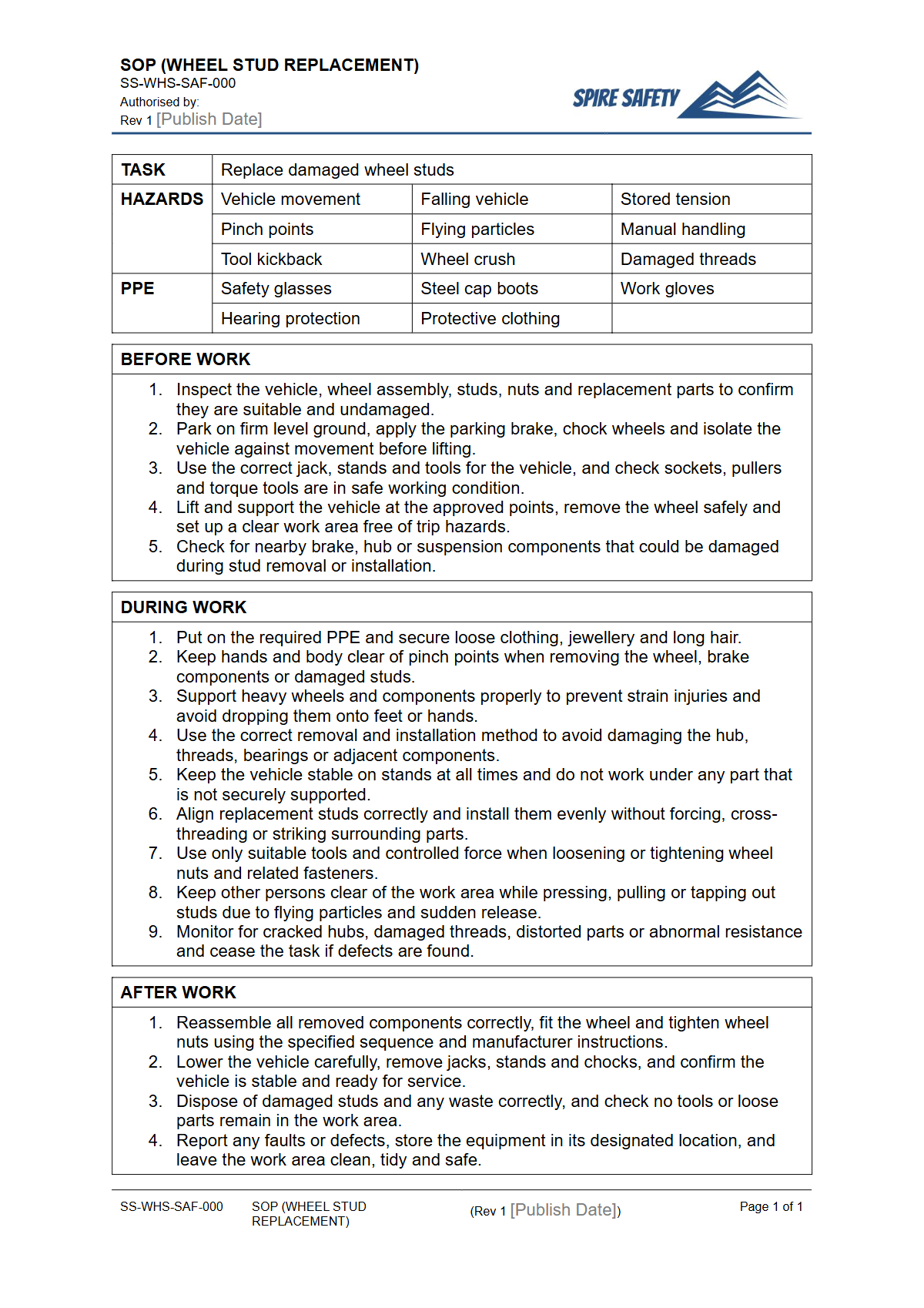
What's included in this Safe Operating Procedure?
- A section for outlining key task details and document control.
- Space to list required Personal Protective Equipment (PPE).
- A pre-operational checks section.
- A step-by-step guide for the procedure, from vehicle preparation to final checks.
- A section for post-task cleanup and reporting.
When to use it
This Safe Operating Procedure should be used whenever a worker is required to replace one or more wheel studs on any vehicle or piece of equipment. This includes both scheduled maintenance and reactive repairs following the discovery of a damaged, broken, or stripped stud during a routine tyre change or vehicle inspection.
It should be readily available in workshops, service bays, and field service vehicles.
Using this SOP ensures that even under pressure, workers follow a safe and methodical process. Many workshops rely on compressed air for impact tools used in this task, so it is important that associated equipment is also covered by a procedure, such as our free Air Compressor SOP, to manage those specific risks.
Who should use it
This SOP is intended for qualified mechanics, tyre fitters, apprentices under supervision, and any other competent personnel tasked with vehicle maintenance and repair. It is also a critical tool for supervisors and managers, who are responsible for ensuring work is performed safely and for providing adequate training and instruction.
Supervisors can use the SOP as a benchmark for observing work practices and verifying competency.
Furthermore, this document serves as crucial evidence during safety reviews and audits. It demonstrates that a formal process is in place to manage the risks associated with wheel maintenance, which is a key area of focus in any WHS compliance auditing process for transport or mobile plant operations.
In some repair scenarios, seized or broken studs may require cutting or the application of heat for removal. Such tasks introduce significant new hazards like hot work, fumes, and fire risk.
These activities must be covered by their own specific procedures, such as an Oxy Acetylene SOP template, and require a separate risk assessment.
Common mistakes
Common mistakes to avoid
- Failing to clean rust and debris from the hub face, wheel mating surface, and stud holes.
- Using an impact wrench to fully tighten lug nuts, leading to over-torquing and stretched studs.
- Forgetting to re-torque the lug nuts after the vehicle has been driven for a short distance (e.g., 50-100 km).
- Neglecting to wear appropriate PPE, especially safety glasses to protect from flying debris or tool slippage.
Legal references
Legal considerations
The following legal requirements may be relevant to this type of work.
- Work Health and Safety Act (Harmonised) — Provides the primary duties for protecting workers and other people from work health and safety risks.
- Work Health and Safety Regulations (Harmonised) — Sets out requirements supporting the management of workplace hazards and risks.
The following codes may be relevant to this type of work.
- Managing WHS Risks Code of Practice — Provides practical guidance on identifying hazards, assessing risks and applying effective controls.
- Work Health and Safety Consultation, Cooperation and Coordination Code of Practice — Provides practical guidance on consulting workers and coordinating with other duty holders.
- Managing the Work Environment and Facilities Code of Practice — Provides practical guidance on safe work environments, workplace facilities and related controls.
Did you know
Torque Sequence Matters
Always tighten lug nuts in a star or criss-cross pattern. This ensures the wheel is seated evenly against the hub, preventing warping of the brake rotor and ensuring consistent clamping force across all studs.
Wheel Detachment Statistics
Investigations by transport authorities have found that improper maintenance, including incorrect torque and failure to re-torque nuts after a short period of driving, are leading causes of wheel detachment incidents for heavy vehicles.
FAQ
Frequently asked questions
01What should be included in a wheel stud replacement SOP?
02Why is a Safe Operating Procedure necessary for changing wheel studs?
03Who is responsible for creating and approving a wheel stud SOP?
04How often should a wheel stud replacement SOP be reviewed?
Share this resource
Free Safe Operating Procedure (Wheel Stud Replacement) Template
Browse Categories
How To Use It
- 1Download and open in Word or PDF.
- 2Replace the placeholders with your business details.
- 3Get it reviewed by a WHS specialist before rollout.
Need it customised?
Our WHS consultants can adapt this template to your site, run a gap analysis, or audit what you already have in place.
Book a Free Consultation WHS consulting servicesor call 1300 156 382
Related templates
- Free Safe Operating Procedure (Wheelchair Brake Check) Template
- Free Safe Operating Procedure (Wheelchair Charging) Template
- Free Safe Operating Procedure (Wheelchair Cushion Clean) Template
- Free Safe Operating Procedure (Wheelchair Footrest) Template
- Free Safe Operating Procedure (Wheelchair Handling) Template
- Free Safe Operating Procedure (Wheelchair Lap Belt) Template