
Free Safe Operating Procedure (Wheel Balancer) Template
Download our free Safe Operating Procedure (Wheel Balancer) Template to document key safety steps. Get your customisable DOCX and PDF template today.
Free Safe Operating Procedure (Wheel Balancer) Template
DOCX • 126 KB + PDF
Updated Oct 2026
No signup required
Purpose of the Free Safe Operating Procedure (Wheel Balancer) Template
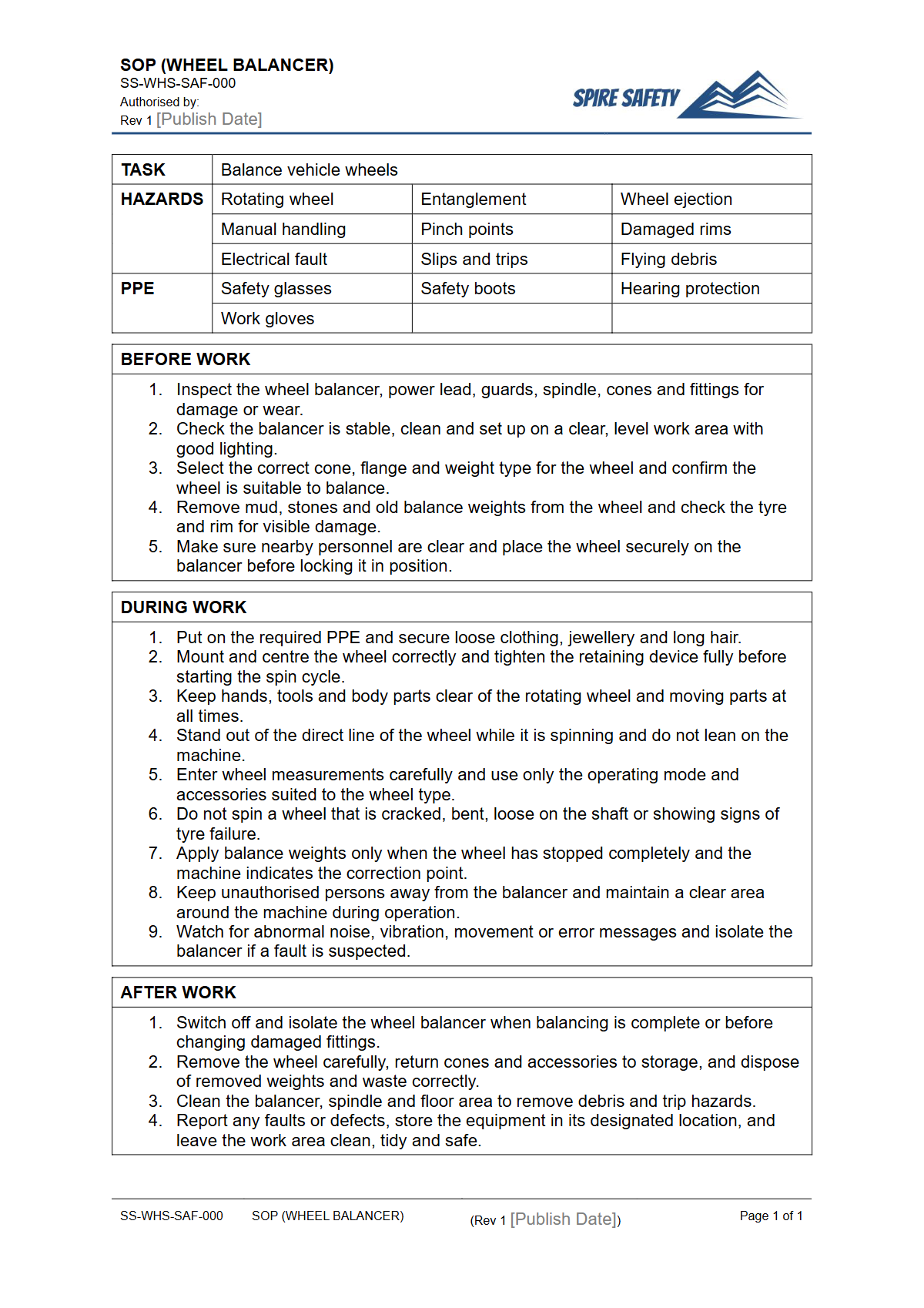
A clear and effective Safe Operating Procedure (SOP) is crucial for managing the risks associated with workshop machinery. This Free Safe Operating Procedure (Wheel Balancer) Template provides a structured foundation for documenting the safe use of wheel balancing equipment in your workplace.
It is designed as a starting point, aligned with Australian WHS principles, to help you formalise safe work methods and meet your health and safety obligations.
The primary purpose of this document is to standardise the operation of wheel balancers to minimise risks to operators and others in the vicinity. By outlining a step-by-step process, it helps control hazards such as rotating parts, pinch points, electrical faults, and manual handling injuries.
Implementing a comprehensive SOP is a key component of effective WHS management systems, ensuring that all workers are aware of the correct procedures, required personal protective equipment (PPE), and emergency responses.
Using this template helps you to systematically identify and control risks, providing a clear reference for worker training and competency assessment. It forms a critical part of your overall safety framework, demonstrating a commitment to proactive risk management for all plant and equipment, much like dedicated air compressor SOPs or procedures for other workshop tools.
Video walkthrough
How to use the Free Safe Operating Procedure (Wheel Balancer) Template
This template is provided in both DOCX and PDF formats for your convenience. The DOCX file is fully editable, allowing you to tailor it precisely to your operational needs. To implement it effectively, follow these steps:
- Download and Review: Start by downloading the template and familiarising yourself with its structure, which covers pre-operational checks, operational steps, and post-operational tasks.
- Conduct a Risk Assessment: Before customising the document, perform a specific risk assessment on the wheel balancer(s) in your workplace. Identify all potential hazards associated with the machine, the environment, and the tasks performed.
- Customise the Content: Edit the DOCX file to include details specific to your workplace. This includes the make and model of your wheel balancer, site-specific hazards, control measures (e.g., guarding, emergency stops), and required PPE.
- Consult with Workers: Involve the operators who use the equipment daily. Their practical knowledge is invaluable for creating a procedure that is both safe and workable. Consultation is a key requirement of WHS legislation.
- Approve and Implement: Once finalised, the SOP should be formally approved by management. Ensure it is readily accessible to all relevant personnel and integrate it into your training program for new and existing employees.
Please note: This is a template only. We have provided a solid framework, but you must customise it to reflect your specific wheel balancer model, workplace environment, and established safety protocols.
If your workshop processes include moving heavy items between stations, you might also require a conveyer system SOP to manage those related risks.
When to use a Wheel Balancer SOP
A Safe Operating Procedure for a wheel balancer should be a living document used consistently throughout your operations. Its application is not a one-time event but an ongoing process.
It should be used as the primary reference document for initial operator training and for conducting regular refresher training sessions to reinforce safe behaviour.
The SOP is also a critical tool during workplace inspections and safety observations. Supervisors can use it as a checklist to verify that correct procedures are being followed.
In the unfortunate event of a near-miss or incident involving the wheel balancer, the SOP provides a baseline for the investigation, helping to identify any procedural gaps or non-compliance. It should be reviewed and updated following any such incident, or whenever there is a change in equipment, processes, or relevant safety regulations.
Establishing clear procedures for all high-risk equipment, including documents like Oxy Acetylene SOPs, creates a more predictable and safer work environment.
Who should use this SOP Template
This template is intended for use by anyone with a responsibility for workplace health and safety in environments where wheel balancers are operated, such as automotive repair shops, tyre retailers, and fleet maintenance workshops. Key users include:
- Persons Conducting a Business or Undertaking (PCBUs): Business owners and directors can use this template to fulfil their primary duty of care to provide and maintain safe systems of work.
- Managers and Supervisors: They are responsible for implementing the SOP on the ground, ensuring operators are trained, and monitoring compliance to maintain a safe working environment. This forms part of the day-to-day safety management of the workshop.
- WHS/HSE Professionals: Safety advisors can use this template as a tool to develop and integrate standardised procedures into the organisation's overall WHS management system.
- Operators: The end-users of the SOP, who must understand and follow the documented steps to perform their work safely and protect themselves and their colleagues from harm.
Ultimately, the SOP is a collaborative document. Its development and ongoing relevance depend on input from all levels of the organisation.
Regular reviews and checks, sometimes supported by external WHS compliance auditing, ensure the procedure remains effective over time.
Common mistakes
Common mistakes to avoid
- Failing to remove stones, mud, or other debris from tyre treads before balancing.
- Wearing loose clothing, untied long hair, or jewellery that can become entangled in rotating parts.
- Not ensuring the protective hood or safety guard is lowered and fully engaged during the spin cycle.
- Using incorrect mounting cones, backplates, or adaptors for the specific wheel being serviced.
Legal references
Legal considerations
The following legal requirements may be relevant to this type of work.
- Work Health and Safety Act (Harmonised) — Provides the primary duties for protecting workers and other people from work health and safety risks.
- Work Health and Safety Regulations (Harmonised) — Sets out requirements supporting the management of workplace hazards and risks.
The following codes may be relevant to this type of work.
- Managing WHS Risks Code of Practice — Provides practical guidance on identifying hazards, assessing risks and applying effective controls.
- Work Health and Safety Consultation, Cooperation and Coordination Code of Practice — Provides practical guidance on consulting workers and coordinating with other duty holders.
- Managing the Work Environment and Facilities Code of Practice — Provides practical guidance on safe work environments, workplace facilities and related controls.
Did you know
The Force of Imbalance
A wheel that is out of balance by just 25 grams travelling at 100 km/h can exert a dynamic force equivalent to a sledgehammer blow on the suspension with every single rotation.
Noise Hazard
Depending on the model, age, and surrounding environment, some wheel balancers can operate at noise levels that require mandatory hearing protection under Australian WHS regulations to prevent hearing loss.
FAQ
Frequently asked questions
01What are the main hazards of using a wheel balancer?
02How often should a wheel balancer SOP be reviewed?
03Is specific training required to use a wheel balancer?
04Can I use this template for any brand of wheel balancer?
Share this resource
Free Safe Operating Procedure (Wheel Balancer) Template
Browse Categories
How To Use It
- 1Download and open in Word or PDF.
- 2Replace the placeholders with your business details.
- 3Get it reviewed by a WHS specialist before rollout.
Need it customised?
Our WHS consultants can adapt this template to your site, run a gap analysis, or audit what you already have in place.
Book a Free Consultation WHS consulting servicesor call 1300 156 382
Related templates
- Free Safe Operating Procedure (Wheel Nut Torquing) Template
- Free Safe Operating Procedure (Wheel Removal) Template
- Free Safe Operating Procedure (Wheel Stud Replacement) Template
- Free Safe Operating Procedure (Wheelchair Brake Check) Template
- Free Safe Operating Procedure (Wheelchair Charging) Template
- Free Safe Operating Procedure (Wheelchair Cushion Clean) Template