
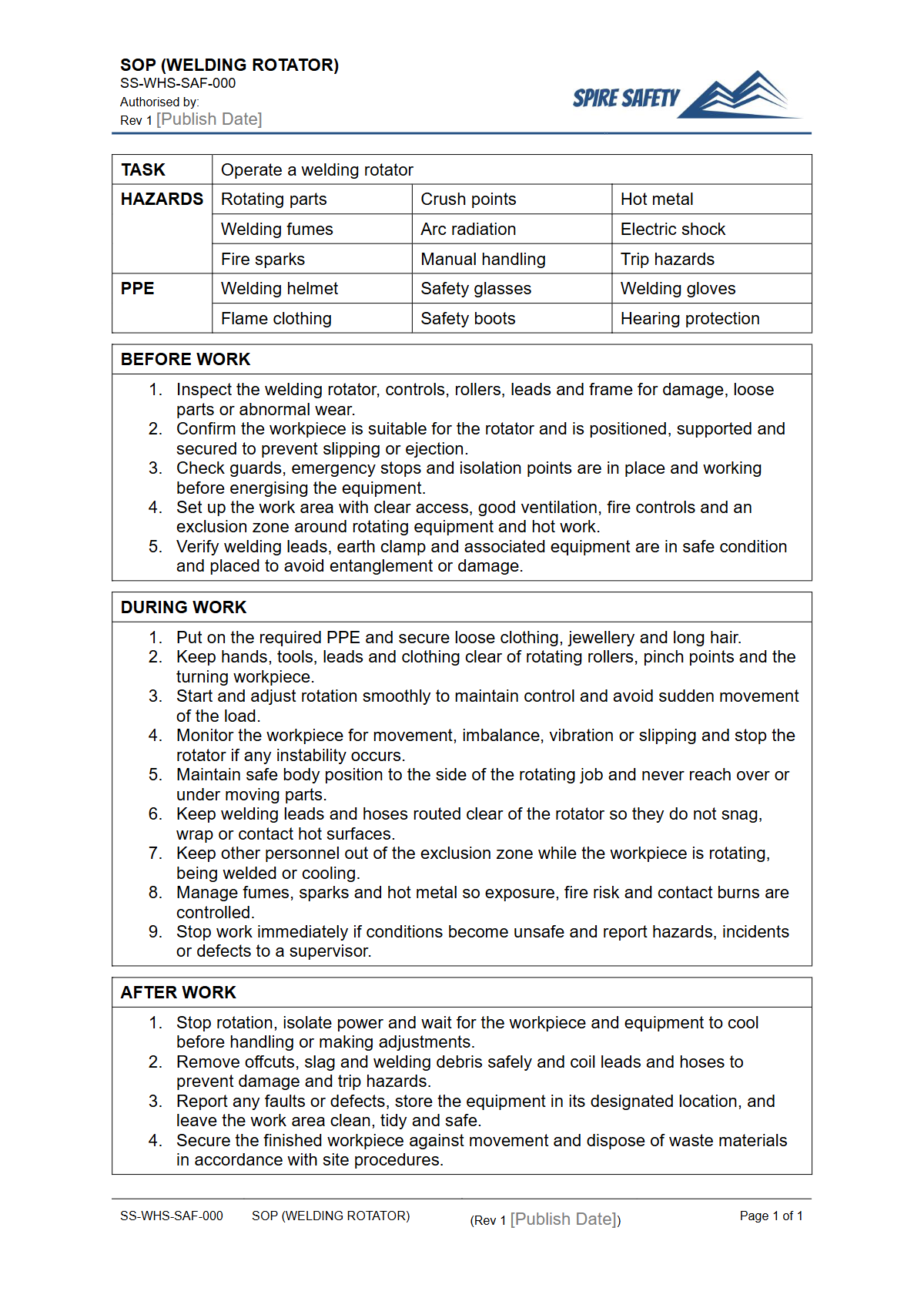
Free Safe Operating Procedure (Welding Rotator) Template
Formalise safety protocols for operating welding rotators with our structured template. Download this free Safe Operating Procedure to start now.
Free Safe Operating Procedure (Welding Rotator) Template
DOCX • 126 KB + PDF
Updated Oct 2026
No signup required
Purpose of the Free Safe Operating Procedure (Welding Rotator) Template
Effectively managing workshop hazards is a core responsibility for any Person Conducting a Business or Undertaking (PCBU). This Free Safe Operating Procedure (Welding Rotator) Template provides a structured starting point for documenting the required safety controls for operating welding rotators.
These machines, while essential for handling large, cylindrical workpieces like pipes and vessels, introduce significant risks, including crushing, entanglement, electrical shock, and burns. A documented SOP ensures that all operators follow a consistent, safe method of work, helping to minimise the risk of injury.
A well-drafted SOP is a key tool in your risk management process. It translates the findings of your risk assessment into practical, step-by-step instructions.
This not only aids in compliance with Australian WHS regulations but also creates a safer, more predictable work environment. It provides a clear reference for training, supervision, and incident investigation.
For related thermal processes, a comprehensive FREE Oxy Acetylene SOP can also formalise your safety protocols.
Video walkthrough
How to use the Free Safe Operating Procedure (Welding Rotator) Template
To get the most value from our Free Safe Operating Procedure (Welding Rotator) Template, download the DOCX file and adapt it to the specific context of your workplace. A generic procedure is not sufficient; you must tailor it to your unique equipment, environment, and tasks.
Consultation is a mandatory part of this process—involve the workers who actually operate the equipment to ensure the procedure is practical and reflects how the work is done.
Follow these steps:
- Download: Choose the DOCX format for easy editing.
- Assess: Conduct a specific risk assessment for your welding rotator and the tasks it's used for. Identify all potential hazards.
- Customise: Populate the template with details specific to your workplace. This includes the make and model of the rotator, required Personal Protective Equipment (PPE), site-specific emergency procedures, and lockdown/tagout steps.
- Consult: Review the draft with operators and health and safety representatives (HSRs). Their feedback is invaluable for creating a workable document. As a business, it is our responsibility to provide a starting point, but you must complete the process.
- Train: Use the finalised SOP as a training tool for all new and existing operators. Ensure everyone understands the steps and the reasoning behind them.
- Implement: Display the SOP near the equipment and integrate it into your daily operations and supervision routines. A robust SOP is a fundamental component of effective WHS management systems.
The document should also detail controls for other equipment commonly used alongside rotators. If your workshop setup includes compressed air systems, consider formalising those procedures with our Free Air Compressor SOP to maintain a consistent safety standard across all plant.
When to use it
A Safe Operating Procedure for a welding rotator should be developed and implemented before the equipment is first used in your workplace. It forms the basis of operator training and competency assessment. The SOP should be a living document, actively used for:
- Inducting and training new employees or contractors.
- Conducting refresher training for existing staff.
- Guiding supervisors on expected safety performance.
- Providing a standard benchmark during safety observations or internal audits.
- Investigating an incident or near miss involving the equipment.
Regular reviews of your SOPs are also crucial. An annual review is good practice, but you must also review and update the document immediately following any changes to the equipment, the work process, or relevant safety legislation.
Formal WHS compliance auditing can help identify gaps in your procedures and ensure they remain effective over time.
Who should use it
This template is designed for anyone responsible for workplace safety and operational management in environments where welding rotators are used, such as fabrication shops, manufacturing plants, and maintenance facilities. Key users include:
- WHS Managers and Advisors: To create and standardise safety documentation as part of the overall WHS management system.
- Workshop Supervisors and Foremen: To train their teams, enforce safe work practices, and conduct pre-start checks.
- Business Owners (PCBUs): To fulfil their primary duty of care by providing a safe system of work.
- Operators: As a clear, step-by-step guide for performing their tasks safely.
Documenting procedures for all high-risk machinery is vital. For other equipment that involves moving parts and potential entanglement hazards, our FREE Conveyer System SOP offers another valuable template.
You can browse our entire free WHS resources library for more templates to support your safety framework.
Common mistakes
Common mistakes to avoid
- Failing to secure the workpiece correctly before starting rotation.
- Neglecting pre-operational checks, especially of emergency stops and guards.
- Operating the rotator with loose clothing, hair, or jewellery that can become entangled.
- Overloading the rotator beyond its specified weight and diameter capacity.
Legal references
Legal considerations
The following legal requirements may be relevant to this type of work.
- Work Health and Safety Act (Harmonised) — Provides the primary duties for protecting workers and other people from work health and safety risks.
- Work Health and Safety Regulations (Harmonised) — Sets out requirements supporting the management of workplace hazards and risks.
The following codes may be relevant to this type of work.
- Managing WHS Risks Code of Practice — Provides practical guidance on identifying hazards, assessing risks and applying effective controls.
- Work Health and Safety Consultation, Cooperation and Coordination Code of Practice — Provides practical guidance on consulting workers and coordinating with other duty holders.
- Managing the Work Environment and Facilities Code of Practice — Provides practical guidance on safe work environments, workplace facilities and related controls.
Did you know
Ergonomic Benefits
Welding rotators not only improve weld quality by allowing continuous welds but also significantly reduce ergonomic risks like awkward postures and manual handling injuries for welders.
Pinch Points
The nip and pinch points between the rollers and the workpiece are the most common cause of serious injuries involving welding rotators, making machine guarding and exclusion zones critical controls.
FAQ
Frequently asked questions
01What is a welding rotator SOP?
02Why are welding rotators a high-risk piece of equipment?
03Who is responsible for creating a Safe Operating Procedure?
04How often should an SOP for a welding rotator be reviewed?
Share this resource
Free Safe Operating Procedure (Welding Rotator) Template
Browse Categories
How To Use It
- 1Download and open in Word or PDF.
- 2Replace the placeholders with your business details.
- 3Get it reviewed by a WHS specialist before rollout.
Need it customised?
Our WHS consultants can adapt this template to your site, run a gap analysis, or audit what you already have in place.
Book a Free Consultation WHS consulting servicesor call 1300 156 382
Related templates
- Free Safe Operating Procedure (Wet Floor Cleaning) Template
- Free Safe Operating Procedure (Wet Sanding) Template
- Free Safe Operating Procedure (Wet Vacuum) Template
- Free Safe Operating Procedure (Wetland Cleanup) Template
- Free Safe Operating Procedure (Wheel Balancer) Template
- Free Safe Operating Procedure (Wheel Nut Torquing) Template