
Free Safe Operating Procedure (Welding Fume Extractor) Template
Manage welding fume risks with our free Safe Operating Procedure (Welding Fume Extractor) template. Download your customisable DOCX and PDF now.
Free Safe Operating Procedure (Welding Fume Extractor) Template
DOCX • 126 KB + PDF
Updated Oct 2026
No signup required
Purpose of the Free Safe Operating Procedure (Welding Fume Extractor) Template
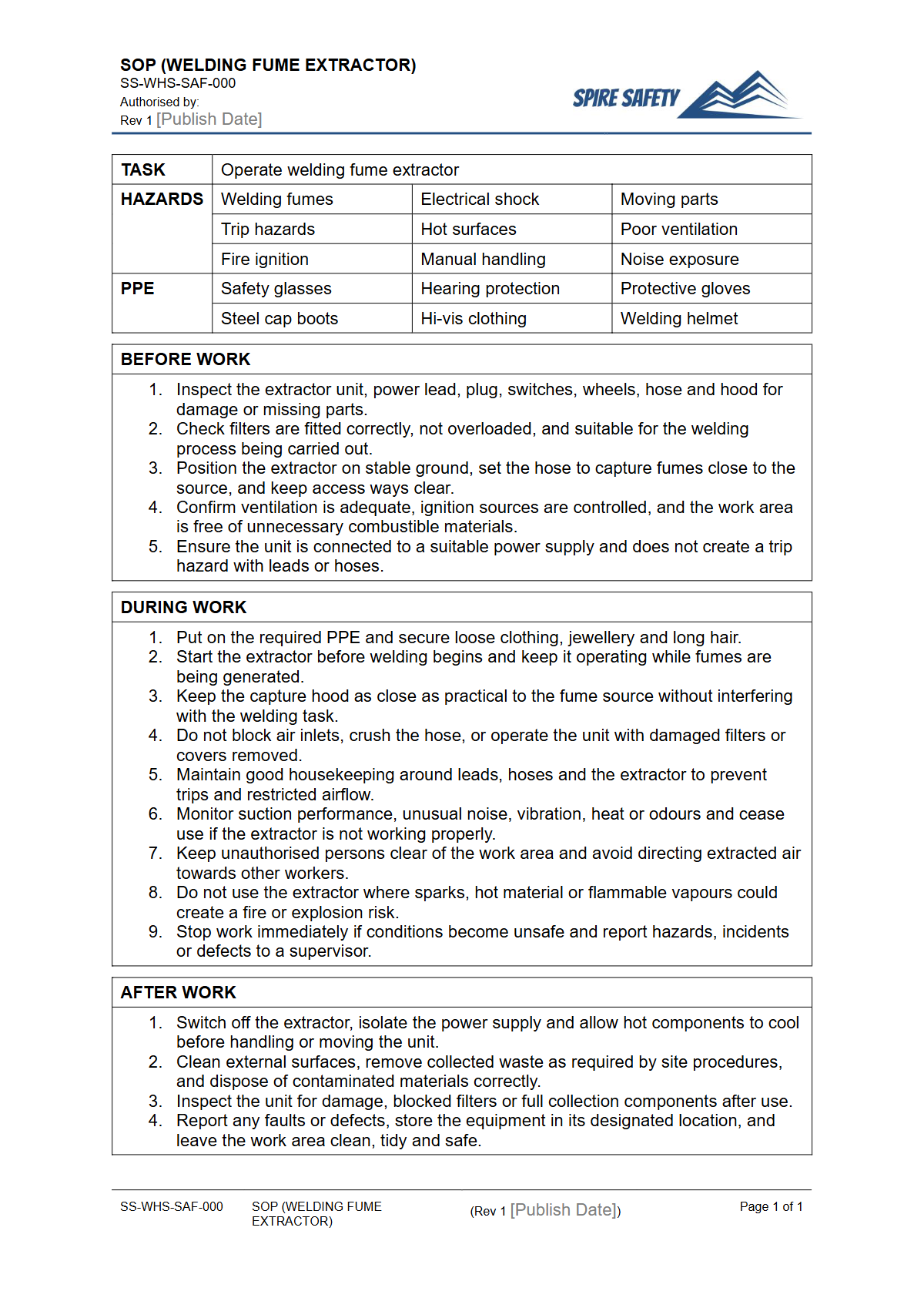
Welding generates airborne contaminants, including metal particulates and gases, that pose a significant risk to worker health. This free Safe Operating Procedure (Welding Fume Extractor) Template provides a structured framework for documenting the safe use of local exhaust ventilation (LEV) systems designed to capture these fumes at the source.
Implementing a clear SOP is a critical step in managing respiratory hazards and demonstrating a commitment to a safe work environment. This document is designed to guide workers through pre-operational checks, safe operation, and post-operational procedures, minimising exposure to harmful substances.
Using a documented procedure helps ensure that all operators use the equipment correctly and consistently, which is vital for the effectiveness of fume extraction. It serves as an essential training tool for new employees and a reference for experienced workers.
Properly controlling welding fumes is a key part of managing workshop hazards, similar to the procedures outlined in our free Oxy Acetylene SOP for gas welding and cutting tasks.
Video walkthrough
How to use the Free Safe Operating Procedure (Welding Fume Extractor) Template
This document is a starting point. To make it effective, you must customise it to reflect the specific equipment and conditions at your site.
Download the DOCX file and adapt the sections to align with your extractor's make and model, the types of welding being performed (e.g., MIG, TIG, stick), and the materials being welded (e.g., mild steel, stainless steel, aluminium).
IMPORTANT: This is a template that we have designed to be customised. You must adapt it to the specific fume extraction equipment, tasks, and environment in your workplace.
We recommend consulting with the welders and supervisors who will be using the equipment to ensure the final SOP is practical and reflects actual site practices. A well-developed SOP is a cornerstone of effective WHS management systems, integrating seamlessly with your broader safety framework.
Key elements to customise:
- Plant & Equipment Details: List the specific make, model, and asset ID of your welding fume extractor(s).
- Pre-start Checks: Modify the checklist to match the manufacturer's recommendations. This should include inspecting hoses for damage, checking filter status indicators, and ensuring the capture hood is clean and undamaged.
- Operating Steps: Detail the correct sequence for positioning the hood (distance and angle from the arc), starting the unit, and monitoring its performance during welding.
- Emergency Procedures: Outline steps to take in case of equipment failure, fire, or personal exposure.
- Maintenance Requirements: Specify the schedule for filter cleaning or replacement and any other routine maintenance tasks as per the manufacturer's guidelines.
When to use a Safe Operating Procedure for a Welding Fume Extractor
An SOP for a welding fume extractor should be used before and during any welding task that produces smoke or fumes. It is not just for the welding itself but for the entire process, from initial setup to shutdown and cleaning.
It is particularly critical in enclosed or poorly ventilated spaces where fume concentration can rapidly reach hazardous levels. This procedure should be a mandatory part of the risk assessment process for any welding job. The principles of pre-use inspection and safe operation are fundamental to all workplace equipment, as seen in other resources like our Free Air Compressor SOP Template.
Who should use this Safe Operating Procedure
This SOP is intended for all personnel involved with welding operations. This includes, but is not limited to, welders, boilermakers, apprentices, supervisors, and maintenance staff responsible for the equipment.
All operators must be trained on the contents of the finalised SOP to ensure they understand the risks and control measures. Supervisors should use the SOP to conduct observations and verify that correct procedures are being followed.
Periodically, a formal review or audit can confirm its ongoing effectiveness, a process often supported by professional WHS compliance auditing services.
Competency in using the equipment safely is paramount. This SOP should form a key part of the training and induction process for any worker required to perform welding.
Documenting procedures for all high-risk plant is a fundamental WHS principle, whether it's for welding equipment or a free Circular Saw SOP for woodworking tasks. For further guidance on developing comprehensive safety documentation, our WHS consulting team can provide expert support tailored to your organisation's needs.
You can also explore our complete free WHS resources library for more templates and guides.
Common mistakes
Common mistakes to avoid
- Positioning the extraction hood too far from the weld, drastically reducing capture efficiency.
- Forgetting to perform daily pre-use checks on hoses, filters, and suction power.
- Using the extractor in a way that creates cross-drafts, pulling fumes across the worker's breathing zone.
- Neglecting regular filter cleaning or replacement, leading to poor performance and motor strain.
Legal references
Legal considerations
The following legal requirements may be relevant to this type of work.
- Work Health and Safety Act (Harmonised) — Provides the primary duties for protecting workers and other people from work health and safety risks.
- Work Health and Safety Regulations (Harmonised) — Sets out requirements supporting the management of workplace hazards and risks.
The following codes may be relevant to this type of work.
- Managing WHS Risks Code of Practice — Provides practical guidance on identifying hazards, assessing risks and applying effective controls.
- Work Health and Safety Consultation, Cooperation and Coordination Code of Practice — Provides practical guidance on consulting workers and coordinating with other duty holders.
- Managing the Work Environment and Facilities Code of Practice — Provides practical guidance on safe work environments, workplace facilities and related controls.
Did you know
A Known Carcinogen
In 2017, the International Agency for Research on Cancer (IARC) reclassified welding fumes from 'possibly carcinogenic' to Group 1, 'carcinogenic to humans'.
Invisible Danger
Many of the most hazardous particles within welding fume are sub-micron in size, making them invisible to the naked eye and easily respirable deep into the lungs.
FAQ
Frequently asked questions
01What is the primary purpose of a welding fume extractor?
02Is a Safe Operating Procedure legally required for a fume extractor in Australia?
03How often should a welding fume extractor and its filters be inspected?
04How close should the extraction hood be to the welding arc?
Share this resource
Free Safe Operating Procedure (Welding Fume Extractor) Template
Browse Categories
How To Use It
- 1Download and open in Word or PDF.
- 2Replace the placeholders with your business details.
- 3Get it reviewed by a WHS specialist before rollout.
Need it customised?
Our WHS consultants can adapt this template to your site, run a gap analysis, or audit what you already have in place.
Book a Free Consultation WHS consulting servicesor call 1300 156 382
Related templates
- Free Safe Operating Procedure (Welding Positioner) Template
- Free Safe Operating Procedure (Welding Rotator) Template
- Free Safe Operating Procedure (Wet Floor Cleaning) Template
- Free Safe Operating Procedure (Wet Sanding) Template
- Free Safe Operating Procedure (Wet Vacuum) Template
- Free Safe Operating Procedure (Wetland Cleanup) Template