
Free Safe Operating Procedure (Weld Purging) Template
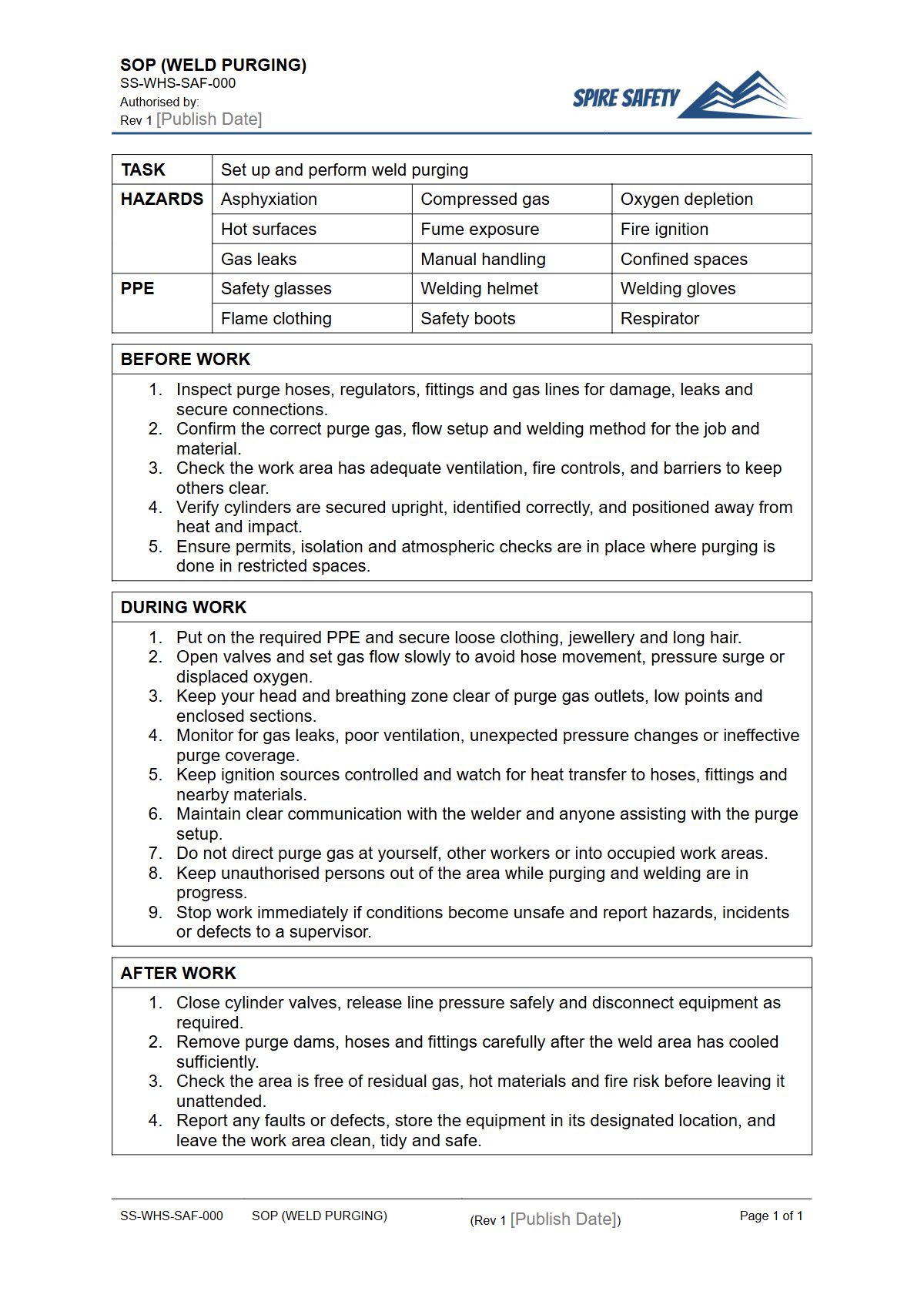
Download our free Safe Operating Procedure (Weld Purging) Template to control risks associated with inert gas purging. Get your customisable DOCX and PDF now.
Free Safe Operating Procedure (Weld Purging) Template
DOCX • 126 KB + PDF
Updated Oct 2026
No signup required
Purpose of the Free Safe Operating Procedure (Weld Purging) Template
Weld purging is a critical process for achieving high-quality, corrosion-resistant welds, particularly on reactive metals like stainless steel, titanium, and nickel alloys. This Free Safe Operating Procedure (Weld Purging) Template provides a structured framework for documenting the required steps, safety controls, and responsibilities for this high-risk task.
The primary purpose of this SOP is to prevent oxidation and contamination of the weld root by displacing oxygen with an inert gas. A documented procedure ensures consistency, quality, and, most importantly, the safety of workers by managing hazards such as asphyxiation, fire, and explosion.
Implementing clear, documented procedures is a fundamental part of a robust safety management system.
By defining the precise methodology, this SOP helps organisations meet their duty of care under Australian WHS laws. It guides workers through the correct sequence of operations, from equipment setup to post-weld inspection, minimising the chance of costly rework or catastrophic failures.
It also standardises the approach across different teams and shifts, ensuring every weld is purged to the same high standard. While this SOP focuses on purging, many fabrication tasks involve other high-risk activities, which also require formalised procedures, such as those covered in our free Oxy Acetylene SOP template.
Video walkthrough
How to use the Free Safe Operating Procedure (Weld Purging) Template
This downloadable document is a template, not a finished procedure. It must be adapted to the specific equipment, materials, and conditions of your workplace. To use it effectively, follow these steps:
- Download: Choose between the DOCX and PDF formats.
- Customise: Edit the document to include site-specific information. This includes details about the types of inert gas used (e.g., Argon, Nitrogen), specific flow rates, types of purge dams or systems, and the models of oxygen analysers in use.
- Consult: Discuss the draft procedure with the welders and supervisors who will be performing the task. Their practical experience is invaluable for creating a procedure that is both safe and workable.
- Approve: Have the final document reviewed and approved by a competent person, such as a supervisor or WHS manager.
- Train: Ensure all relevant workers are trained on the contents of the final SOP. Keep records of this training.
- Review: Schedule regular reviews of the SOP (e.g., annually or after an incident) to ensure it remains current.
Properly maintaining associated equipment is also essential for safety. For example, procedures for pressurised gas systems share common safety principles with those for other compressed air equipment; our Air Compressor SOP template provides a useful reference for this.
Important: This is a template and must be customised to your workplace. We are not responsible for the implementation or compliance of the final document. You must consult with your team and adapt it to reflect your specific machinery, operational environment, and risk profile.
When to use a Weld Purging SOP
A Safe Operating Procedure for weld purging should be developed and implemented whenever the task is performed. It is particularly critical in the following situations:
- Welding of reactive metals: Stainless steels (austenitic, duplex), titanium alloys, and nickel-based alloys require a purged environment to prevent the formation of oxides that degrade mechanical properties and corrosion resistance.
- High-purity applications: Industries like food and beverage, pharmaceutical, and semiconductor manufacturing require perfectly smooth and clean internal weld surfaces to prevent contamination.
- Confined space entry: When purging is conducted inside a tank, vessel, or extensive pipework, the risk of asphyxiation from the inert gas is significantly higher, demanding strict procedural controls.
- Critical structural welds: For applications where weld integrity is paramount for safety and performance, a purged weld root ensures maximum strength and durability.
Who should use this Safe Operating Procedure
This SOP is intended for use by various personnel within an organisation to ensure the task is managed and performed safely:
- Welders and Boilermakers: The primary users who will follow the step-by-step instructions to perform the weld purging process safely.
- Supervisors and Forepersons: Responsible for ensuring workers are trained on the SOP, have the correct equipment, and are following the procedure correctly.
- WHS Managers and Advisors: Use the SOP as a tool for risk assessment, training development, and incident investigation. They ensure the procedure aligns with the company’s overall WHS management systems and legal obligations.
- Engineers and Quality Control Personnel: Refer to the SOP to ensure that welding parameters and outcomes meet technical specifications and quality standards.
For organisations needing broader support with their safety frameworks, Spire Safety offers expert WHS consulting services to help develop and implement effective safety solutions.
Enhancing Safety Through Audits and Reviews
Once implemented, the effectiveness of your Weld Purging SOP should be periodically verified. This can be achieved through workplace inspections and observations to see if the documented procedure matches actual work practices.
Formal audits provide a systematic way to check for compliance and identify opportunities for improvement. These checks ensure the controls are working and the documented procedure remains relevant.
Spire Safety can assist with independent WHS compliance auditing to validate your systems and procedures.
By establishing and refining procedures like this one, your organisation builds a stronger safety culture. For more tools to support your safety management efforts, explore our complete free WHS resources library, which offers a wide range of templates, checklists, and guides.
Common mistakes
Common mistakes to avoid
- Using an incorrect gas flow rate—too high causes turbulence that pulls in air, while too low fails to displace oxygen effectively.
- Failing to properly seal the purge area with dams or tape, allowing oxygen to leak back in during the process.
- Removing the purge gas flow too soon after welding, while the metal is still hot enough to oxidise on contact with air.
- Not using a calibrated oxygen analyser to verify that the target oxygen level has been reached before starting the weld.
Legal references
Legal considerations
The following legal requirements may be relevant to this type of work.
- Work Health and Safety Act (Harmonised) — Provides the primary duties for protecting workers and other people from work health and safety risks.
- Work Health and Safety Regulations (Harmonised) — Sets out requirements supporting the management of workplace hazards and risks.
The following codes may be relevant to this type of work.
- Managing WHS Risks Code of Practice — Provides practical guidance on identifying hazards, assessing risks and applying effective controls.
- Work Health and Safety Consultation, Cooperation and Coordination Code of Practice — Provides practical guidance on consulting workers and coordinating with other duty holders.
- Managing the Work Environment and Facilities Code of Practice — Provides practical guidance on safe work environments, workplace facilities and related controls.
Did you know
Gas Weight Matters
Argon is approximately 40% heavier than air, making it highly effective at displacing oxygen when purging pipework in a flat or downward-sloping position. For vertical or overhead pipes, a lighter gas like helium may be more effective.
Oxygen Threshold
Even a tiny amount of oxygen, as little as 50 parts per million (0.005%), can cause significant heat tint (discolouration) and severely reduce the corrosion resistance of a stainless steel weld.
FAQ
Frequently asked questions
01What is the main risk of incorrect weld purging?
02Can I use nitrogen for purging all types of stainless steel?
03How do you confirm a pipe is sufficiently purged before welding?
04Is an SOP legally required for weld purging in Australia?
Share this resource
Free Safe Operating Procedure (Weld Purging) Template
Browse Categories
How To Use It
- 1Download and open in Word or PDF.
- 2Replace the placeholders with your business details.
- 3Get it reviewed by a WHS specialist before rollout.
Need it customised?
Our WHS consultants can adapt this template to your site, run a gap analysis, or audit what you already have in place.
Book a Free Consultation WHS consulting servicesor call 1300 156 382
Related templates
- Free Safe Operating Procedure (Welder - Stick Arc Operation) Template
- Free Safe Operating Procedure (Welder - TIG Operation) Template
- Free Safe Operating Procedure (Welding Fume Extractor) Template
- Free Safe Operating Procedure (Welding Positioner) Template
- Free Safe Operating Procedure (Welding Rotator) Template
- Free Safe Operating Procedure (Wet Floor Cleaning) Template