
Free Safe Operating Procedure (Weighbridge Ticketing) Template
Download our free Safe Operating Procedure (Weighbridge Ticketing) template to manage vehicle and pedestrian safety during weighing operations.
Free Safe Operating Procedure (Weighbridge Ticketing) Template
DOCX • 126 KB + PDF
Updated Oct 2026
No signup required
Purpose of the Free Safe Operating Procedure (Weighbridge Ticketing) Template
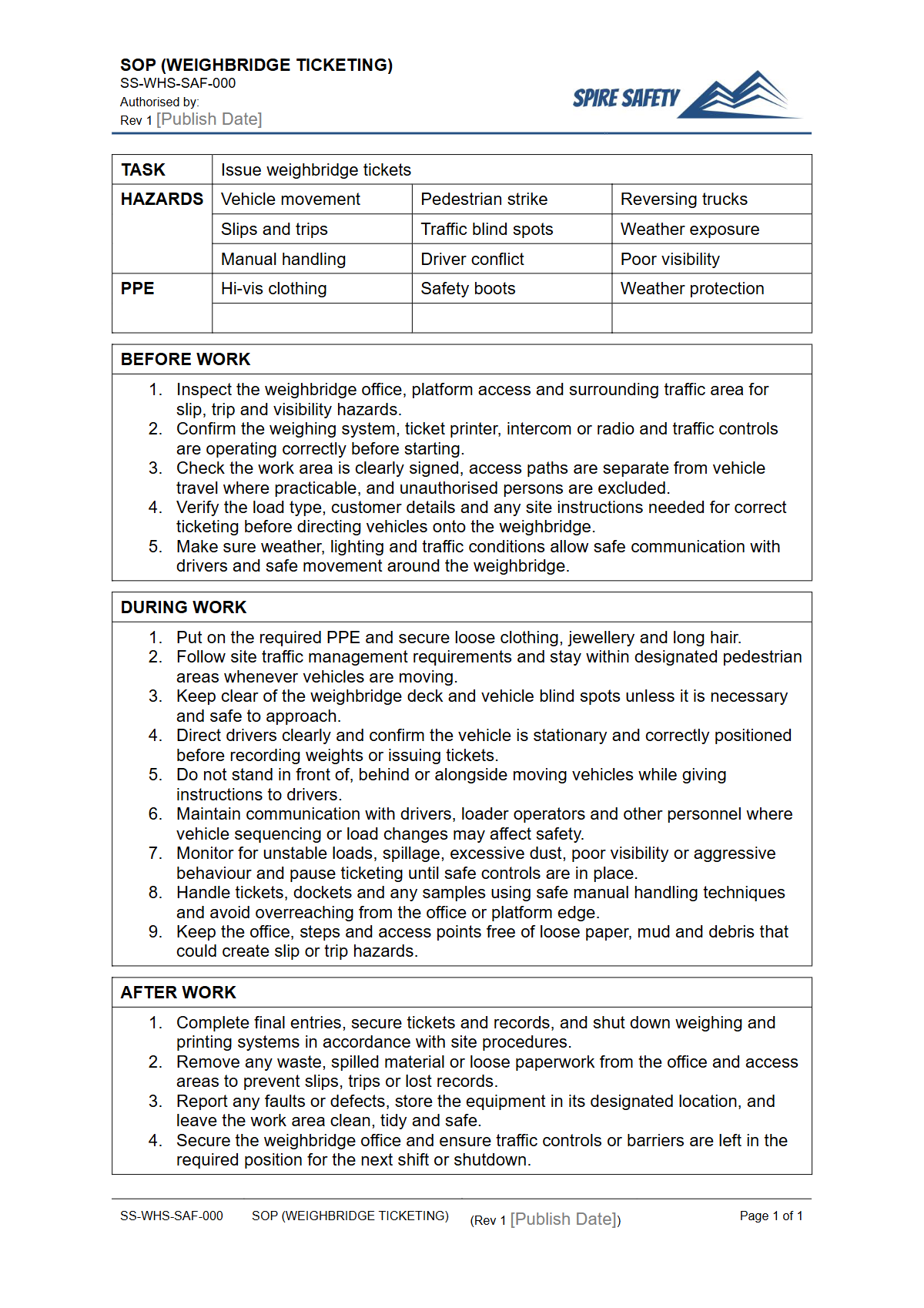
Operating a weighbridge involves significant risks related to vehicle movement, pedestrian interaction, and data management. This Free Safe Operating Procedure (Weighbridge Ticketing) Template provides a structured framework for documenting the required steps to perform the task safely.
It helps organisations establish and communicate clear instructions for operators, drivers, and other personnel, reducing the risk of collisions, falls, and operational errors. By outlining pre-operational checks, safe work methods, and emergency responses, this SOP serves as a critical tool for fulfilling your primary duty of care under Australian WHS laws.
A documented procedure is essential for standardising behaviour and ensuring consistency across all shifts and operators. It acts as a key reference during worker training, inductions, and incident investigations.
Integrating this SOP into your safety framework helps to systematically manage hazards associated with heavy vehicle traffic, such as blind spots, reversing, and interaction with ground staff. For facilities that handle bulk materials, ensuring this procedure aligns with related processes is crucial; our free Conveyer System SOP can provide a useful starting point for adjacent operations.
Video walkthrough
How to use the Free Safe Operating Procedure (Weighbridge Ticketing) Template
This document is a template and must be customised to suit the specific needs of your workplace. To use it effectively, download the DOCX version and carefully review each section.
It is essential to incorporate details specific to your site, including the type of weighbridge (e.g., pit, pitless, portable), the layout of your site, established traffic flow patterns, and the types of vehicles that use the facility. Update the procedure to reflect your specific communication methods (e.g., two-way radio, traffic lights, hand signals) and the software used for ticketing.
Important: This is a starting point, not a finished document. We cannot guarantee it covers every hazard unique to your operation.
You must consult with your weighbridge operators, drivers, supervisors, and a health and safety representative during the customisation process. This consultation ensures the final SOP is practical, comprehensive, and accurately reflects how the work is, and should be, done safely on your site. Once finalised, the SOP should be integrated into your broader comprehensive WHS management systems.
When to use this Safe Operating Procedure
A Safe Operating Procedure for weighbridge ticketing should be used consistently as the standard for all weighing activities. It is not just a document to be filed away; it is an active tool for daily risk management.
It should be readily accessible to all relevant personnel, particularly weighbridge operators. This SOP forms the basis for worker training, competency assessments, and site inductions for new employees and contractors.
The procedure should be reviewed and reinforced during toolbox talks, especially if there have been any near misses or changes to the work environment. In agricultural settings, where equipment like grain handlers and tractors frequent the weighbridge, integrating this SOP with other machinery guides, such as our free Grain Drill SOP, ensures a holistic approach to farm safety.
Who should use this Safe Operating Procedure
This SOP is intended for a range of personnel within an organisation. The primary users are the weighbridge operators who perform the task daily.
It is also essential for truck drivers and mobile plant operators who must understand the site rules for approaching, mounting, and exiting the weighbridge. Supervisors and managers are responsible for implementing the SOP, ensuring workers are trained on its contents, and monitoring compliance.
Furthermore, WHS managers and safety officers will use this document as a key part of their risk assessments, training programs, and for conducting regular WHS compliance auditing to verify that safe practices are being followed. For sites with varied heavy equipment, operators of machinery covered by a Telehandler SOP should also be familiar with weighbridge protocols.
Ultimately, anyone whose work requires them to be on or near a weighbridge should be familiar with the procedures outlined in this document. Creating a culture of safety around these critical traffic control points requires everyone to understand their roles and responsibilities. For more templates and safety resources, you can browse our complete free WHS resources library.
Common mistakes
Common mistakes to avoid
- Failing to establish and enforce clear pedestrian exclusion zones around the weighbridge.
- Neglecting a regular schedule for weighbridge inspection, calibration, and maintenance.
- Using a generic template without customising it for the site's specific traffic flow, vehicle types, and communication protocols.
- Poor or inconsistent communication between weighbridge operators and vehicle drivers, leading to confusion and unsafe movements.
Legal references
Legal considerations
The following legal requirements may be relevant to this type of work.
- Work Health and Safety Act (Harmonised) — Provides the primary duties for protecting workers and other people from work health and safety risks.
- Work Health and Safety Regulations (Harmonised) — Sets out requirements supporting the management of workplace hazards and risks.
The following codes may be relevant to this type of work.
- Managing WHS Risks Code of Practice — Provides practical guidance on identifying hazards, assessing risks and applying effective controls.
- Work Health and Safety Consultation, Cooperation and Coordination Code of Practice — Provides practical guidance on consulting workers and coordinating with other duty holders.
- Managing the Work Environment and Facilities Code of Practice — Provides practical guidance on safe work environments, workplace facilities and related controls.
Did you know
Accuracy is Key
Modern electronic weighbridges can be accurate to within 0.1% of their capacity. This precision is vital not only for commercial purposes but also for safety, helping to prevent dangerous vehicle overloads.
Traffic Flow
A well-designed traffic management plan for a weighbridge area can reduce vehicle turnaround time by over 30%, which significantly improves site efficiency and reduces congestion-related risks.
FAQ
Frequently asked questions
01What are the main hazards at a weighbridge?
02Is a weighbridge SOP a legal requirement in Australia?
03How often should we review our Weighbridge Ticketing SOP?
04Can this template be used for a public weighbridge?
Share this resource
Free Safe Operating Procedure (Weighbridge Ticketing) Template
Browse Categories
How To Use It
- 1Download and open in Word or PDF.
- 2Replace the placeholders with your business details.
- 3Get it reviewed by a WHS specialist before rollout.
Need it customised?
Our WHS consultants can adapt this template to your site, run a gap analysis, or audit what you already have in place.
Book a Free Consultation WHS consulting servicesor call 1300 156 382
Related templates
- Free Safe Operating Procedure (Weld Post Heating) Template
- Free Safe Operating Procedure (Weld Preheating) Template
- Free Safe Operating Procedure (Weld Purging) Template
- Free Safe Operating Procedure (Welder - Stick Arc Operation) Template
- Free Safe Operating Procedure (Welder - TIG Operation) Template
- Free Safe Operating Procedure (Welding Fume Extractor) Template