
Free Safe Operating Procedure (Weld Post Heating) Template
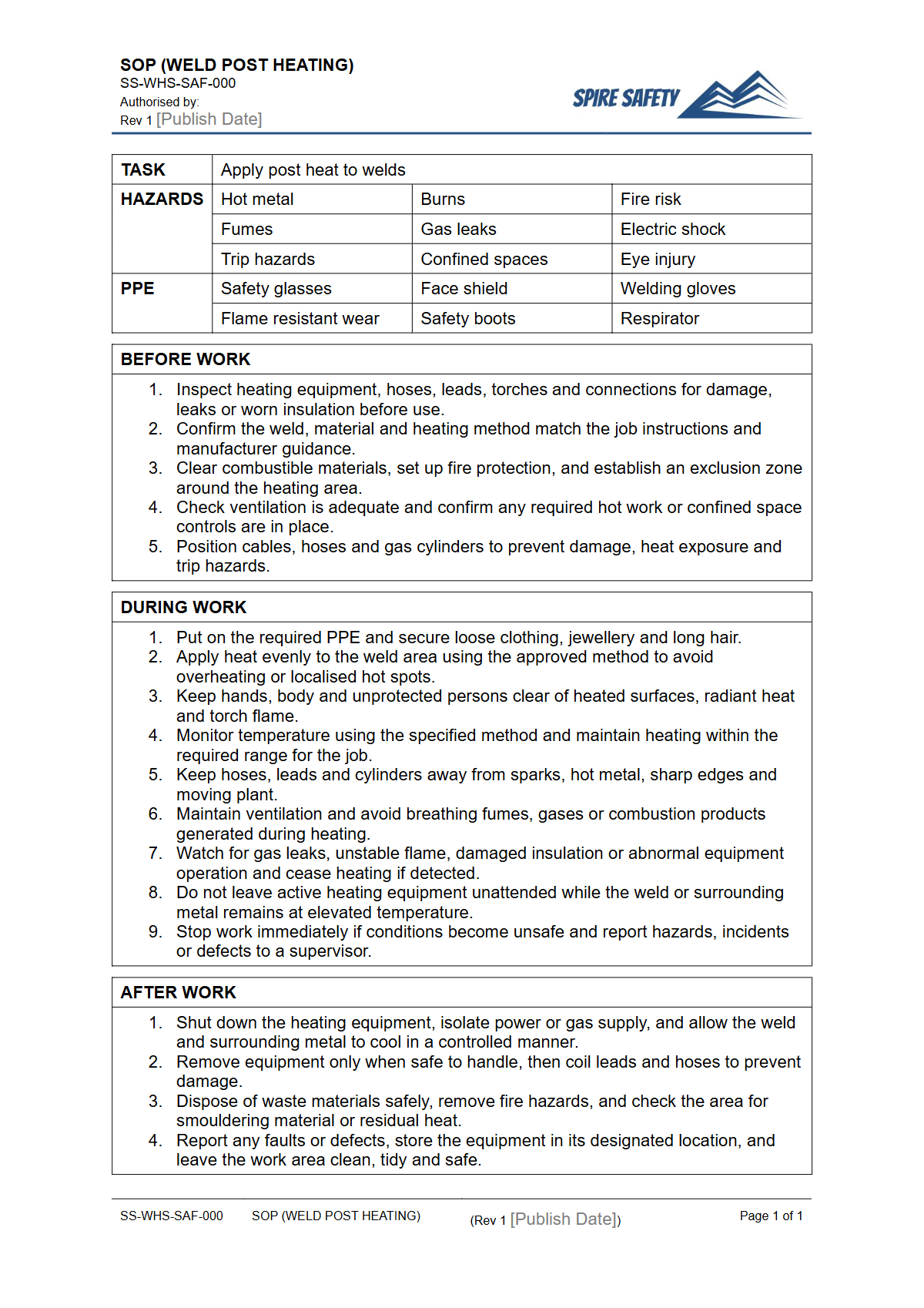
Download our free Safe Operating Procedure for weld post heating to manage thermal risks. This customisable template helps you formalise safety controls.
Free Safe Operating Procedure (Weld Post Heating) Template
DOCX • 126 KB + PDF
Updated Oct 2026
No signup required
Purpose of the Free Safe Operating Procedure (Weld Post Heating) Template
This Free Safe Operating Procedure (Weld Post Heating) Template provides a structured framework for documenting the safety requirements of post weld heat treatment (PWHT). The primary purpose of weld post heating is to control the cooling of a weldment to relieve residual stresses, improve ductility, and reduce the risk of issues like brittle fracture or stress corrosion cracking.
A formal SOP ensures this high-risk process is performed consistently and safely, every time.
By using this template, you can clearly define the required equipment, personal protective equipment (PPE), emergency procedures, and step-by-step instructions for workers. It serves as a critical tool for training, risk management, and demonstrating due diligence in managing workplace hazards associated with thermal processes.
Formalising your procedure helps standardise safe work practices, reduce the chance of human error, and improve the overall metallurgical quality and structural integrity of the final product.
Video walkthrough
How to use the Free Safe Operating Procedure (Weld Post Heating) Template
This template is designed as a comprehensive starting point. To implement it effectively, you must adapt it to the specific context of your workplace, including the types of metals being treated, the heating equipment used, and your unique site conditions.
Start by downloading the DOCX file and reviewing its contents with the workers and supervisors who will be performing the task.
In consultation with your team, edit the document to include details such as:
- Specific heating and cooling rates required by the relevant welding code or engineering specification.
- The make and model of heating equipment (e.g., induction heaters, resistance blankets, gas-fired furnaces).
- Emergency shutdown and first aid procedures for thermal burns or electrical shock.
- Site-specific roles, responsibilities, and required competencies.
- Details of temperature monitoring and recording methods.
An SOP is a critical document within your overall safety framework. Integrating this procedure into your broader WHS management systems ensures it is subject to regular review, continuous improvement, and effective record-keeping.
Important: This is a template only. We are not familiar with your specific machinery, site, or personnel.
You MUST customise this document to reflect the actual hazards and control measures relevant to your workplace before use.
When to use it
A Safe Operating Procedure for weld post heating should be used whenever a welding specification or engineering requirement mandates PWHT. This is common for certain materials and applications to ensure the mechanical properties of the weld and heat-affected zone (HAZ) are restored.
It is particularly critical for thick-section carbon steels, high-strength low-alloy (HSLA) steels, and chrome-moly steels used in pressure vessels, piping, and structural fabrication.
This procedure should be readily available at the point of work before any heating activities commence. It forms part of the pre-start risk assessment and should be referenced during toolbox talks.
While this document focuses on post-heating, many of the safety principles apply to other hot work, such as those covered in a FREE Oxy Acetylene SOP, which also involves managing thermal hazards, gas cylinders, and ignition sources.
Who should use it
This SOP is intended for all personnel involved in the weld post heating process. This includes, but is not limited to:
- Welders and Boilermakers
- Heat Treatment Technicians
- Supervisors and Foremen
- Workshop Managers
- WHS Officers and Advisors
All individuals must be trained on the contents of the final, customised SOP to ensure they understand the risks and required controls. Supervisors should use the document to verify that work is being conducted as planned, which can be a key part of internal verification or more formal WHS compliance auditing. Competency for this task must be verified and recorded before any worker is authorised to perform it independently.
In a typical fabrication workshop, workers may be exposed to multiple hazards. Safety procedures for other equipment are just as important.
For example, ensure workers are also trained using the FREE Circular Saw SOP Template for material preparation tasks.
Similarly, a workshop environment often relies on compressed air for tooling and cleaning. Ensure your procedures cover this by implementing an Air Compressor SOP to manage the associated risks of high-pressure air and equipment failure.
You can find more templates like this in our free WHS resources library to build a comprehensive safety system for your organisation.
Common mistakes
Common mistakes to avoid
- Using the template without customising it for site-specific equipment and materials.
- Applying incorrect heating or cooling rates, which can damage the material's properties.
- Failing to adequately secure and insulate the heating area, leading to burn risks and inefficient heating.
- Neglecting to monitor and document temperatures accurately throughout the entire cycle.
Legal references
Legal considerations
The following legal requirements may be relevant to this type of work.
- Work Health and Safety Act (Harmonised) — Provides the primary duties for protecting workers and other people from work health and safety risks.
- Work Health and Safety Regulations (Harmonised) — Sets out requirements supporting the management of workplace hazards and risks.
The following codes may be relevant to this type of work.
- Managing WHS Risks Code of Practice — Provides practical guidance on identifying hazards, assessing risks and applying effective controls.
- Work Health and Safety Consultation, Cooperation and Coordination Code of Practice — Provides practical guidance on consulting workers and coordinating with other duty holders.
- Managing the Work Environment and Facilities Code of Practice — Provides practical guidance on safe work environments, workplace facilities and related controls.
Did you know
A Matter of Integrity
Failing to correctly perform post weld heat treatment can leave high levels of residual stress in a component, making it significantly more susceptible to brittle fracture, even when not under load.
Reading the Rainbow
While modern equipment uses thermocouples for accuracy, welders have traditionally estimated steel temperature by its colour. A dull red glow indicates around 600°C, while a bright cherry red is closer to 800°C.
FAQ
Frequently asked questions
01What is post weld heat treatment (PWHT)?
02Why is a Safe Operating Procedure for weld post heating important?
03What hazards are associated with weld post heating?
04Can I use this template for pre-heating as well?
Share this resource
Free Safe Operating Procedure (Weld Post Heating) Template
Browse Categories
How To Use It
- 1Download and open in Word or PDF.
- 2Replace the placeholders with your business details.
- 3Get it reviewed by a WHS specialist before rollout.
Need it customised?
Our WHS consultants can adapt this template to your site, run a gap analysis, or audit what you already have in place.
Book a Free Consultation WHS consulting servicesor call 1300 156 382
Related templates
- Free Safe Operating Procedure (Weld Preheating) Template
- Free Safe Operating Procedure (Weld Purging) Template
- Free Safe Operating Procedure (Welder - Stick Arc Operation) Template
- Free Safe Operating Procedure (Welder - TIG Operation) Template
- Free Safe Operating Procedure (Welding Fume Extractor) Template
- Free Safe Operating Procedure (Welding Positioner) Template