
Free Safe Operating Procedure (Weed Spraying Setup) Template
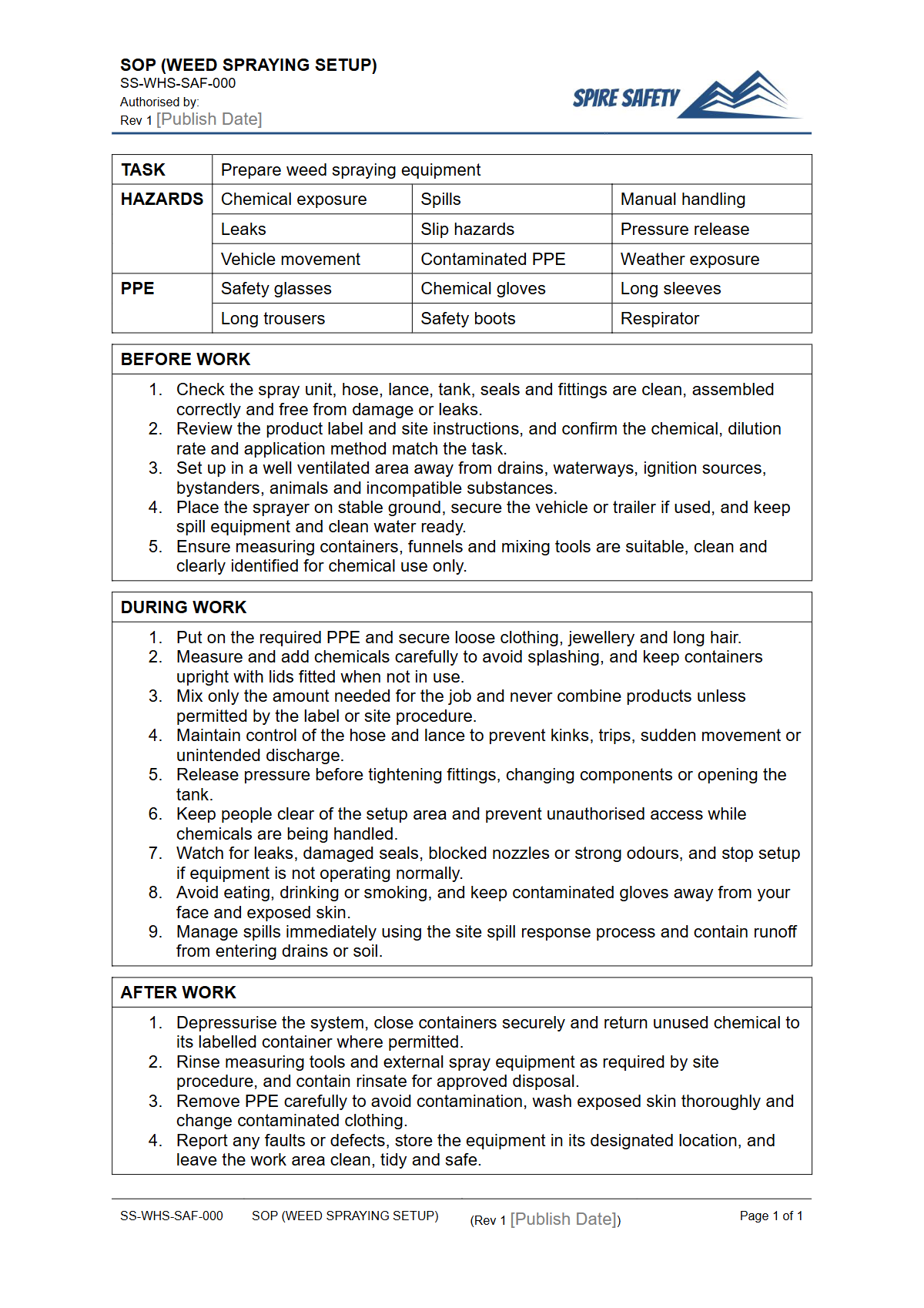
Download our free Safe Operating Procedure (Weed Spraying Setup) Template to establish a clear, safe process for herbicide application.
Free Safe Operating Procedure (Weed Spraying Setup) Template
DOCX • 126 KB + PDF
Updated Oct 2026
No signup required
Purpose of the Free Safe Operating Procedure (Weed Spraying Setup) Template
This Free Safe Operating Procedure (Weed Spraying Setup) Template provides a structured framework for documenting the safe use of weed spraying equipment in your workplace. Its purpose is to help Persons Conducting a Business or Undertaking (PCBUs) and their workers identify and control risks associated with setting up, operating, and maintaining herbicide application machinery.
Key hazards include chemical exposure (inhalation, skin contact), manual handling injuries during setup, equipment malfunction, and environmental contamination. By implementing a clear SOP, you create a consistent, repeatable process that minimises risks and supports your WHS duties.
A well-defined SOP is a critical tool for managing tasks involving agricultural machinery. While this document focuses on weed spraying, the principles of risk management and procedural clarity are universal.
For related tasks, consider using a specific document like our free Spreader SOP template to ensure all equipment is covered by documented safe work processes.
Video walkthrough
How to use the Free Safe Operating Procedure (Weed Spraying Setup) Template
To effectively implement this SOP, download the DOCX or PDF file and integrate it into your safety management system. The process involves several key steps:
- Customise: Review every section and adapt the content to reflect your specific workplace. This includes detailing the exact make and model of your weed spraying equipment, the specific chemicals used, site-specific hazards (e.g., terrain, proximity to waterways), and your organisation's emergency contacts.
- Consult: Discuss the draft SOP with the workers who will be performing the task. Their direct experience is invaluable for identifying practical risks and effective control measures that might otherwise be overlooked.
- Train: Use the finalised SOP as a training tool for all operators. Ensure every worker reads, understands, and demonstrates competence in following the procedure before they are authorised to perform the task unsupervised.
- Implement and Review: Make the SOP readily accessible at the point of work. Schedule regular reviews (e.g., annually, or after an incident) to ensure it remains current and effective.
Important: This document is a template only. It is not a complete, ready-to-use safety document.
You must customise it to suit the unique circumstances of your business and operating environment to ensure it is useful. An SOP is a fundamental component of robust WHS management systems, providing the practical, on-the-ground instructions that bring safety policies to life.
What is covered in the template?
Our weed spraying setup SOP template provides a comprehensive starting point, with sections dedicated to:
- Required Personal Protective Equipment (PPE): Outlines the necessary PPE based on risk assessment, referencing the chemical's Safety Data Sheet (SDS).
- Pre-Operational Checks: A step-by-step checklist to ensure the equipment is safe to use before the task begins, covering hoses, nozzles, pumps, and safety guards.
- Operating Procedure: Detailed instructions for the safe operation of the equipment, including chemical mixing, application techniques, and monitoring for drift.
- Post-Operation and Cleaning: Procedures for safely shutting down, decontaminating, and storing the equipment to prevent residue buildup and environmental harm.
- Emergency Procedures: Clear instructions for responding to spills, chemical exposure, or equipment failure.
Thorough procedures are essential for demonstrating due diligence and are often scrutinised during regular WHS compliance audits. Ensuring your documentation is detailed and site-specific is a key part of this process.
When to use it
A Safe Operating Procedure for weed spraying should be used as a primary reference document in several scenarios. It should be consulted before every task to ensure all pre-operational checks are completed and safety controls are in place.
It serves as the foundational text for training new employees or for workers taking on the task for the first time. The SOP also provides a benchmark for performance during routine supervision and competency assessments.
Furthermore, in the event of a near miss or incident, the SOP becomes a critical document for investigation to determine if procedures were followed and whether they need to be improved. The principles of when to use an SOP apply to all machinery; for other landscaping or ground preparation tasks, you might also require documents like our free Trencher SOP.
Who should use it
This SOP is intended for a range of personnel within an organisation. The primary users are the operators themselves—the workers who physically set up and use the weed spraying equipment.
They rely on it for step-by-step guidance on performing their tasks safely. Supervisors and managers must also be intimately familiar with the SOP to effectively oversee work, conduct safety observations, and enforce safe work practices.
Additionally, WHS officers or safety managers will use this template as a basis for developing their organisation's official documentation. For complex environments or if you lack internal expertise, engaging with specialist WHS consulting services can help ensure your procedures are comprehensive and aligned with best practice.
Ultimately, the PCBU holds the primary duty of care and is responsible for ensuring safe systems of work, like SOPs, are developed, implemented, and maintained. The use of clear, documented procedures extends to all agricultural tasks, including seeding, which can be managed with resources like our free Planter SOP. If you need other templates, you can browse our complete free WHS resources library for a wide range of documents covering various tasks and equipment.
Common mistakes
Common mistakes to avoid
- Using the wrong PPE for the specific chemical being handled.
- Spraying in unsuitable weather conditions (e.g., high wind, or when rain is imminent).
- Failing to properly clean and decontaminate equipment after use, leading to cross-contamination or equipment failure.
- Inadequate storage of chemicals, such as leaving them in direct sunlight or unsecured areas.
Legal references
Legal considerations
The following legal requirements may be relevant to this type of work.
- Work Health and Safety Act (Harmonised) — Provides the primary duties for protecting workers and other people from work health and safety risks.
- Work Health and Safety Regulations (Harmonised) — Sets out requirements supporting the management of workplace hazards and risks.
The following codes may be relevant to this type of work.
- Managing WHS Risks Code of Practice — Provides practical guidance on identifying hazards, assessing risks and applying effective controls.
- Work Health and Safety Consultation, Cooperation and Coordination Code of Practice — Provides practical guidance on consulting workers and coordinating with other duty holders.
- Managing the Work Environment and Facilities Code of Practice — Provides practical guidance on safe work environments, workplace facilities and related controls.
Did you know
Chemical Drift
Herbicide spray drift can travel several kilometres under the wrong weather conditions, potentially damaging non-target crops, native vegetation, and posing a risk to public health.
PPE Degradation
Not all glove materials are suitable for all chemicals. Some herbicides can degrade certain types of rubber or plastic, compromising protection, so always check the SDS for correct PPE selection.
FAQ
Frequently asked questions
01What should be included in a weed spraying setup SOP?
02Is training required for using weed spraying equipment?
03How often should a Safe Operating Procedure for weed spraying be reviewed?
04Do I need a Safety Data Sheet (SDS) for the chemicals I use?
Share this resource
Free Safe Operating Procedure (Weed Spraying Setup) Template
Browse Categories
How To Use It
- 1Download and open in Word or PDF.
- 2Replace the placeholders with your business details.
- 3Get it reviewed by a WHS specialist before rollout.
Need it customised?
Our WHS consultants can adapt this template to your site, run a gap analysis, or audit what you already have in place.
Book a Free Consultation WHS consulting servicesor call 1300 156 382
Related templates
- Free Safe Operating Procedure (Weighbridge Load Check) Template
- Free Safe Operating Procedure (Weighbridge Operation) Template
- Free Safe Operating Procedure (Weighbridge Ticketing) Template
- Free Safe Operating Procedure (Weld Post Heating) Template
- Free Safe Operating Procedure (Weld Preheating) Template
- Free Safe Operating Procedure (Weld Purging) Template