
Free Safe Operating Procedure (Weighbridge Load Check) Template
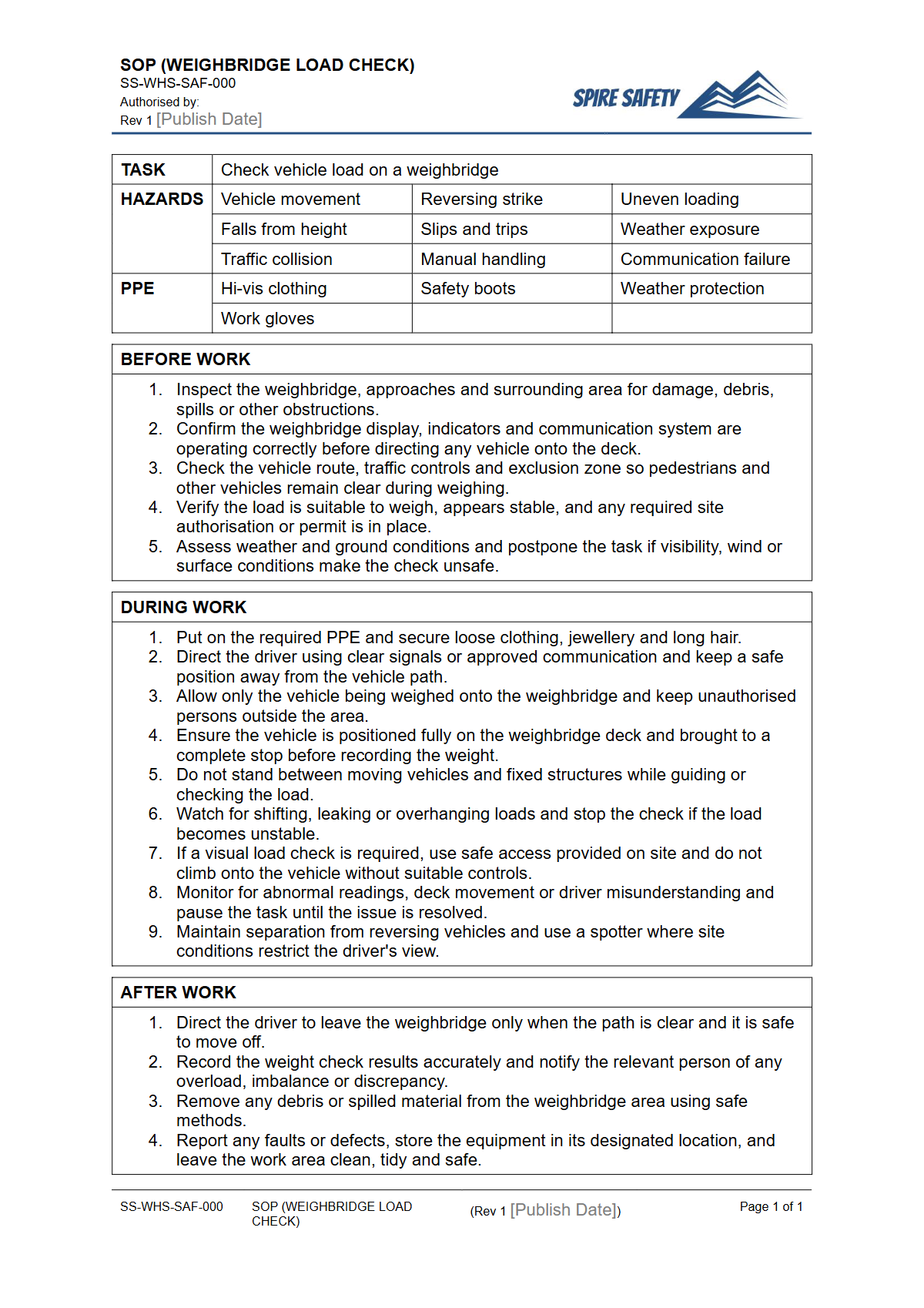
Download our free Safe Operating Procedure for weighbridge load checks. This template helps formalise your process for verifying vehicle weights and ensuring load security.
Free Safe Operating Procedure (Weighbridge Load Check) Template
DOCX • 126 KB + PDF
Updated Oct 2026
No signup required
Purpose of the Free Safe Operating Procedure (Weighbridge Load Check) Template
Effectively managing vehicle loads is a critical safety and compliance function in many Australian industries, from transport and logistics to construction and agriculture. This Free Safe Operating Procedure (Weighbridge Load Check) Template provides a structured starting point for documenting the process of weighing vehicles to verify load mass and ensure it complies with legal limits and company policy.
Using a formal SOP helps prevent overloading, which can lead to vehicle instability, brake failure, and increased risk of road incidents. It also supports compliance with Australia's Chain of Responsibility (CoR) laws, which place accountability on all parties in the supply chain for breaches of road transport law.
A documented procedure ensures that weighbridge operations are performed consistently and safely by all personnel. It outlines the required steps, potential hazards, and control measures needed to protect workers and the public.
Integrating this procedure into your organisation's broader safety framework is a key step in managing operational risks. A robust safety framework forms the backbone of proactive risk management, and formalising procedures like this is a fundamental component of effective WHS management systems.
Video walkthrough
How to use the Free Safe Operating Procedure (Weighbridge Load Check) Template
This template is provided as a fully editable DOCX file and a print-ready PDF. To use it, download the document and adapt it to the specific requirements of your workplace.
It is essential that you customise this template to reflect your site-specific equipment, vehicle types, materials handled, and existing safety protocols. Generic procedures are not sufficient to ensure safety or compliance.
Important: We have created this template as a guide. Before use, you must consult with your workers and other relevant stakeholders to ensure it is practical and effective for your business.
The procedure should be reviewed and signed off by a competent person within your organisation. This might involve tasks associated with other equipment; for example, if loads are adjusted on-site, you may need to reference procedures for other plant, such as those covered in our free Telehandler SOP template.
Key customisation areas include:
- Specific weighbridge make, model, and operating instructions.
- Types of vehicles and configurations being weighed (e.g., B-doubles, semi-trailers, rigid trucks).
- Procedures for recording tare, gross, and net weights.
- Actions to be taken for non-compliant (overweight or underloaded) vehicles.
- Emergency procedures, such as dealing with spills or vehicle breakdowns on the weighbridge.
- Personal Protective Equipment (PPE) requirements for operators and drivers.
When to use it
A Weighbridge Load Check SOP should be applied whenever a vehicle's mass needs to be officially verified. This typically occurs at key transition points in the supply chain to ensure safety and regulatory compliance.
Common scenarios include weighing trucks before they leave a depot, quarry, or farm to enter public roads, and verifying incoming loads at a receiving facility, such as a warehouse or processing plant. The procedure is relevant across numerous sectors, including transport, logistics, mining, waste management, and agriculture.
It is also a vital tool for managing bulk materials. In facilities that use automated loading systems, regular weighbridge checks confirm that the machinery is dispensing the correct quantities.
This is particularly relevant where materials are moved via fixed plant; a process that should be governed by its own procedure, such as our FREE Conveyer System SOP Template. Random checks can also be incorporated into your safety system to audit compliance and deter deliberate overloading.
Who should use it
This Safe Operating Procedure is primarily for Weighbridge Operators, who are responsible for the day-to-day execution of the weighing process. However, other personnel have a role in its implementation and oversight.
Supervisors and Logistics Managers should use the SOP to train staff, set performance expectations, and ensure the procedure is being followed correctly. WHS Advisors and Compliance Managers will use it as part of the site's overall safety management system and as a reference during safety audits.
Training is essential for all users to ensure they understand not just the steps, but the reasoning behind them, including the significant risks of non-compliance. Verifying that these documented procedures are consistently followed in practice is a core part of due diligence, often assessed during WHS compliance auditing. Drivers should also be made aware of the procedure so they know what to expect when arriving at the weighbridge and what their responsibilities are during the process.
The SOP should also consider interactions with drivers of other heavy equipment on site. If materials are being loaded or unloaded by earthmoving equipment, those operators must also be aware of the weighbridge protocols.
For instance, an operator loading a truck with material from a stockpile needs to follow their own equipment procedures, like those in a FREE Scraper SOP Template, while also understanding the weight limitations verified by the weighbridge operator.
You can find this and many other helpful documents in our complete free WHS resources library, designed to support Australian businesses in building safer workplaces.
Common mistakes
Common mistakes to avoid
- Failing to ensure the vehicle is positioned correctly and fully on the weighbridge deck.
- Using a single, generic tare weight for all trucks instead of measuring it each time or using a specific tare for that vehicle.
- Not training operators on how to handle non-compliant loads, leading to unsafe or ad-hoc decisions.
- Neglecting to check for uneven load distribution, which can create axle overloads even if the gross vehicle mass is within limits.
Legal references
Legal considerations
The following legal requirements may be relevant to this type of work.
- Work Health and Safety Act (Harmonised) — Provides the primary duties for protecting workers and other people from work health and safety risks.
- Work Health and Safety Regulations (Harmonised) — Sets out requirements supporting the management of workplace hazards and risks.
The following codes may be relevant to this type of work.
- Managing WHS Risks Code of Practice — Provides practical guidance on identifying hazards, assessing risks and applying effective controls.
- Work Health and Safety Consultation, Cooperation and Coordination Code of Practice — Provides practical guidance on consulting workers and coordinating with other duty holders.
- Managing the Work Environment and Facilities Code of Practice — Provides practical guidance on safe work environments, workplace facilities and related controls.
Did you know
Chain of Responsibility (CoR)
Australia's Chain of Responsibility laws mean that if a vehicle is overloaded, it's not just the driver who is liable. Anyone who had control or influence over the transport task, including managers and loaders, can be prosecuted.
Tare Weight Fluctuations
A truck's tare (empty) weight can fluctuate significantly based on its fuel level, water in the tanks, and even the presence of the driver. Accurate procedures must account for these variables to determine the true net weight of the load.
FAQ
Frequently asked questions
01What is a Safe Operating Procedure for a weighbridge?
02Why is checking vehicle loads on a weighbridge a WHS issue?
03Who is responsible for ensuring vehicle loads are correct?
04Does this template cover weighbridge calibration?
Share this resource
Free Safe Operating Procedure (Weighbridge Load Check) Template
Browse Categories
How To Use It
- 1Download and open in Word or PDF.
- 2Replace the placeholders with your business details.
- 3Get it reviewed by a WHS specialist before rollout.
Need it customised?
Our WHS consultants can adapt this template to your site, run a gap analysis, or audit what you already have in place.
Book a Free Consultation WHS consulting servicesor call 1300 156 382
Related templates
- Free Safe Operating Procedure (Weighbridge Operation) Template
- Free Safe Operating Procedure (Weighbridge Ticketing) Template
- Free Safe Operating Procedure (Weld Post Heating) Template
- Free Safe Operating Procedure (Weld Preheating) Template
- Free Safe Operating Procedure (Weld Purging) Template
- Free Safe Operating Procedure (Welder - Stick Arc Operation) Template