
Free Safe Operating Procedure (Weed Mat Installation) Template
Download our free Safe Operating Procedure for weed mat installation. This template helps outline risks and controls for landscaping tasks.
Free Safe Operating Procedure (Weed Mat Installation) Template
DOCX • 126 KB + PDF
Updated Oct 2026
No signup required
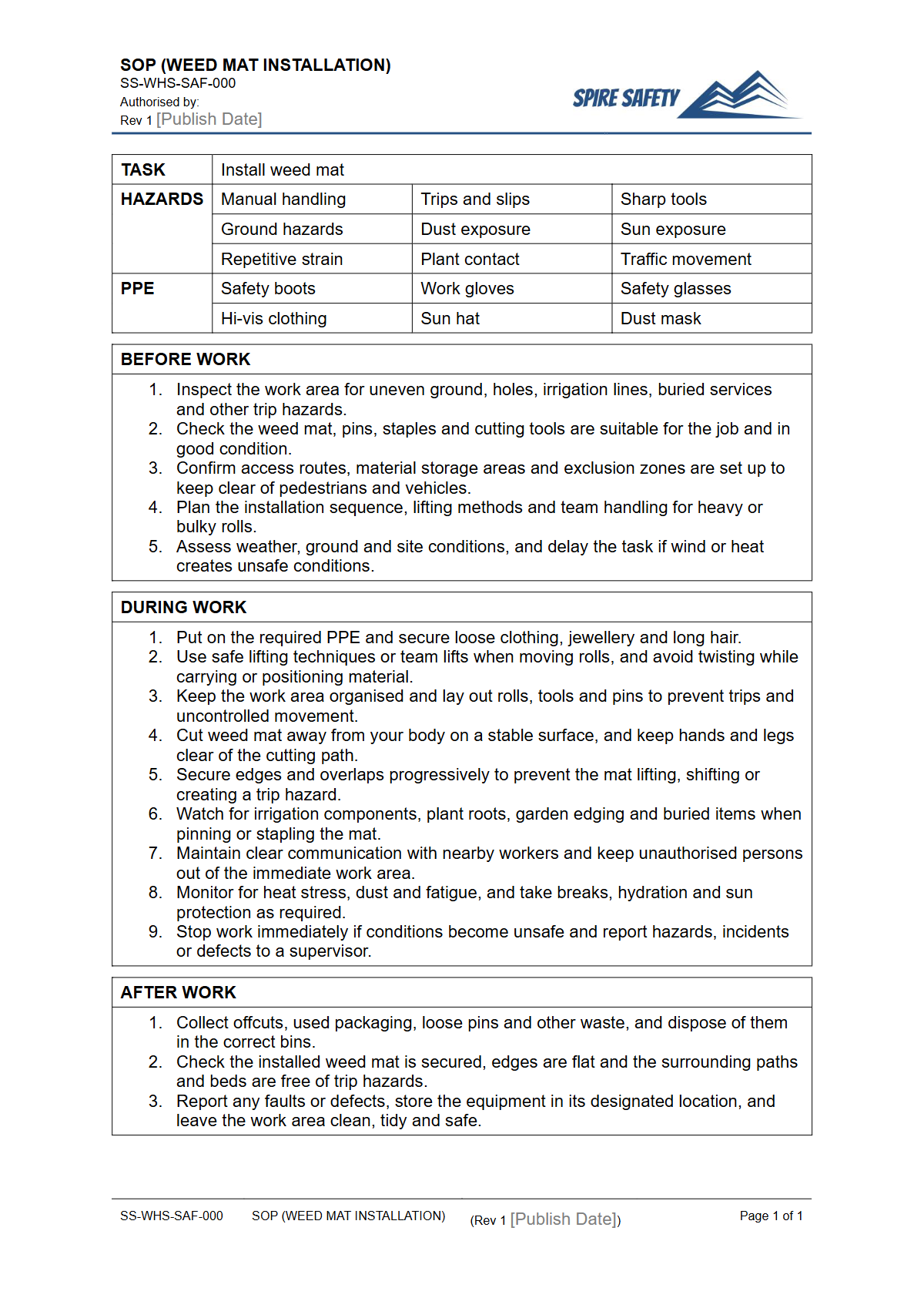
Purpose of the Free Safe Operating Procedure (Weed Mat Installation) Template
This Free Safe Operating Procedure (Weed Mat Installation) Template provides a structured starting point for documenting a safe system of work for landscaping and agricultural tasks. Its purpose is to help you systematically identify the hazards associated with laying weed matting and implement effective control measures.
Key risks often include manual handling injuries from lifting heavy rolls, cuts from knives, slips and trips on uneven ground or the mat itself, and environmental factors like heat stress. Using a formal SOP helps standardise the process, provides a critical tool for worker training and induction, and serves as tangible evidence of your commitment to risk management.
Formalising procedures like this is a key component of building robust WHS management systems that protect workers and ensure operational consistency.
Video walkthrough
How to use the Free Safe Operating Procedure (Weed Mat Installation) Template
Our Safe Operating Procedure for weed mat installation is designed for straightforward customisation. First, download the template in your preferred format—DOCX for easy editing or PDF for reference.
The document comes pre-filled with common steps, potential hazards, and typical controls relevant to the task. You must then conduct a site-specific risk assessment and adapt the content to reflect your unique operational environment.
This includes adding your company details, specifying the exact tools and equipment used, listing the required personal protective equipment (PPE), and detailing your emergency response procedures. This process is similar to customising other groundskeeping documents, like our free Planter SOP, ensuring all procedural documents are specific to your worksite.
Important: This document is a template only and must be customised to suit your specific workplace. We recommend a consultation process involving the workers who will perform the task to ensure the SOP is practical, comprehensive, and accurately reflects the work as it is actually done.
When to use this Safe Operating Procedure
A Safe Operating Procedure for weed mat installation should be an integral part of your daily work planning and safety management. It should be used before commencing any weed matting task, especially on new or unfamiliar sites.
It is an essential resource during the induction and training of new employees or when a worker is assigned the task for the first time. The SOP should also be referenced during regular safety talks or toolbox meetings to reinforce safe work habits.
Furthermore, following any incident or near miss, the SOP must be reviewed and updated to incorporate learnings and prevent recurrence. This is also true for tasks that may precede weed matting, such as applying soil treatments, which would be covered in a document like our Spreader SOP template.
Who should use it
This SOP template is beneficial for a range of personnel within any organisation involved in landscaping, horticulture, agriculture, or civil construction. Persons Conducting a Business or Undertaking (PCBUs) can use it to fulfil their primary duty of care.
Site managers, supervisors, and team leaders are responsible for implementing the SOP, ensuring workers understand it, and monitoring its application on the ground. WHS advisors and officers will find it a useful tool for developing and auditing safety documentation.
Most importantly, the workers performing the weed mat installation must use the finalised SOP as their guide to performing the job safely and correctly. For complex ground preparation that might precede this task, you may also need documentation such as our Trencher SOP template.
Key Hazards in Weed Mat Installation
While installing weed matting may seem straightforward, it presents several hazards that require careful management. A thorough SOP helps ensure these risks are not overlooked.
Manual Handling Injuries
Rolls of commercial-grade weed mat can be heavy and awkward to lift, carry, and unroll. This creates a significant risk of musculoskeletal injuries affecting the back, shoulders, and arms.
Awkward postures while bending to lay and pin the matting can also lead to strains. If your team is struggling to integrate practical controls for these types of risks, engaging with external safety professionals can provide valuable insights and practical solutions.
The guidance of experienced WHS consulting professionals can help you refine your procedures effectively.
Cuts and Lacerations
Utility knives, scissors, or other sharp tools are used to cut the weed mat to size. A slip with a sharp blade can cause serious lacerations.
This risk is increased if the cutting tool is dull, requiring excessive force, or if workers are not wearing appropriate cut-resistant gloves.
Slips, Trips, and Falls
The work environment itself is a major source of risk. Uneven ground, concealed holes, rocks, and debris can easily cause trips and falls.
The weed matting itself can be a trip hazard before it is properly secured, and it can become very slippery when wet. Tools and equipment left in walkways also contribute to this risk.
Environmental Hazards
Landscaping work is often performed outdoors, exposing workers to environmental hazards. These include UV radiation from the sun, leading to sunburn and increasing long-term skin cancer risk, as well as heat stress during hot weather.
Working in the rain can increase slip hazards and risk of illness. This SOP should prompt consideration of controls like sunscreen, shade, hydration, and appropriate scheduling. You can find more templates to manage a wide variety of workplace risks in our full library of free WHS resources.
Common mistakes
Common mistakes to avoid
- Failing to properly prepare the ground surface, leading to trips and poor mat adhesion.
- Using dull cutting tools, which require more force and increase the risk of slips and deep lacerations.
- Not securing the matting adequately with enough pins, causing it to become a trip hazard in windy conditions.
- Ignoring personal protective equipment (PPE) like gloves for hand protection and sunscreen for UV exposure.
Legal references
Legal considerations
The following legal requirements may be relevant to this type of work.
- Work Health and Safety Act (Harmonised) — Provides the primary duties for protecting workers and other people from work health and safety risks.
- Work Health and Safety Regulations (Harmonised) — Sets out requirements supporting the management of workplace hazards and risks.
The following codes may be relevant to this type of work.
- Managing WHS Risks Code of Practice — Provides practical guidance on identifying hazards, assessing risks and applying effective controls.
- Work Health and Safety Consultation, Cooperation and Coordination Code of Practice — Provides practical guidance on consulting workers and coordinating with other duty holders.
- Managing the Work Environment and Facilities Code of Practice — Provides practical guidance on safe work environments, workplace facilities and related controls.
Did you know
Material Matters
Most commercial-grade weed mats are made from woven polypropylene. While effective at blocking weeds, this material can become a significant slip hazard when wet or laid on a slope.
Hidden Hazard
Manual handling injuries from lifting and carrying heavy, awkward rolls of weed matting are one of the most common, yet overlooked, risks associated with this seemingly simple landscaping task.
FAQ
Frequently asked questions
01What should be included in a Weed Mat Installation SOP?
02Is a Safe Operating Procedure a legal requirement in Australia?
03How often should we review our weed mat installation SOP?
04Can I use this template for commercial landscaping jobs?
Share this resource
Free Safe Operating Procedure (Weed Mat Installation) Template
Browse Categories
How To Use It
- 1Download and open in Word or PDF.
- 2Replace the placeholders with your business details.
- 3Get it reviewed by a WHS specialist before rollout.
Need it customised?
Our WHS consultants can adapt this template to your site, run a gap analysis, or audit what you already have in place.
Book a Free Consultation WHS consulting servicesor call 1300 156 382
Related templates
- Free Safe Operating Procedure (Weed Spraying Setup) Template
- Free Safe Operating Procedure (Weighbridge Load Check) Template
- Free Safe Operating Procedure (Weighbridge Operation) Template
- Free Safe Operating Procedure (Weighbridge Ticketing) Template
- Free Safe Operating Procedure (Weld Post Heating) Template
- Free Safe Operating Procedure (Weld Preheating) Template