
Free Safe Operating Procedure (Weather Station) Template
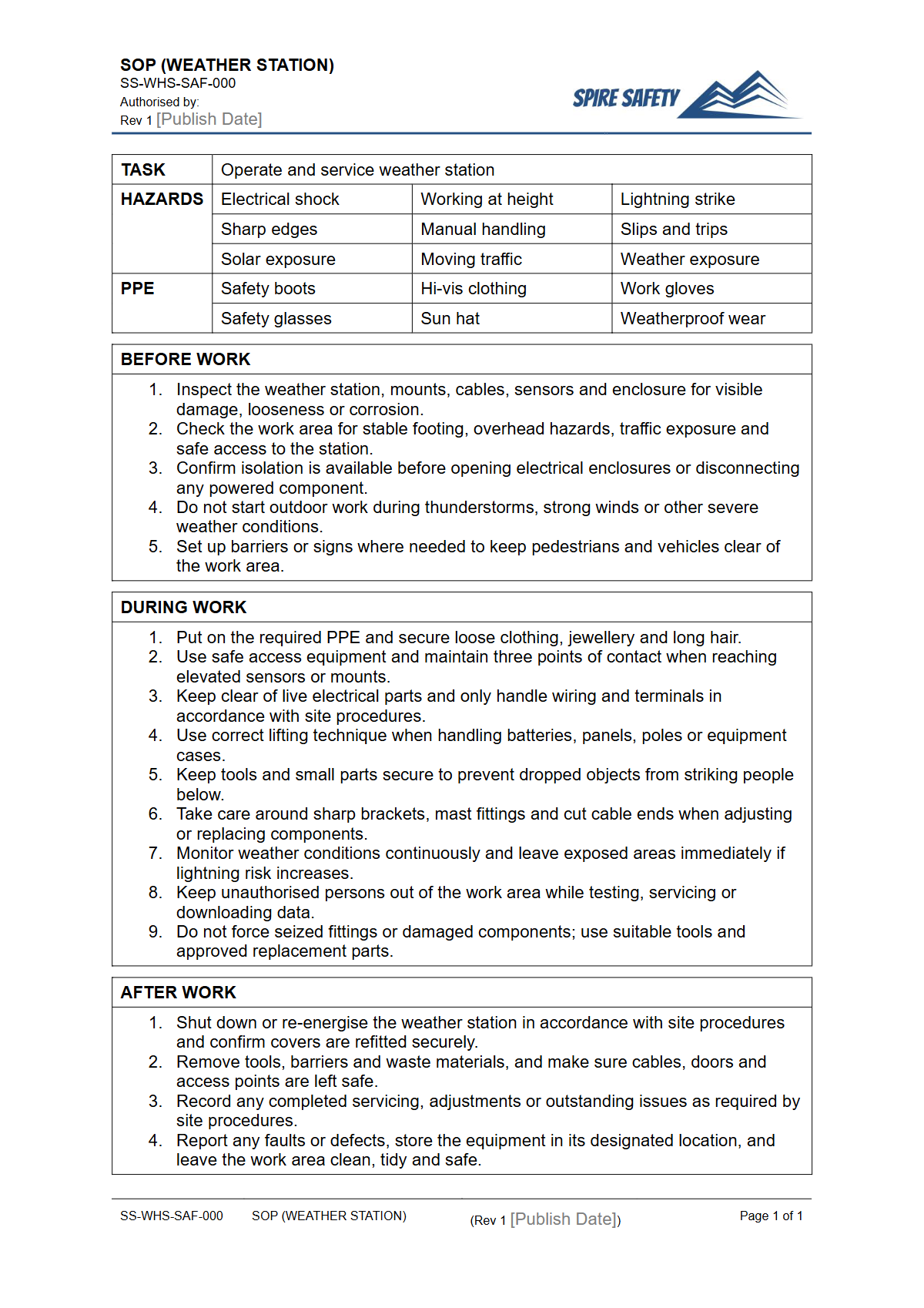
Download our free Safe Operating Procedure (Weather Station) Template to standardise safe use, data collection, and maintenance.
Free Safe Operating Procedure (Weather Station) Template
DOCX • 126 KB + PDF
Updated Oct 2026
No signup required
Purpose of the Free Safe Operating Procedure (Weather Station) Template
Operating and maintaining a weather station involves more than just collecting data; it requires a structured approach to manage risks effectively. Our Free Safe Operating Procedure (Weather Station) Template provides a clear, documented framework for your organisation.
It helps standardise the steps for installation, inspection, maintenance, and data retrieval, ensuring tasks are performed consistently and safely every time. This document is a critical tool for identifying hazards such as working at heights, electrical risks, and environmental exposure, and for outlining the control measures necessary to protect your workers.
By implementing a specific Safe Operating Procedure for weather stations, you create a reliable reference point for training and competency. It formalises expectations for safe work behaviour and helps meet your duty of care under Australian WHS laws.
This template serves as a robust starting point, designed to be adapted to the unique context of your agricultural, construction, or meteorological operations. For agricultural operations, ensure this SOP integrates with other key equipment procedures, such as those documented in our free Grain Drill SOP template.
Video walkthrough
How to use the Free Safe Operating Procedure (Weather Station) Template
This template is provided in both DOCX and PDF formats for your convenience. The DOCX version is fully editable, allowing you to tailor the content to your specific workplace.
It is crucial to replace the placeholder text with details relevant to your site, including the make and model of your weather station, specific site hazards, emergency contacts, and required Personal Protective Equipment (PPE). A generic procedure is not effective; its value comes from its specific application to your environment.
Note: To make this document effective, you must customise it to reflect the specific weather station models, site conditions, and organisational procedures at your workplace. We have included comments and prompts within the document to guide you through this customisation process.
Involving workers who directly operate and maintain the equipment in the drafting process will ensure the final SOP is practical, accurate, and readily adopted by the team.
Key Hazards When Operating Weather Stations
A comprehensive weather station SOP should address all foreseeable risks. This template prompts you to consider hazards including:
- Working at heights: Risk of falls when accessing roof-mounted or mast-mounted units. Procedures should cover ladder safety, fall protection, and securing tools.
- Electrical hazards: Risks from mains power, solar panel systems, battery banks, and lightning strikes. Controls include lockout-tagout procedures and proper grounding.
- Manual handling: Strains and sprains from lifting or moving heavy components during installation or maintenance.
- Environmental exposure: Hazards like heat stress, UV radiation, high winds, and bites or stings from insects or wildlife.
- Slips, trips, and falls: Caused by uneven ground, wet surfaces, or cabling around the base of the station.
During maintenance, you might use compressed air for cleaning sensitive components. Always follow established safe procedures for ancillary equipment, similar to those outlined in our Air Compressor SOP.
When to use this Safe Operating Procedure
A Safe Operating Procedure for a weather station is not a document to be filed away; it should be an active part of your operational workflow. It should be consulted before commencing any non-routine task and used as a core training document. Key times to use the SOP include:
- Before initial installation: To plan the work and ensure all safety controls are in place.
- For routine inspections and maintenance: As a step-by-step guide to ensure no critical safety or maintenance checks are missed.
- During calibration or sensor replacement: To ensure data accuracy and protect sensitive electronic components.
- For training new employees: To provide a standardised and safe method of instruction.
- During incident investigations: To review whether established procedures were followed.
Integrating this SOP into a broader safety framework is a key step towards a mature safety culture. Spire Safety offers expert WHS management systems development to help structure your entire safety approach.
Who should use it
This procedure is designed for use by a range of personnel within an organisation. The primary users are the individuals directly interacting with the equipment. This includes:
- Technicians and Maintenance Staff: For guidance on safe inspection, cleaning, repair, and calibration tasks.
- Field Workers and Agricultural Staff: Who may be responsible for daily checks or retrieving data from the station.
- Site Managers and Supervisors: To oversee work, conduct safety observations, and ensure procedures are being followed correctly.
- WHS Advisors and Officers: As a tool for risk assessment, training development, and compliance verification.
Regularly reviewing the effectiveness of your SOPs is a core part of safety assurance. Our WHS compliance auditing services can help identify gaps and opportunities for improvement in your procedures.
Just as with complex machinery, a structured SOP is vital. This principle applies equally to our FREE Conveyer System SOP template, where detailed steps prevent incidents.
This template is one of many tools available; explore our complete free WHS resources library for more templates and guides.
Common mistakes
Common mistakes to avoid
- Neglecting to customise the template for the specific site and equipment model.
- Failing to include procedures for non-routine tasks like troubleshooting or emergency response.
- Overlooking environmental hazards like heat stress, high winds, or insect bites during maintenance.
- Not providing adequate training on the finalised SOP to all relevant personnel.
Legal references
Legal considerations
The following legal requirements may be relevant to this type of work.
- Work Health and Safety Act (Harmonised) — Provides the primary duties for protecting workers and other people from work health and safety risks.
- Work Health and Safety Regulations (Harmonised) — Sets out requirements supporting the management of workplace hazards and risks.
The following codes may be relevant to this type of work.
- Managing WHS Risks Code of Practice — Provides practical guidance on identifying hazards, assessing risks and applying effective controls.
- Work Health and Safety Consultation, Cooperation and Coordination Code of Practice — Provides practical guidance on consulting workers and coordinating with other duty holders.
- Managing the Work Environment and Facilities Code of Practice — Provides practical guidance on safe work environments, workplace facilities and related controls.
Did you know
Data Integrity is a Safety Issue
A key, often-overlooked purpose of a weather station SOP is ensuring data integrity. Incorrect sensor placement or poor maintenance can lead to flawed data, impacting critical safety decisions in agriculture, aviation, and emergency management.
Lightning Risk
Modern weather stations often include lightning detectors, but the mast itself can attract strikes. Proper grounding and surge protection, as outlined in an SOP, are critical safety features for both the equipment and any personnel working nearby.
FAQ
Frequently asked questions
01What hazards should a weather station SOP cover?
02Is a Safe Operating Procedure legally required for a weather station in Australia?
03How often should we review our weather station SOP?
04Can this template be used for any type of weather station?
Share this resource
Free Safe Operating Procedure (Weather Station) Template
Browse Categories
How To Use It
- 1Download and open in Word or PDF.
- 2Replace the placeholders with your business details.
- 3Get it reviewed by a WHS specialist before rollout.
Need it customised?
Our WHS consultants can adapt this template to your site, run a gap analysis, or audit what you already have in place.
Book a Free Consultation WHS consulting servicesor call 1300 156 382
Related templates
- Free Safe Operating Procedure (Weaving Loom) Template
- Free Safe Operating Procedure (Weed Mat Installation) Template
- Free Safe Operating Procedure (Weed Spraying Setup) Template
- Free Safe Operating Procedure (Weighbridge Load Check) Template
- Free Safe Operating Procedure (Weighbridge Operation) Template
- Free Safe Operating Procedure (Weighbridge Ticketing) Template