
Free Safe Operating Procedure (Wax Heater) Template
Formalise safety protocols for beauty and spa equipment with our free Safe Operating Procedure (Wax Heater) template. Download the customisable DOCX and PDF.
Free Safe Operating Procedure (Wax Heater) Template
DOCX • 126 KB + PDF
Updated Oct 2026
No signup required
Purpose of the Free Safe Operating Procedure (Wax Heater) Template
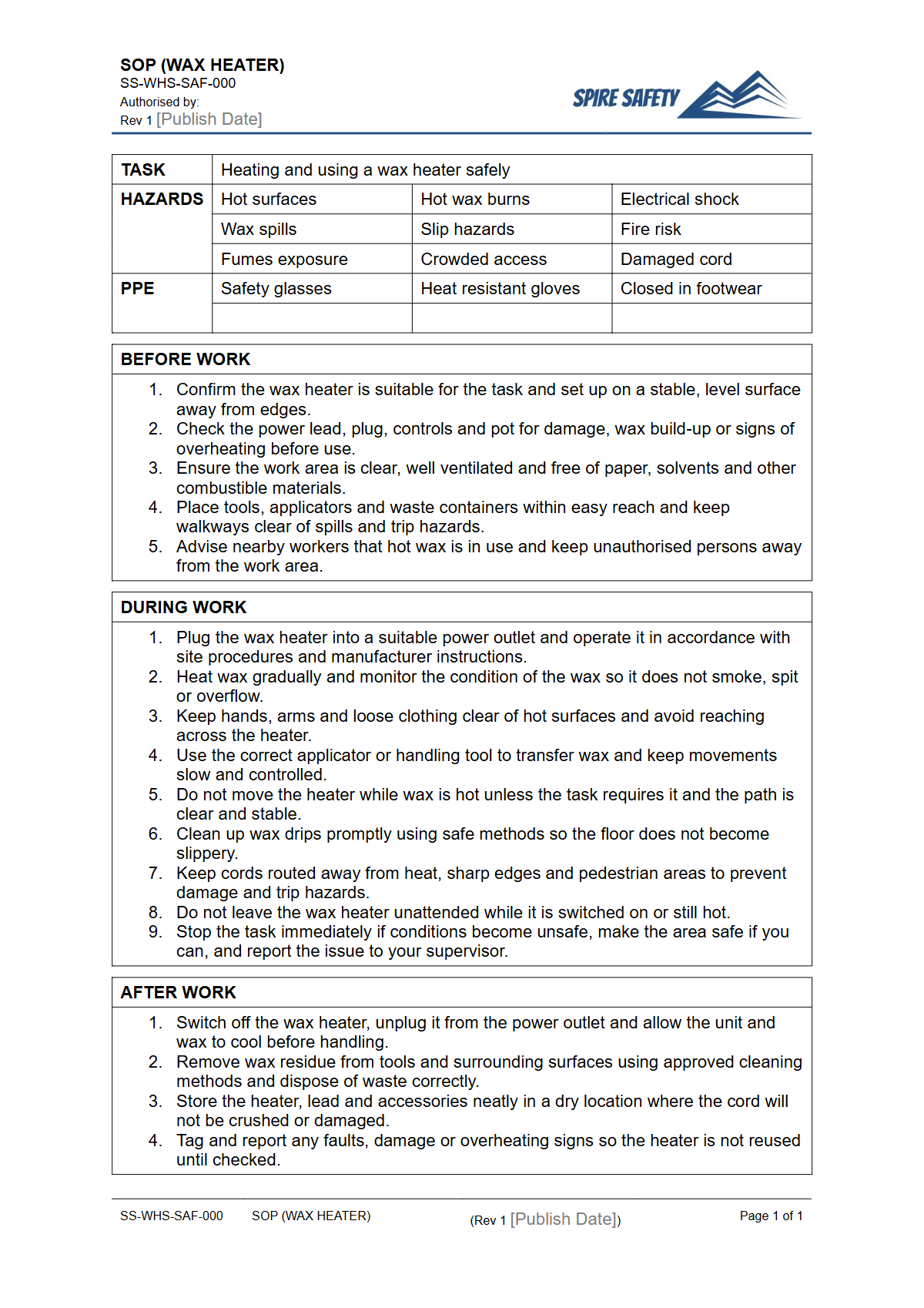
Operating equipment like a professional wax heater involves significant risks, primarily from thermal burns and electrical hazards. This free Safe Operating Procedure (Wax Heater) template provides a structured format to document the safest way to perform this task.
An SOP is a fundamental risk control measure that outlines a logical sequence of steps to ensure the task is performed correctly and safely every time. Implementing clear, documented procedures helps your business meet its primary duty of care under Australian WHS laws by minimising risks to workers and clients.
Using a standardised procedure promotes consistency, simplifies staff training, and provides a clear benchmark for supervision and performance assessment. Formalising your processes with SOPs is a key activity in developing robust WHS management systems that protect your team and your business.
Video walkthrough
How to use the Free Safe Operating Procedure (Wax Heater) Template
This template is designed as a comprehensive starting point. After downloading the DOCX file, you must systematically review and adapt each section to align with your specific operational context.
This includes detailing the exact make and model of your wax heaters, the types of wax used, and the layout of your treatment rooms or workspace.
Important: This document is a template only. It must be customised to suit the specific equipment, chemicals, and processes in your workplace.
We are not liable for any incidents that occur from the use of this resource. Your final SOP should be a practical tool developed in consultation with the workers who will use it.
As you adapt this document, you might find it helpful to see how procedures are structured for other heated appliances, such as in our free Deep Fryer SOP template, to understand how controls can be tailored.
Key Sections to Customise:
- Hazard Identification: Add any hazards specific to your environment, such as slip risks from spilled wax or ergonomic risks related to workstation setup.
- Pre-Operational Checks: Detail the daily checks required for your specific model, including inspecting the power cord, plug, and casing for damage, and ensuring the thermostat is functioning correctly.
- Step-by-Step Instructions: Write clear, simple steps for the entire process, from safely filling the heater and setting the temperature to applying wax and monitoring levels during use.
- Cleaning and Maintenance: Specify the approved methods and products for cleaning the wax heater and the frequency of maintenance tasks.
- Emergency Procedures: Outline the exact steps to take in case of a burn, electrical shock, or fire, including the location of first aid kits and fire extinguishers.
When to use it
A Safe Operating Procedure for a wax heater should be a living document integrated into your daily operations. It serves as the primary reference guide for performing the task safely.
It is essential during the induction and training of new employees to ensure they learn the correct, safe method from the beginning. It should also be used for regular refresher training for all staff and be readily accessible in the work area for quick reference.
Furthermore, the SOP is a critical document during incident investigations and safety audits.
Who should use it
This template is intended for any Person Conducting a Business or Undertaking (PCBU) where wax heaters are used. This typically includes salon owners, spa managers, and clinic operators in the beauty and personal services industry.
Health and Safety Representatives (HSRs), WHS managers, and the technicians or therapists who operate the equipment daily should all be involved in the customisation and review of the final document to ensure it is practical and effective.
Periodically reviewing your SOPs against actual practice is crucial for maintaining safety standards. An external audit can provide valuable, impartial feedback on the effectiveness of your documented procedures.
Engaging professionals for WHS compliance auditing can help identify gaps between your SOP and workplace behaviour.
If you're unsure how to begin integrating SOPs into your broader safety framework or need assistance with complex risk assessments, our team can provide expert guidance through our WHS consulting services.
By establishing and enforcing a clear SOP, you create a safer environment for everyone. Explore our complete free WHS resources library for more templates to support your safety management system.
Common mistakes
Common mistakes to avoid
- Using the template as-is without adding site-specific details for equipment and environment.
- Failing to include detailed cleaning, shutdown, and maintenance procedures.
- Neglecting to consult with and train the staff who will be using the SOP.
- Not specifying the required Personal Protective Equipment (PPE), such as heat-resistant gloves for cleaning.
Legal references
Legal considerations
The following legal requirements may be relevant to this type of work.
- Work Health and Safety Act (Harmonised) — Provides the primary duties for protecting workers and other people from work health and safety risks.
- Work Health and Safety Regulations (Harmonised) — Sets out requirements supporting the management of workplace hazards and risks.
The following codes may be relevant to this type of work.
- Managing WHS Risks Code of Practice — Provides practical guidance on identifying hazards, assessing risks and applying effective controls.
- Work Health and Safety Consultation, Cooperation and Coordination Code of Practice — Provides practical guidance on consulting workers and coordinating with other duty holders.
- Managing the Work Environment and Facilities Code of Practice — Provides practical guidance on safe work environments, workplace facilities and related controls.
Did you know
Burn Severity
Contact with cosmetic wax, often heated to between 50°C and 80°C, can cause second-degree burns in less than a second of contact with skin.
Electrical Testing
Under Australian standards (AS/NZS 3760), portable appliances like wax heaters used in a commercial environment require regular 'test and tag' inspections to verify their electrical safety.
FAQ
Frequently asked questions
01What are the main hazards of using a professional wax heater?
02How often should a Safe Operating Procedure for a wax heater be reviewed?
03Is a Safe Operating Procedure a legal requirement for wax heaters in Australia?
04Can this template be used for different types of wax heaters?
Share this resource
Free Safe Operating Procedure (Wax Heater) Template
Browse Categories
How To Use It
- 1Download and open in Word or PDF.
- 2Replace the placeholders with your business details.
- 3Get it reviewed by a WHS specialist before rollout.
Need it customised?
Our WHS consultants can adapt this template to your site, run a gap analysis, or audit what you already have in place.
Book a Free Consultation WHS consulting servicesor call 1300 156 382
Related templates
- Free Safe Operating Procedure (Wayfinding Sign Cleaning) Template
- Free Safe Operating Procedure (Weather Station) Template
- Free Safe Operating Procedure (Weaving Loom) Template
- Free Safe Operating Procedure (Weed Mat Installation) Template
- Free Safe Operating Procedure (Weed Spraying Setup) Template
- Free Safe Operating Procedure (Weighbridge Load Check) Template