
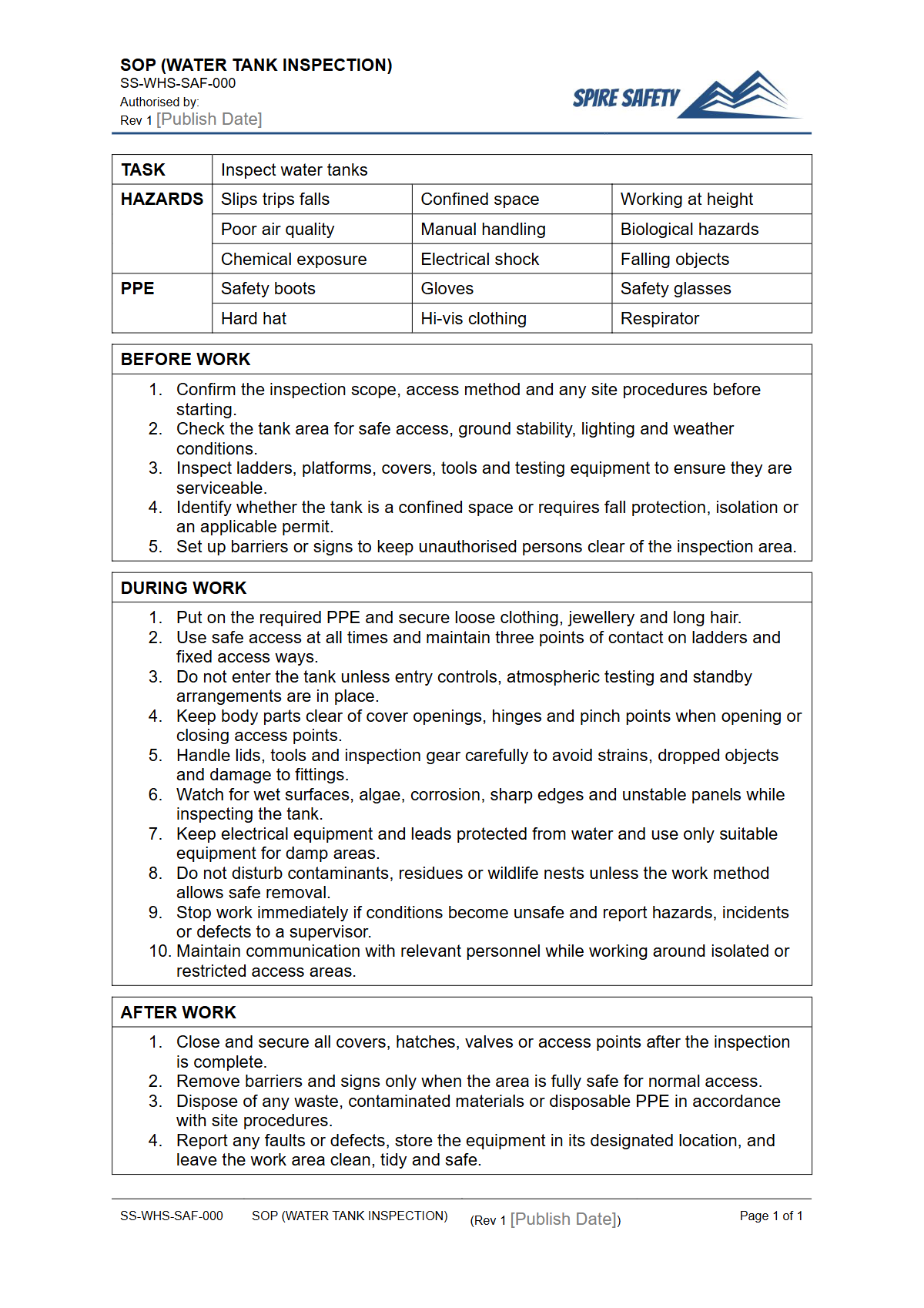
Free Safe Operating Procedure (Water Tank Inspection) Template
Conduct thorough water tank inspections with our structured Safe Operating Procedure template.
Free Safe Operating Procedure (Water Tank Inspection) Template
DOCX • 126 KB + PDF
Updated Oct 2026
No signup required
Purpose of the Free Safe Operating Procedure (Water Tank Inspection) Template
This Free Safe Operating Procedure (Water Tank Inspection) Template provides a structured framework for businesses to establish and document a safe system of work for inspecting water storage tanks. Water tank inspections present significant risks, including those associated with confined spaces, falls from height, hazardous atmospheres, drowning, and exposure to biological contaminants like Legionella.
Using this SOP helps your organisation systematically identify these hazards, assess the associated risks, and implement effective control measures to ensure worker safety. It serves as a vital tool for meeting your duties under Australian WHS legislation by formalising procedures and promoting consistent, safe work practices among all personnel involved in the task.
Key Hazards Addressed
A comprehensive water tank inspection procedure should account for a range of potential dangers. This template prompts you to consider and control for:
- Confined Space Entry: Many tanks are classified as confined spaces, requiring strict entry permits, atmospheric monitoring, and rescue plans.
- Falls from Height: Accessing the top of tanks or working on internal structures often involves working at height, necessitating fall prevention or fall arrest systems.
- Hazardous Atmospheres: Poor ventilation can lead to oxygen deficiency or the buildup of toxic gases.
- Drowning: The presence of water, even at shallow depths, creates a drowning risk, especially in the event of a fall or medical emergency.
- Biological and Chemical Hazards: Contact with contaminated water, sludge, or cleaning chemicals can pose health risks.
Video walkthrough
How to use the Free Safe Operating Procedure (Water Tank Inspection) Template
To effectively implement this Safe Operating Procedure, download the DOCX file and adapt it to the specific context of your workplace. This is not a finished document; it is a starting point.
We strongly recommend you consult with workers who perform the inspections, as their practical experience is invaluable for identifying all task steps and risks. Review each section and add, remove, or modify content to reflect your specific tanks, equipment, and operational environment.
For complex scenarios or if you lack in-house expertise, engaging with professional WHS consulting services can provide the necessary guidance to develop a robust and effective procedure.
When to use this Safe Operating Procedure
This SOP should be used by trained and competent personnel before undertaking any physical inspection of a water tank. It is applicable for various scenarios, including routine maintenance checks, water quality assessments, structural integrity inspections, and cleaning operations.
Formalising your process is also critical after an incident or near-miss to prevent recurrence. Furthermore, having documented procedures is often a key requirement during a WHS compliance auditing process, demonstrating your organisation's commitment to proactive safety management.
Who should use it
This template is designed for use by Persons Conducting a Business or Undertaking (PCBUs), facility managers, maintenance supervisors, and WHS professionals. It provides the foundation for the final document that will be used by the workers and contractors who physically carry out the inspections.
It is crucial that all personnel assigned to the task are thoroughly trained on the site-specific SOP before commencing work. This training, along with the SOP itself, forms an essential part of your broader comprehensive WHS management systems, ensuring safety obligations are understood and consistently met.
Equipment and Machinery Procedures
During a water tank inspection, various types of equipment may be required. This can range from access equipment like ladders and harnesses to tools for cleaning and testing.
If powered equipment is used, such as for de-sludging or cleaning, ensure separate SOPs exist for their safe operation. For example, if compressed air is used for cleaning surfaces, workers must be trained on a specific procedure, like the one outlined in our free Air Compressor SOP, to manage risks like high-pressure injection injuries.
Safe Access and Egress
Planning safe access to and from the tank is a critical step. This may involve fixed ladders, temporary scaffolding, or the use of mobile plant.
If using machinery like an elevating work platform or a telehandler to access external inspection points on large, elevated tanks, ensure operators are licensed and follow a specific procedure for that plant. You can reference our FREE Telehandler SOP Template as an example of a machine-specific procedure.
Building Your Safety Document Library
A Safe Operating Procedure is one of many documents a business needs to manage WHS effectively. It should be supported by risk assessments, training records, and maintenance logs.
By developing a suite of clear, practical safety documents, you create a more resilient safety culture. For more templates and guidance documents, you can explore our complete free WHS resources library.
Common mistakes
Common mistakes to avoid
- Failing to correctly identify the water tank as a confined space and proceeding without an entry permit.
- Using inadequate or uninspected fall protection equipment when working on top of or inside tanks.
- Neglecting water quality protocols, leading to contamination of potable water systems.
- Assuming the atmosphere inside a tank is safe without conducting proper, calibrated gas testing before entry.
Legal references
Legal considerations
The following legal requirements may be relevant to this type of work.
- Work Health and Safety Act (Harmonised) — Provides the primary duties for protecting workers and other people from work health and safety risks.
- Work Health and Safety Regulations (Harmonised) — Sets out requirements supporting the management of workplace hazards and risks.
The following codes may be relevant to this type of work.
- Managing WHS Risks Code of Practice — Provides practical guidance on identifying hazards, assessing risks and applying effective controls.
- Work Health and Safety Consultation, Cooperation and Coordination Code of Practice — Provides practical guidance on consulting workers and coordinating with other duty holders.
- Managing the Work Environment and Facilities Code of Practice — Provides practical guidance on safe work environments, workplace facilities and related controls.
Did you know
Confined Space Dangers
Over 60% of confined space fatalities are would-be rescuers who enter the space to help a fallen colleague without proper training or equipment. This highlights the critical need for a formal rescue plan in every confined space SOP.
Legionella Risk
Legionella bacteria, which causes Legionnaires' disease, can thrive in water tanks with temperatures between 20°C and 45°C. Regular inspection and cleaning are key control measures to prevent its growth and aerosolization.
FAQ
Frequently asked questions
01What are the main hazards during a water tank inspection?
02How often should a Safe Operating Procedure for water tanks be reviewed?
03Is a Safe Operating Procedure legally required for water tank inspections in Australia?
04Can this template be used for both potable and non-potable water tanks?
Share this resource
Free Safe Operating Procedure (Water Tank Inspection) Template
Browse Categories
How To Use It
- 1Download and open in Word or PDF.
- 2Replace the placeholders with your business details.
- 3Get it reviewed by a WHS specialist before rollout.
Need it customised?
Our WHS consultants can adapt this template to your site, run a gap analysis, or audit what you already have in place.
Book a Free Consultation WHS consulting servicesor call 1300 156 382
Related templates
- Free Safe Operating Procedure (Water Valve Inspection) Template
- Free Safe Operating Procedure (Waterway Debris Removal) Template
- Free Safe Operating Procedure (Waterway Litter Cleanup) Template
- Free Safe Operating Procedure (Wax Heater) Template
- Free Safe Operating Procedure (Wayfinding Sign Cleaning) Template
- Free Safe Operating Procedure (Weather Station) Template