
Free Safe Operating Procedure (Waterway Debris Removal) Template
Download our free Safe Operating Procedure (Waterway Debris Removal) template. This resource provides a structured starting point for your safety documents.
Free Safe Operating Procedure (Waterway Debris Removal) Template
DOCX • 126 KB + PDF
Updated Oct 2026
No signup required
Purpose of the Free Safe Operating Procedure (Waterway Debris Removal) Template
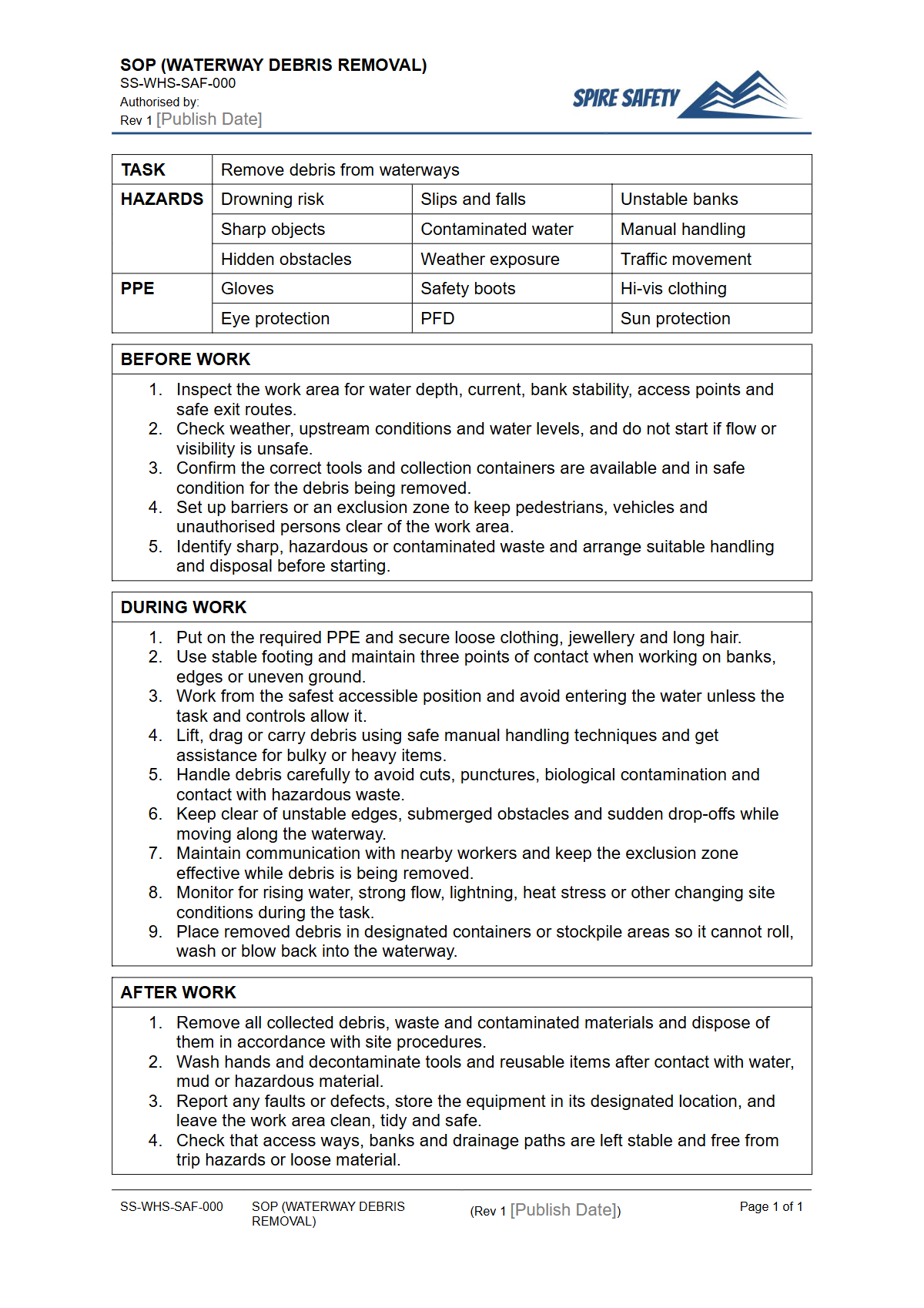
Working in or near water presents a unique and serious set of risks. This free Safe Operating Procedure (Waterway Debris Removal) template provides a structured framework for outlining the hazards and control measures associated with clearing debris from rivers, creeks, dams, and stormwater channels.
The primary purpose of an SOP is to provide clear, step-by-step instructions to workers, ensuring tasks are performed safely and consistently.
Key risks addressed in this process include drowning, slips, trips, and falls on unstable or slippery banks, and exposure to biological hazards such as bacteria, viruses, and venomous animals. It also covers risks from hazardous manual tasks when moving heavy or awkward items, potential contact with submerged utilities, and the safe operation of any machinery used during the cleanup.
How this Safe Operating Procedure helps:
- Provides a clear, sequential guide for workers to follow.
- Acts as a key training document for new and existing personnel.
- Helps PCBUs (Persons Conducting a Business or Undertaking) meet their primary duty of care under WHS legislation.
- Establishes a standard for safe work that can be monitored and reviewed.
Video walkthrough
How to use the Free Safe Operating Procedure (Waterway Debris Removal) Template
This resource is available for download as a DOCX file, which is fully editable in Microsoft Word or other compatible programs, and a PDF for easy printing and distribution. To use it effectively, you must tailor it to the specific conditions of your workplace.
A generic procedure cannot account for every unique hazard present at a particular site. This involves conducting a site-specific risk assessment before starting work.
Important: We have developed this document as a comprehensive starting point, but it is not a complete, ready-to-use solution. You must customise this Safe Operating Procedure by consulting with your workers and incorporating details about your specific site, equipment, materials, and personnel. Integrating customised SOPs into your broader safety framework is a critical part of developing robust WHS management systems.
When to use this Safe Operating Procedure
This SOP should be implemented for any planned activity involving the removal of debris from a waterway. It is an essential planning document that should be reviewed and communicated to all workers before work commences. Common scenarios include:
- Routine maintenance of stormwater drains, culverts, and channels.
- Post-flood or storm cleanup operations.
- Environmental rehabilitation projects to improve water flow and habitat.
- Clearing agricultural dams or irrigation channels.
- Removing blockages caused by fallen trees, rubbish, or sediment buildup.
Regularly reviewing your procedures is a key part of the safety lifecycle. An external review or WHS compliance auditing can help identify gaps and ensure your safety documents remain effective and aligned with current standards.
Who should use this Safe Operating Procedure
This template is designed for use by any organisation or individual responsible for managing waterway maintenance activities. This includes WHS managers, supervisors, team leaders, and the workers carrying out the task. It is particularly relevant for:
- Local councils and government agencies responsible for public land and waterways.
- Environmental and land care organisations.
- Agricultural businesses.
- Civil construction and maintenance contractors.
Supervisors must ensure that workers have read and understood the SOP before starting work. For tasks involving heavy plant, such as lifting large logs or debris with a crane, operators must be competent and hold the appropriate high-risk work licence. If using other equipment like a telehandler to move debris, workers must be trained on its safe operation, as detailed in documents like our FREE Telehandler SOP Template.
Further customisation considerations
When adapting this template, consider adding specific details about communication methods (e.g., two-way radios), site-specific emergency plans (including water rescue procedures), and procedures for identifying and managing hazardous materials that may be found in the debris. If you require expert assistance in developing site-specific safety documentation, consider engaging specialist WHS consulting services.
The equipment used will heavily influence your procedure. Clearing large areas may involve earthmoving plant, and workers must be familiar with the relevant procedures for each machine.
If your task involves using an earthmoving scraper to clear banks or access points, you may find our FREE Scraper SOP Template to be a useful supplementary resource.
This document is just one of many templates designed to support Australian businesses. You can explore a wide range of checklists, procedures, and forms in our free WHS resources library to help build out your safety management system.
Common mistakes
Common mistakes to avoid
- Failing to adequately assess water conditions, including flow rate, depth, temperature, and currents.
- Using the generic template without customising it for the specific site, equipment, and team.
- Neglecting to check for submerged or hidden hazards like pipes, cables, sharp objects, or unstable ground.
- Inadequate training on emergency response procedures, particularly for rescue from water.
Legal references
Legal considerations
The following legal requirements may be relevant to this type of work.
- Work Health and Safety Act (Harmonised) — Provides the primary duties for protecting workers and other people from work health and safety risks.
- Work Health and Safety Regulations (Harmonised) — Sets out requirements supporting the management of workplace hazards and risks.
The following codes may be relevant to this type of work.
- Managing WHS Risks Code of Practice — Provides practical guidance on identifying hazards, assessing risks and applying effective controls.
- Work Health and Safety Consultation, Cooperation and Coordination Code of Practice — Provides practical guidance on consulting workers and coordinating with other duty holders.
- Managing the Work Environment and Facilities Code of Practice — Provides practical guidance on safe work environments, workplace facilities and related controls.
Did you know
Drowning at Work
According to Safe Work Australia, between 2003 and 2021, 390 workers were killed in work-related drowning incidents. The majority of these occurred in the transport, postal & warehousing, and agriculture industries.
Floodwater Hazards
Floodwaters are often heavily contaminated with sewage, agricultural and industrial waste, and bacteria like E. coli and Leptospira. Direct contact without appropriate PPE can lead to serious illness.
FAQ
Frequently asked questions
01What PPE is required for waterway debris removal?
02How often should a Safe Operating Procedure for waterway debris removal be reviewed?
03Is an SOP the same as a risk assessment?
04Can this template be used for volunteer groups?
Share this resource
Free Safe Operating Procedure (Waterway Debris Removal) Template
Browse Categories
How To Use It
- 1Download and open in Word or PDF.
- 2Replace the placeholders with your business details.
- 3Get it reviewed by a WHS specialist before rollout.
Need it customised?
Our WHS consultants can adapt this template to your site, run a gap analysis, or audit what you already have in place.
Book a Free Consultation WHS consulting servicesor call 1300 156 382
Related templates
- Free Safe Operating Procedure (Waterway Litter Cleanup) Template
- Free Safe Operating Procedure (Wax Heater) Template
- Free Safe Operating Procedure (Wayfinding Sign Cleaning) Template
- Free Safe Operating Procedure (Weather Station) Template
- Free Safe Operating Procedure (Weaving Loom) Template
- Free Safe Operating Procedure (Weed Mat Installation) Template