
Free Safe Operating Procedure (Water Valve Inspection) Template
Download our Free Safe Operating Procedure for water valve inspections. This customisable template provides a structured format to document your WHS processes.
Free Safe Operating Procedure (Water Valve Inspection) Template
DOCX • 126 KB + PDF
Updated Oct 2026
No signup required
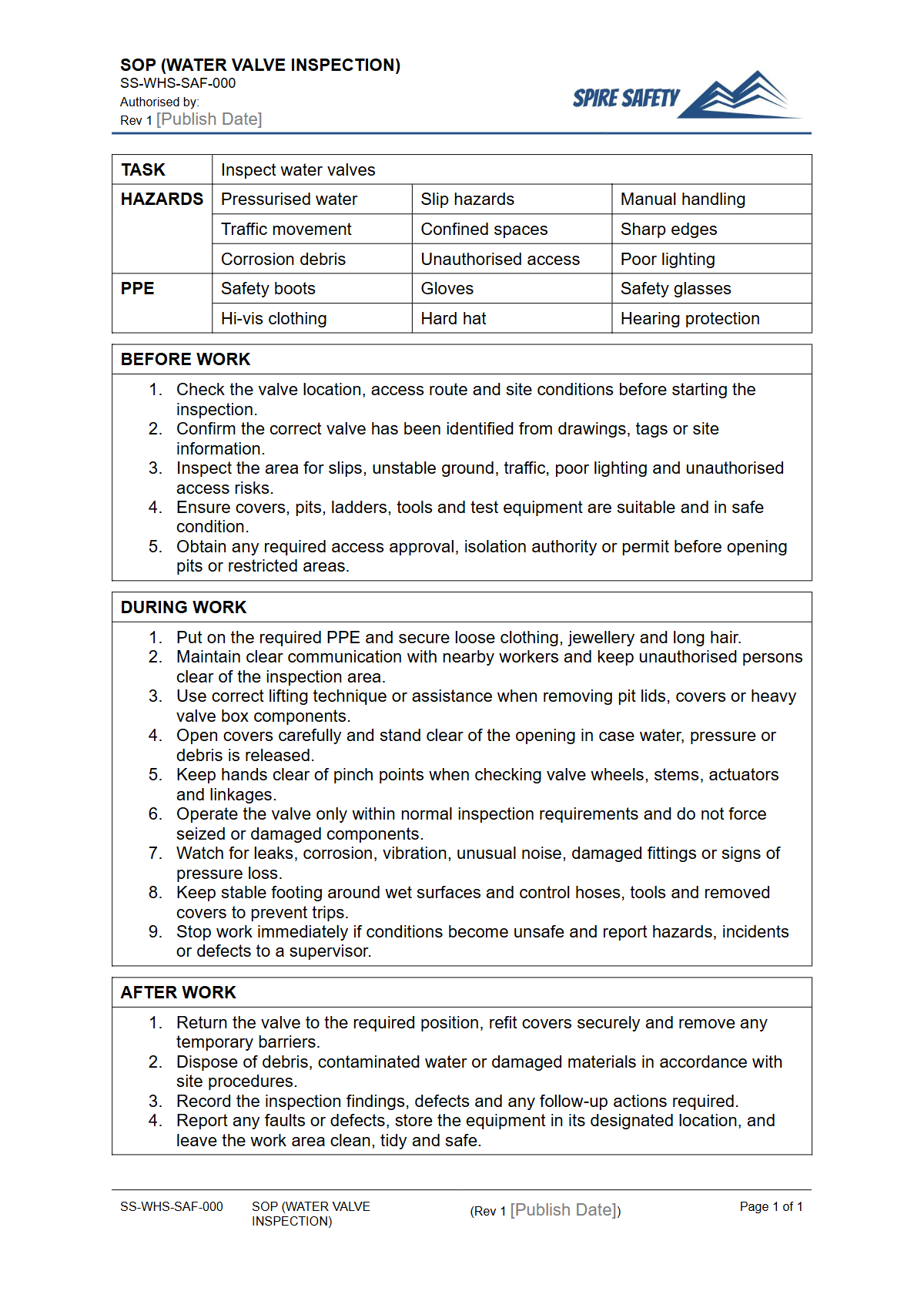
Purpose of the Free Safe Operating Procedure (Water Valve Inspection) Template
Effectively managing water systems is critical for safety, operational continuity, and asset protection. This Free Safe Operating Procedure (Water Valve Inspection) Template provides a structured framework for documenting the safe and systematic inspection of water valves.
Using a standardised SOP ensures that every inspection is conducted consistently and thoroughly, significantly reducing the risk of incidents such as uncontrolled water release, pressure hazards, or exposure to contaminated water. It helps in the early detection of leaks, corrosion, or damage, preventing costly repairs and unplanned downtime.
By formalising this process, organisations can demonstrate a commitment to safety and due diligence. A documented SOP is a cornerstone of proactive maintenance and serves as a vital training tool for new and existing personnel.
It ensures that critical safety steps, like isolation and depressurisation, are never missed. Implementing clear, repeatable procedures for essential tasks is a fundamental component of robust WHS management systems, helping to embed a culture of safety throughout the workplace.
Video walkthrough
How to use the Free Safe Operating Procedure (Water Valve Inspection) Template
This template is provided in both DOCX and PDF formats to serve as a comprehensive starting point. It is designed to be adapted to the unique context of your workplace, including your specific types of valves (e.g., gate, ball, butterfly, globe), system pressures, and operational environment.
To use it effectively, begin by conducting a site-specific risk assessment for the valve inspection task, identifying all potential hazards and establishing appropriate control measures.
Involve the workers who will be performing the inspections in the customisation process. Their practical experience is invaluable for creating a procedure that is both safe and workable.
Fill in the template with details specific to your site, including required personal protective equipment (PPE), tools, step-by-step instructions for isolation and inspection, and emergency procedures. Procedures for other common plant, such as our free Air Compressor SOP template, can also provide useful structure.
Important Note: This document is a template and not a complete Safe Operating Procedure. To be effective, we strongly advise that you customise this template to the specific equipment, personnel, and hazards found in your workplace.
When should this Safe Operating Procedure be used?
A Water Valve Inspection SOP should be used consistently as part of a scheduled maintenance program. Regular, documented inspections are key to ensuring the ongoing integrity and reliability of a water distribution system.
The frequency of these inspections—whether monthly, quarterly, or annually—should be determined by a risk assessment, manufacturer recommendations, and the criticality of the system.
Beyond routine checks, this SOP should be used whenever a valve's operational status is critical. This includes before commencing major works that rely on the valve for isolation, after system repairs or modifications to verify functionality, and during the commissioning of new pipework.
It is also an essential document for training and assessing the competency of personnel tasked with these inspections. For broader site work involving ground-penetrating equipment, you might also require procedures like our FREE Trencher SOP.
Who should use this Safe Operating Procedure?
This Safe Operating Procedure is intended for any person conducting water valve inspections. This typically includes maintenance personnel, plumbers, facilities management staff, and plant operators.
Using the SOP ensures that all workers, regardless of their individual experience level, follow a single, approved method that prioritises safety and thoroughness. It eliminates guesswork and reduces the likelihood of procedural errors.
Supervisors and managers are responsible for ensuring that this SOP is implemented, understood, and followed by their teams. They should use it as a tool for training, supervision, and performance monitoring. WHS managers and safety officers can also use the documented procedure as evidence of a safe system of work during safety reviews and WHS compliance auditing. Documented procedures are just as vital for other equipment, as shown in our FREE Conveyer System SOP (Safe Operating Procedure) Template.
By standardising tasks with tools like this template, you contribute to a safer, more efficient workplace. Explore our complete free WHS resources library for more templates to support your safety management system.
Common mistakes
Common mistakes to avoid
- Failing to confirm system isolation and release stored pressure before touching the valve.
- Using excessive force or the wrong tool (e.g., a pipe wrench on a handwheel), which can damage the valve stem or body.
- Not checking the correct direction of turn to close the valve (most are clockwise, but not all).
- Forgetting to document the inspection, including the valve's condition, position (open/closed), and any actions taken.
Legal references
Legal considerations
The following legal requirements may be relevant to this type of work.
- Work Health and Safety Act (Harmonised) — Provides the primary duties for protecting workers and other people from work health and safety risks.
- Work Health and Safety Regulations (Harmonised) — Sets out requirements supporting the management of workplace hazards and risks.
The following codes may be relevant to this type of work.
- Managing WHS Risks Code of Practice — Provides practical guidance on identifying hazards, assessing risks and applying effective controls.
- Work Health and Safety Consultation, Cooperation and Coordination Code of Practice — Provides practical guidance on consulting workers and coordinating with other duty holders.
- Managing the Work Environment and Facilities Code of Practice — Provides practical guidance on safe work environments, workplace facilities and related controls.
Did you know
Valve Seizure
One of the most common causes of valve failure is seizure due to inactivity. Many maintenance SOPs include 'exercising' the valve—fully opening and closing it—to prevent this and ensure it will work when needed.
Hidden Water Waste
A leaking valve can have a significant environmental and financial impact. A single valve leaking at just one drop per second can waste over 10,000 litres of water per year.
FAQ
Frequently asked questions
01What are the common hazards during a water valve inspection?
02How often should water valves be inspected in Australia?
03Is a Safe Operating Procedure a legal requirement for this task?
04What is the difference between a SOP and a Safe Work Method Statement (SWMS)?
Share this resource
Free Safe Operating Procedure (Water Valve Inspection) Template
Browse Categories
How To Use It
- 1Download and open in Word or PDF.
- 2Replace the placeholders with your business details.
- 3Get it reviewed by a WHS specialist before rollout.
Need it customised?
Our WHS consultants can adapt this template to your site, run a gap analysis, or audit what you already have in place.
Book a Free Consultation WHS consulting servicesor call 1300 156 382
Related templates
- Free Safe Operating Procedure (Waterway Debris Removal) Template
- Free Safe Operating Procedure (Waterway Litter Cleanup) Template
- Free Safe Operating Procedure (Wax Heater) Template
- Free Safe Operating Procedure (Wayfinding Sign Cleaning) Template
- Free Safe Operating Procedure (Weather Station) Template
- Free Safe Operating Procedure (Weaving Loom) Template