
Free Safe Operating Procedure (Water Sampling) Template
Formalise your water sampling process with our structured Safe Operating Procedure template. Download this customisable guide to ensure safety and consistency.
Free Safe Operating Procedure (Water Sampling) Template
DOCX • 126 KB + PDF
Updated Oct 2026
No signup required
Purpose of the Free Safe Operating Procedure (Water Sampling) Template
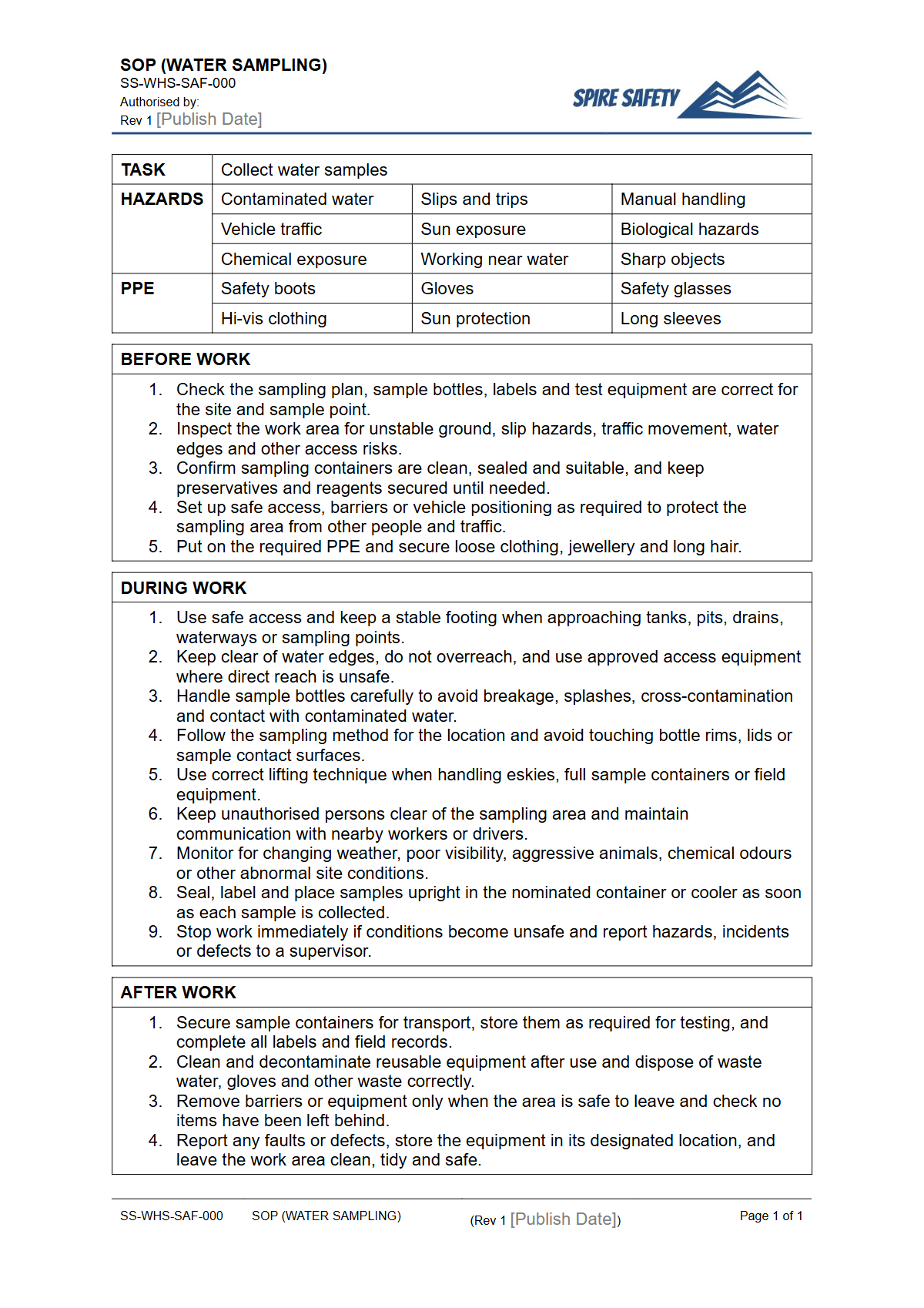
This Free Safe Operating Procedure (Water Sampling) Template provides a comprehensive framework for outlining the hazards and control measures associated with collecting water samples. A documented SOP is essential for ensuring tasks are performed safely, consistently, and in a manner that protects both the worker and the integrity of the sample.
It serves as a vital tool for worker training, competency assessment, and demonstrating due diligence in managing workplace risks. By systematically addressing potential hazards—such as drowning, slips and trips, chemical exposure from preservatives, and biological contamination—this SOP helps your organisation create a safer work environment for everyone involved in the sampling process.
Implementing a robust SOP is a foundational element of a strong safety culture. It transforms verbal instructions into a formal, reliable process that reduces the likelihood of incidents and errors.
Properly developed, it supports your overall approach to risk management and can be a critical document during safety audits. For organisations seeking to establish or refine their safety protocols, integrating task-specific SOPs is a key step towards building effective WHS management systems.
Video walkthrough
How to use the Free Safe Operating Procedure (Water Sampling) Template
Our template is available in both DOCX and PDF formats. The DOCX file is fully editable, allowing you to tailor the content to the specific requirements of your workplace.
The PDF version can be used as a static reference or for straightforward printing and distribution. To effectively use this resource, you should methodically work through each section, replacing the placeholder text with details relevant to your site, equipment, personnel, and the types of water bodies being sampled.
Important: This document is a template and must be customised to reflect the unique conditions and risks of your workplace. We are not WHS consultants, and this template is not a substitute for professional advice.
Consultation is a key part of the risk management process. You must consult with your workers, supervisors, and health and safety representatives when developing the final procedure to ensure it is practical and effective.
If you require assistance, engaging professional WHS consulting services can help ensure your documentation is robust and fit for purpose.
Key Hazards in Water Sampling
Water sampling can expose workers to a range of serious hazards that must be identified and controlled. A thorough risk assessment should precede any sampling activity.
Primary Hazards Include:
- Working Over or Near Water: The risk of falling into water and drowning is significant, especially when sampling from boats, bridges, steep banks, or near fast-moving currents.
- Slips, Trips, and Falls: Wet, slippery, or uneven ground around sampling locations is a common cause of injury.
- Biological Hazards: The water being sampled may contain harmful microorganisms like bacteria (e.g., Legionella, E. coli), viruses, or protozoa, leading to infection or illness if inhaled, ingested, or absorbed through skin contact.
- Chemical Hazards: Workers may be exposed to hazardous substances within the water itself or from chemical preservatives (e.g., acids) added to sample bottles.
- Manual Handling: Carrying sampling equipment, eskies, and full water containers over difficult terrain can lead to musculoskeletal injuries.
- Environmental Factors: Exposure to extreme weather, remote locations without support, and potentially dangerous fauna like snakes or spiders are all risks to consider. The process for assessing these varied environmental risks is crucial, similar to the pre-operational checks needed for complex equipment covered in our FREE Telehandler SOP.
When to Implement This Safe Operating Procedure
A specific SOP for water sampling should be used whenever a worker is required to collect water samples as part of their job. This applies across numerous industries and scenarios, providing clear, step-by-step instructions to minimise risk.
It is not just for high-risk environments; even seemingly simple sampling tasks benefit from a formalised procedure to ensure consistency and safety.
Common Applications:
- Environmental monitoring of rivers, lakes, oceans, and groundwater.
- Potable water quality testing in municipal systems.
- Wastewater and trade waste discharge compliance sampling.
- Testing water in cooling towers for Legionella and other pathogens.
- Agricultural water testing for irrigation suitability or livestock health.
- Sample collection in food processing facilities where water is a critical ingredient. In these facilities, water safety procedures run alongside other critical processes, which might be documented in resources such as our free deep fryer operation SOP.
Who Should Use This SOP?
This Safe Operating Procedure is intended for use by any person or organisation involved in the planning and execution of water sampling activities. It is designed to be adaptable for a wide range of roles and responsibilities.
Relevant Roles Include:
- Persons Conducting a Business or Undertaking (PCBUs): To meet their primary duty of care to ensure worker health and safety.
- WHS Managers and Advisors: To develop, implement, and review safety procedures as part of the wider safety management system. The effectiveness of such procedures is often a focus during WHS compliance auditing.
- Supervisors and Team Leaders: To train workers, oversee sampling tasks, and ensure procedures are followed correctly.
- Workers and Technicians: As a clear guide for performing their tasks safely and for reference during their work. In agricultural settings, this document complements other safety procedures, like those in our FREE Grain Drill SOP, to ensure a safe system of work.
By using this SOP, organisations can better standardise training and provide a clear benchmark for expected safe work behaviour. You can find many other useful templates in our free WHS resources library to help build out your safety documentation.
Common mistakes
Common mistakes to avoid
- Failing to conduct a site-specific risk assessment before starting.
- Using incorrect sample bottles or failing to add required preservatives.
- Not wearing task-appropriate PPE, especially gloves and flotation devices when near water.
- Inaccurate or incomplete sample labelling and documentation, compromising data integrity.
Legal references
Legal considerations
The following legal requirements may be relevant to this type of work.
- Work Health and Safety Act (Harmonised) — Provides the primary duties for protecting workers and other people from work health and safety risks.
- Work Health and Safety Regulations (Harmonised) — Sets out requirements supporting the management of workplace hazards and risks.
The following codes may be relevant to this type of work.
- Managing WHS Risks Code of Practice — Provides practical guidance on identifying hazards, assessing risks and applying effective controls.
- Work Health and Safety Consultation, Cooperation and Coordination Code of Practice — Provides practical guidance on consulting workers and coordinating with other duty holders.
- Managing the Work Environment and Facilities Code of Practice — Provides practical guidance on safe work environments, workplace facilities and related controls.
Did you know
The Hidden Hazard in the Bottle
Many water sample bottles contain small amounts of preservatives, such as sulphuric or nitric acid, to stabilise the sample for analysis. These can cause serious chemical burns if splashed onto skin or into eyes, highlighting the need for appropriate PPE like gloves and safety glasses.
A Silent Risk
Drowning is a leading cause of workplace fatalities in Australia, and working alone near water significantly increases this risk. A robust SOP should always include controls like buddy systems, communication plans, and personal flotation devices for such tasks.
FAQ
Frequently asked questions
01What should be included in a water sampling SOP?
02Why is a Safe Operating Procedure important for water sampling?
03Who is responsible for creating a water sampling SOP?
04How often should a water sampling SOP be reviewed?
Share this resource
Free Safe Operating Procedure (Water Sampling) Template
Browse Categories
How To Use It
- 1Download and open in Word or PDF.
- 2Replace the placeholders with your business details.
- 3Get it reviewed by a WHS specialist before rollout.
Need it customised?
Our WHS consultants can adapt this template to your site, run a gap analysis, or audit what you already have in place.
Book a Free Consultation WHS consulting servicesor call 1300 156 382
Related templates
- Free Safe Operating Procedure (Water Stain Removal) Template
- Free Safe Operating Procedure (Water Tank Inspection) Template
- Free Safe Operating Procedure (Water Valve Inspection) Template
- Free Safe Operating Procedure (Waterway Debris Removal) Template
- Free Safe Operating Procedure (Waterway Litter Cleanup) Template
- Free Safe Operating Procedure (Wax Heater) Template