
Free Safe Operating Procedure (Water Meter Pit Access) Template
Accessing water meter pits presents unique workplace risks. This free Safe Operating Procedure template helps you outline essential safety controls.
Free Safe Operating Procedure (Water Meter Pit Access) Template
DOCX • 126 KB + PDF
Updated Oct 2026
No signup required
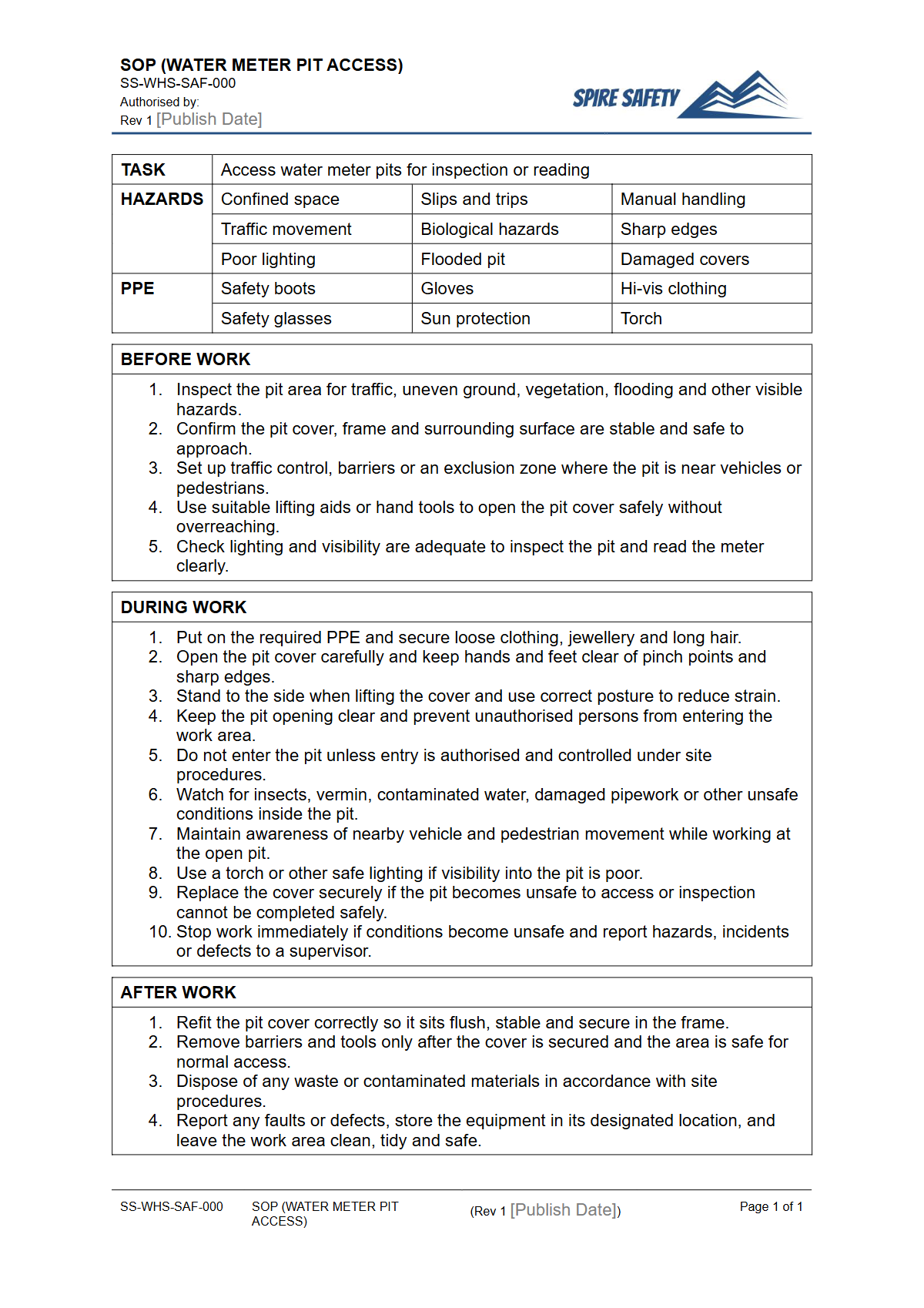
Purpose of the Free Safe Operating Procedure (Water Meter Pit Access) Template
Accessing water meter pits, while seemingly routine, introduces significant hazards that must be managed. This free Safe Operating Procedure (Water Meter Pit Access) template provides a structured starting point for documenting the risks and control measures for this common task.
The primary purpose is to establish a clear, repeatable process that workers can follow to ensure their safety and the safety of others. It helps organisations fulfil their duty of care by formally addressing hazards such as manual handling injuries from heavy lids, slips and trips around the pit opening, and potential atmospheric hazards within the pit itself.
A well-defined SOP is a critical component of your risk management process. It details the specific steps for pre-work checks, safe entry and exit, and task completion.
This includes identifying necessary personal protective equipment (PPE), required tools, and emergency procedures. For tasks that involve any ground disturbance or excavation nearby, it is also crucial to have a documented process like a safe operating procedure for trenchers to manage those separate risks effectively.
Video walkthrough
How to use the Free Safe Operating Procedure (Water Meter Pit Access) Template
This template is provided in both DOCX and PDF formats for your convenience. The DOCX file is fully editable, allowing you to tailor the content to the specific conditions of your workplace, the types of water meter pits your teams access, and your existing safety protocols.
It is designed as a foundation, not a final document.
To effectively implement this Safe Operating Procedure for water meter pit access, follow these steps:
- Download: Choose the DOCX version for customisation.
- Customise: Review each section and add or remove information to reflect your site-specific hazards and control measures. This includes specifying the types of pit lids, lifting tools used, and local emergency contacts. Consider if the pit could be classified as a confined space under WHS Regulations and adjust the procedure accordingly.
- Consult: Involve your workers and health and safety representatives in the drafting process. Their firsthand experience is invaluable for creating a practical and effective document.
- Integrate: Incorporate the finalised SOP into your broader comprehensive WHS management systems. This ensures it connects with your training, induction, and risk assessment activities.
- Train: Ensure all relevant personnel are trained on the final procedure before undertaking the task.
Note: This document is a template only. We are not familiar with your unique business operations, sites, or specific risks.
You MUST customise this document to suit your organisation's specific circumstances before use.
Adapting the template for specific equipment
Your procedure should also account for any powered equipment used during the task. For example, if workers use pneumatic tools for maintenance or a blower for ventilation, you should ensure a corresponding SOP for air compressors is also available and referenced.
This ensures that every component of the job is covered by a formal safety process.
When to use it
This Safe Operating Procedure should be used as a key reference document in several scenarios. Primarily, it must be consulted by workers before starting any task that involves accessing a water meter pit.
It serves as a practical, step-by-step guide to be followed on the job. It is also an essential training tool for new employees during their induction or for existing workers undergoing refresher training on specific hazards.
Supervisors can use it to conduct pre-start briefings and to verify that correct procedures are being followed.
Furthermore, the SOP is a critical piece of evidence during safety reviews and audits. It demonstrates that the organisation has a formal, documented process for managing the risks associated with this task.
Regular reviews of the SOP, especially after an incident or near miss, help maintain its relevance and effectiveness. Integrating this procedure into your audit schedule can be simplified through professional WHS compliance auditing services.
Who should use it
This procedure is intended for use by all personnel involved in accessing water meter pits. This includes plumbers, utility workers, council employees, maintenance staff, and contractors.
Supervisors and managers are responsible for ensuring the SOP is implemented, understood, and followed by their teams. Persons Conducting a Business or Undertaking (PCBUs) can use this template to develop documentation that supports their primary duty of care under Australian WHS law.
On larger sites, a range of other activities may occur simultaneously. If heavy pit lids or associated equipment need to be moved, it's vital that operators of any plant on site, such as a telehandler, have their own specific instructions.
A dedicated telehandler safe operating procedure ensures that lifting operations near the work area are also performed safely, preventing conflicts and additional hazards. This holistic approach ensures every interacting task is managed. For more templates covering various tasks and equipment, browse our complete library of free WHS resources.
Common mistakes
Common mistakes to avoid
- Failing to test the atmosphere before entry, even in shallow pits.
- Using incorrect manual handling techniques to lift or replace heavy lids, leading to back injuries.
- Assuming a pit is not a confined space without a formal risk assessment.
- Neglecting to secure the work area with barriers or signage, exposing workers and the public to trip hazards.
Legal references
Legal considerations
The following legal requirements may be relevant to this type of work.
- Work Health and Safety Act (Harmonised) — Provides the primary duties for protecting workers and other people from work health and safety risks.
- Work Health and Safety Regulations (Harmonised) — Sets out requirements supporting the management of workplace hazards and risks.
The following codes may be relevant to this type of work.
- Managing WHS Risks Code of Practice — Provides practical guidance on identifying hazards, assessing risks and applying effective controls.
- Work Health and Safety Consultation, Cooperation and Coordination Code of Practice — Provides practical guidance on consulting workers and coordinating with other duty holders.
- Managing the Work Environment and Facilities Code of Practice — Provides practical guidance on safe work environments, workplace facilities and related controls.
Did you know
Lid Weight
Concrete and cast-iron water meter pit lids can weigh over 25 kg, placing them in a high-risk category for manual handling injuries if not lifted with appropriate techniques or mechanical aids.
Hidden Atmospheres
Even shallow pits can accumulate dangerous atmospheres. Carbon dioxide or other gases heavier than air can displace oxygen, creating an invisible and potentially fatal hazard.
FAQ
Frequently asked questions
01What are the main hazards when accessing a water meter pit?
02Is a Safe Operating Procedure legally required for water meter pit access in Australia?
03Can I use this template for other types of pit or manhole access?
04What training should accompany this Safe Operating Procedure?
Share this resource
Free Safe Operating Procedure (Water Meter Pit Access) Template
Browse Categories
How To Use It
- 1Download and open in Word or PDF.
- 2Replace the placeholders with your business details.
- 3Get it reviewed by a WHS specialist before rollout.
Need it customised?
Our WHS consultants can adapt this template to your site, run a gap analysis, or audit what you already have in place.
Book a Free Consultation WHS consulting servicesor call 1300 156 382
Related templates
- Free Safe Operating Procedure (Water Meter Pit Clean) Template
- Free Safe Operating Procedure (Water Ram) Template
- Free Safe Operating Procedure (Water Rescue Equipment) Template
- Free Safe Operating Procedure (Water Sample Handover) Template
- Free Safe Operating Procedure (Water Sampling) Template
- Free Safe Operating Procedure (Water Stain Removal) Template