
Free Safe Operating Procedure (Water Meter Pit Clean) Template
Formalise your safety process for cleaning water meter pits with our customisable template. Download this free Safe Operating Procedure to get started today.
Free Safe Operating Procedure (Water Meter Pit Clean) Template
DOCX • 126 KB + PDF
Updated Oct 2026
No signup required
Purpose of the Free Safe Operating Procedure (Water Meter Pit Clean) Template
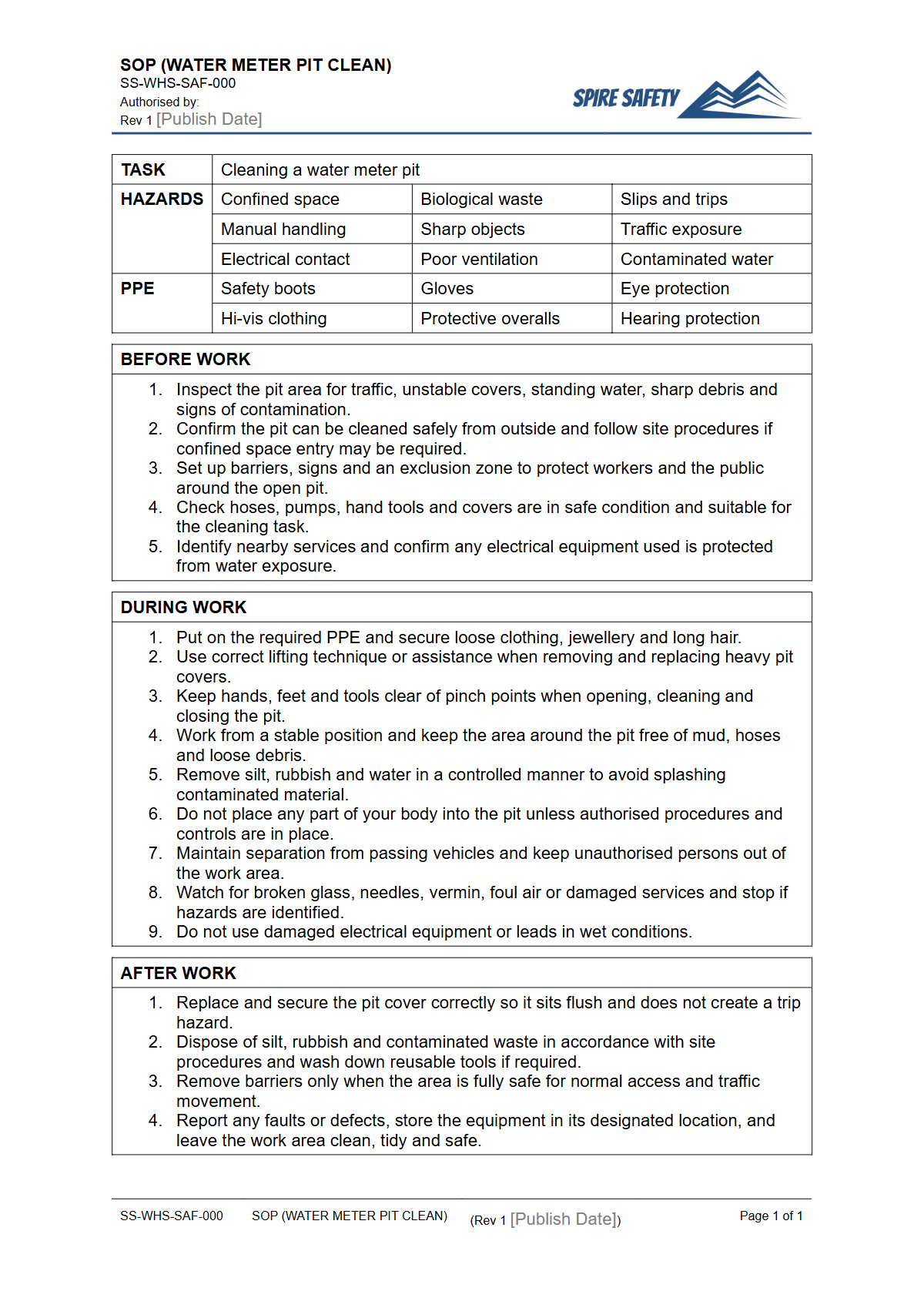
A Safe Operating Procedure (SOP) is a critical document that provides step-by-step instructions on how to perform a work task safely. This free Safe Operating Procedure for water meter pit cleaning helps your organisation formalise the process, ensuring workers understand the associated hazards and the control measures required to stay safe.
Water meter pits can present numerous risks, including manual handling injuries, slips and falls, and unexpected encounters with pests or hazardous atmospheres. By implementing a clear SOP, you establish a consistent and safe method for all personnel to follow, reducing the likelihood of incidents.
This template serves as a foundational component of your overall safety framework, helping you meet your duties under WHS legislation. Integrating clear procedures like this one into broader WHS management systems demonstrates a proactive approach to risk management and workplace safety.
It provides a structured format for outlining required PPE, pre-operational checks, the cleaning process itself, and post-task clean-up, ensuring no critical step is overlooked.
Key Hazards Addressed
Cleaning water meter pits involves more than just lifting a lid. This SOP template prompts you to consider and control a range of specific hazards, including:
- Confined Spaces: The potential for the pit to be classified as a confined space, requiring specific entry permits and procedures.
- Manual Handling: Injuries from lifting heavy pit lids or working in awkward postures.
- Slips, Trips, and Falls: Risks from wet surfaces, uneven ground around the pit, or debris.
- Biological Hazards: Contact with spiders, snakes, insects, rodents, or stagnant water.
- Hazardous Atmospheres: Potential for low oxygen or toxic gases in poorly ventilated pits.
- Tools and Equipment: Risks associated with using hand tools, water jets, or other cleaning equipment.
Video walkthrough
How to use the Free Safe Operating Procedure (Water Meter Pit Clean) Template
Upon downloading the DOCX or PDF file, you will need to customise it to reflect the specific conditions of your workplace. It is crucial to understand that this is a template, not a finished document.
We have designed it as a starting point, and you must adapt it to the specific hazards, equipment, environment, and personnel at your worksite. This involves conducting a site-specific risk assessment for the task of cleaning water meter pits and incorporating your findings into the document.
Fill in the company-specific details, such as company name, site location, and the names of responsible persons. Walk through the step-by-step procedure and adjust it to match your operational methods.
Most importantly, consult with your workers—the people who actually perform the task—to ensure the procedure is practical, accurate, and effective. If you need expert assistance in tailoring safety documents, our WHS consulting services can provide tailored support.
When to use it
This Safe Operating Procedure should be used as a primary reference tool for all water meter pit cleaning activities. It should be readily accessible to all workers involved in the task.
Specific times to use this SOP include during worker training and induction, as a planning tool before starting a job, and as a reference during the work itself. It is also an essential document for supervisors to use when monitoring work and for WHS managers during safety reviews.
The SOP should also be a central part of any incident investigation related to this task, helping to identify whether procedures were followed and if they need improvement. The principles of identifying hazards and outlining clear steps are similar across various excavation-related tasks, as seen in our free Trencher SOP template.
Who should use it
This document is intended for use by multiple roles within an organisation. Workers, such as plumbers, groundskeepers, and maintenance staff, will use it to understand and follow the safe work method.
Site supervisors and team leaders should use it to induct new workers, conduct pre-start briefings, and verify that tasks are being performed correctly and safely. WHS managers and officers will use the SOP as part of the organisation's safety management system, ensuring that documented procedures are in place for hazardous tasks and are regularly reviewed.
Regular verification through observation and discussion is a key part of ensuring any SOP is effective in practice, and can be supported by periodic WHS compliance auditing to ensure systems are working as intended.
Ultimately, anyone involved in the planning, execution, or supervision of water meter pit cleaning has a responsibility to be familiar with this procedure. You can find more templates and checklists like this one in our free WHS resources library to support a wide range of operational tasks.
Common mistakes
Common mistakes to avoid
- Failing to conduct a site-specific risk assessment before starting the job.
- Assuming the pit is not a confined space without a proper evaluation by a competent person.
- Using incorrect or poorly maintained tools, including damaged pit lid lifters.
- Neglecting to check for pests, sharp objects, or water accumulation before starting work.
Legal references
Legal considerations
The following legal requirements may be relevant to this type of work.
- Work Health and Safety Act (Harmonised) — Provides the primary duties for protecting workers and other people from work health and safety risks.
- Work Health and Safety Regulations (Harmonised) — Sets out requirements supporting the management of workplace hazards and risks.
The following codes may be relevant to this type of work.
- Managing WHS Risks Code of Practice — Provides practical guidance on identifying hazards, assessing risks and applying effective controls.
- Work Health and Safety Consultation, Cooperation and Coordination Code of Practice — Provides practical guidance on consulting workers and coordinating with other duty holders.
- Managing the Work Environment and Facilities Code of Practice — Provides practical guidance on safe work environments, workplace facilities and related controls.
Did you know
Hidden Dangers
Water meter pits can harbour dangerous pests like redback spiders and snakes, especially in rural and suburban areas. Always inspect a pit visually with a torch before reaching inside.
Atmospheric Hazards
Decomposing organic matter in a poorly ventilated pit can create a hazardous atmosphere, depleting oxygen or releasing toxic gases like hydrogen sulphide. Mechanical ventilation may be required.
FAQ
Frequently asked questions
01What should be included in a water meter pit cleaning SOP?
02Is cleaning a water meter pit considered a confined space entry?
03How often should we review our Safe Operating Procedures?
04Can I use this template for other types of pit maintenance?
Share this resource
Free Safe Operating Procedure (Water Meter Pit Clean) Template
Browse Categories
How To Use It
- 1Download and open in Word or PDF.
- 2Replace the placeholders with your business details.
- 3Get it reviewed by a WHS specialist before rollout.
Need it customised?
Our WHS consultants can adapt this template to your site, run a gap analysis, or audit what you already have in place.
Book a Free Consultation WHS consulting servicesor call 1300 156 382
Related templates
- Free Safe Operating Procedure (Water Ram) Template
- Free Safe Operating Procedure (Water Rescue Equipment) Template
- Free Safe Operating Procedure (Water Sample Handover) Template
- Free Safe Operating Procedure (Water Sampling) Template
- Free Safe Operating Procedure (Water Stain Removal) Template
- Free Safe Operating Procedure (Water Tank Inspection) Template