
Free Safe Operating Procedure (Water Ram) Template
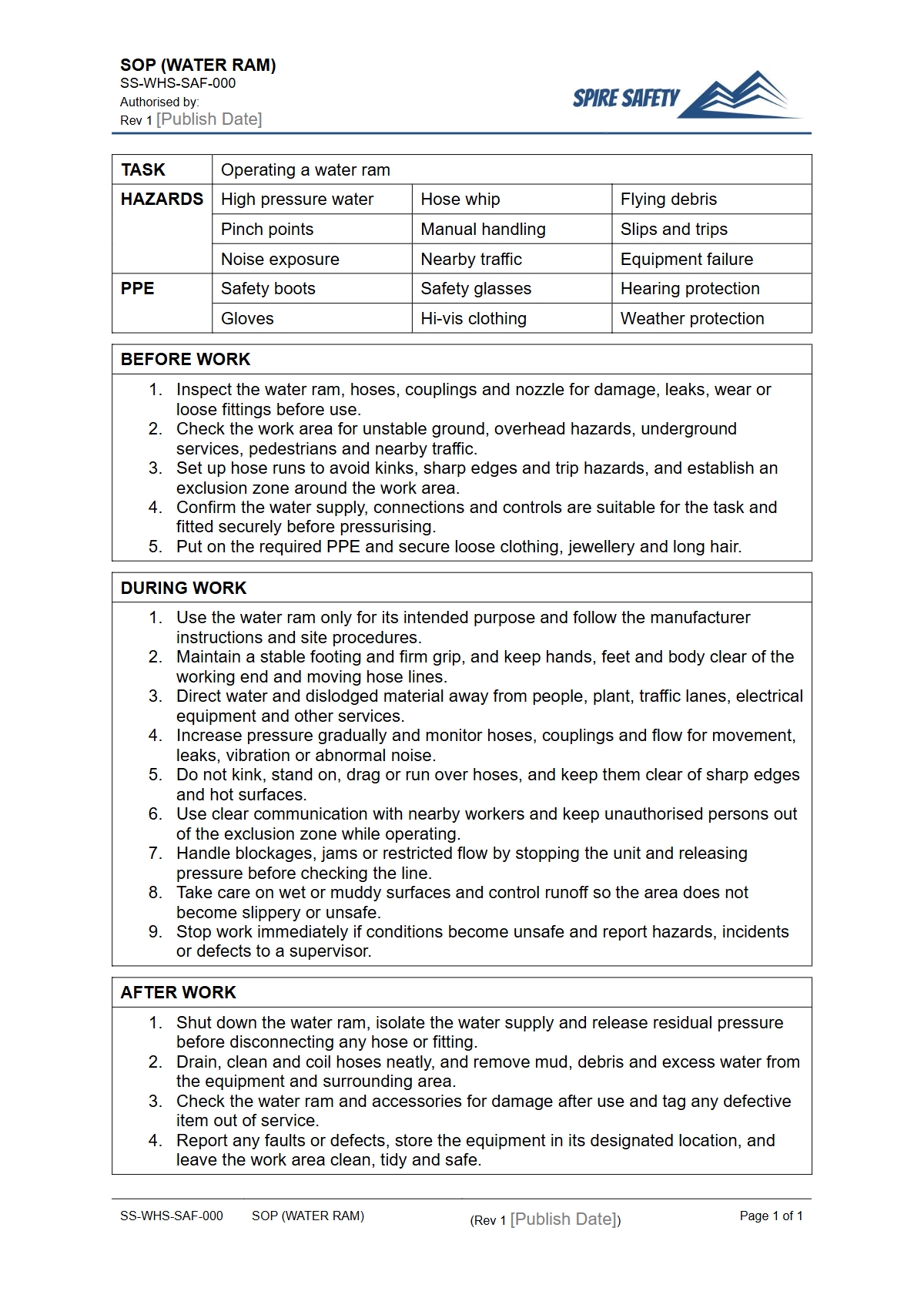
Download our free Safe Operating Procedure (Water Ram) template to formalise safety steps for using this high-pressure tool. Get started with our DOCX and PDF.
Free Safe Operating Procedure (Water Ram) Template
DOCX • 126 KB + PDF
Updated Oct 2026
No signup required
Purpose of the Free Safe Operating Procedure (Water Ram) Template
A water ram, or kinetic water ram, is a powerful tool used by plumbers and maintenance staff to clear stubborn blockages in pipes. It works by using a burst of compressed air to create a shockwave through water, generating significant force.
While effective, this high pressure introduces serious workplace hazards. This free Safe Operating Procedure (Water Ram) template provides a structured framework for documenting the required safety controls for operating the equipment.
Formalising your process helps manage risks such as pipe rupture from excessive pressure, injury from uncontrolled release of the tool, or exposure to hazardous biological waste. An effective SOP is a critical administrative control that outlines pre-start checks, operational steps, shutdown procedures, and required Personal Protective Equipment (PPE).
It serves as a vital training and reference document, ensuring all workers follow a consistent, safe method. For managing other pressurised equipment, you may also find value in our free Air Compressor SOP.
Video walkthrough
How to use the Free Safe Operating Procedure (Water Ram) Template
This resource is provided in both DOCX and PDF formats for your convenience. The DOCX version is fully editable, allowing you to tailor the content directly to your operational needs and site-specific risks.
To create a robust and effective procedure, you must customise this template.
We have provided a structured starting point aligned with Australian WHS practice, but you must adapt it to your unique context. This involves:
- Consulting the specific manufacturer’s operating manual for your model of water ram.
- Conducting a thorough risk assessment for the tasks where the water ram will be used.
- Incorporating details about the types of pipe systems it will be used on and their pressure ratings.
- Clearly defining the required PPE, such as safety glasses, face shields, gloves, and protective clothing.
- Involving your workers in the drafting and review process to ensure the SOP is practical and understood by those performing the task.
A well-developed SOP is a cornerstone of proactive safety management, forming an integral part of broader WHS management systems that protect your workers and your business.
What is a Safe Operating Procedure?
A Safe Operating Procedure (SOP), sometimes called a Safe Work Procedure, is a written document that provides step-by-step instructions on how to perform a specific task safely. It identifies the hazards associated with the task and details the control measures required to eliminate or minimise the risk of injury or illness.
An SOP is more detailed than a risk assessment, focusing on the 'how-to' of performing work safely from start to finish.
When to use a Water Ram SOP
An SOP for a water ram should be developed before the equipment is ever used in your workplace. It should be readily accessible to workers at all times.
It is a mandatory reference during worker training and induction, and should be used as a pre-task checklist for experienced operators to ensure no steps are missed.
The SOP should also be a live document, subject to regular review. This review should occur at least annually, or more frequently if:
- An incident or near-miss involving a water ram occurs.
- A new model of water ram is introduced.
- The types of tasks or environments change.
- Changes are made to relevant WHS legislation or codes of practice.
Regular reviews are a key part of ensuring ongoing safety performance, a process which can be verified through formal WHS compliance auditing.
Who should use this Safe Operating Procedure
This SOP is intended for use by multiple people within an organisation, each with distinct responsibilities:
- Persons Conducting a Business or Undertaking (PCBUs): Have the primary duty of care to ensure safe systems of work are in place. This includes providing resources to develop, implement, and review SOPs.
- Managers and Supervisors: Are responsible for ensuring that workers are trained on the SOP, understand its contents, and follow it consistently. They also oversee the review process.
- Workers and Operators: Plumbers, facilities maintenance staff, and other technicians must follow the instructions detailed in the SOP to protect their own health and safety and that of others. They should also be encouraged to provide feedback for improving the procedure.
Many tradespeople who use a water ram also work with other power tools, making it important to have documented procedures for all high-risk equipment. As an example, you can download our FREE Circular Saw SOP Template to standardise another common task. For a wider selection of safety documents, browse our complete free WHS resources library.
Common mistakes
Common mistakes to avoid
- Using the tool on pipes not rated for the generated pressure, leading to ruptures.
- Failing to seal all other openings in the drain system, causing hazardous blow-back.
- Neglecting to wear appropriate PPE, particularly high-impact eye and full-face protection.
- Not inspecting the tool for cracks, damage, or wear before pressurising and firing.
Legal references
Legal considerations
The following legal requirements may be relevant to this type of work.
- Work Health and Safety Act (Harmonised) — Provides the primary duties for protecting workers and other people from work health and safety risks.
- Work Health and Safety Regulations (Harmonised) — Sets out requirements supporting the management of workplace hazards and risks.
The following codes may be relevant to this type of work.
- Managing WHS Risks Code of Practice — Provides practical guidance on identifying hazards, assessing risks and applying effective controls.
- Work Health and Safety Consultation, Cooperation and Coordination Code of Practice — Provides practical guidance on consulting workers and coordinating with other duty holders.
- Managing the Work Environment and Facilities Code of Practice — Provides practical guidance on safe work environments, workplace facilities and related controls.
Did you know
Shockwave Speed
The shockwave created by a kinetic water ram travels through water at nearly 1,500 metres per second. This is what gives it the force to dislodge blockages far down a pipeline without needing to dismantle the system.
FAQ
Frequently asked questions
01What is a water ram and what are its main hazards?
02Is a Safe Operating Procedure legally required for a water ram in Australia?
03How often should our Water Ram SOP be reviewed?
04Can I use this template for a chemical or pneumatic drain cleaner?
Share this resource
Free Safe Operating Procedure (Water Ram) Template
Browse Categories
How To Use It
- 1Download and open in Word or PDF.
- 2Replace the placeholders with your business details.
- 3Get it reviewed by a WHS specialist before rollout.
Need it customised?
Our WHS consultants can adapt this template to your site, run a gap analysis, or audit what you already have in place.
Book a Free Consultation WHS consulting servicesor call 1300 156 382
Related templates
- Free Safe Operating Procedure (Water Rescue Equipment) Template
- Free Safe Operating Procedure (Water Sample Handover) Template
- Free Safe Operating Procedure (Water Sampling) Template
- Free Safe Operating Procedure (Water Stain Removal) Template
- Free Safe Operating Procedure (Water Tank Inspection) Template
- Free Safe Operating Procedure (Water Valve Inspection) Template