
Free Safe Operating Procedure (Water Rescue Equipment) Template
Formalise your safety protocols for water rescue operations with our customisable template. Download this free Safe Operating Procedure to get started.
Free Safe Operating Procedure (Water Rescue Equipment) Template
DOCX • 126 KB + PDF
Updated Oct 2026
No signup required
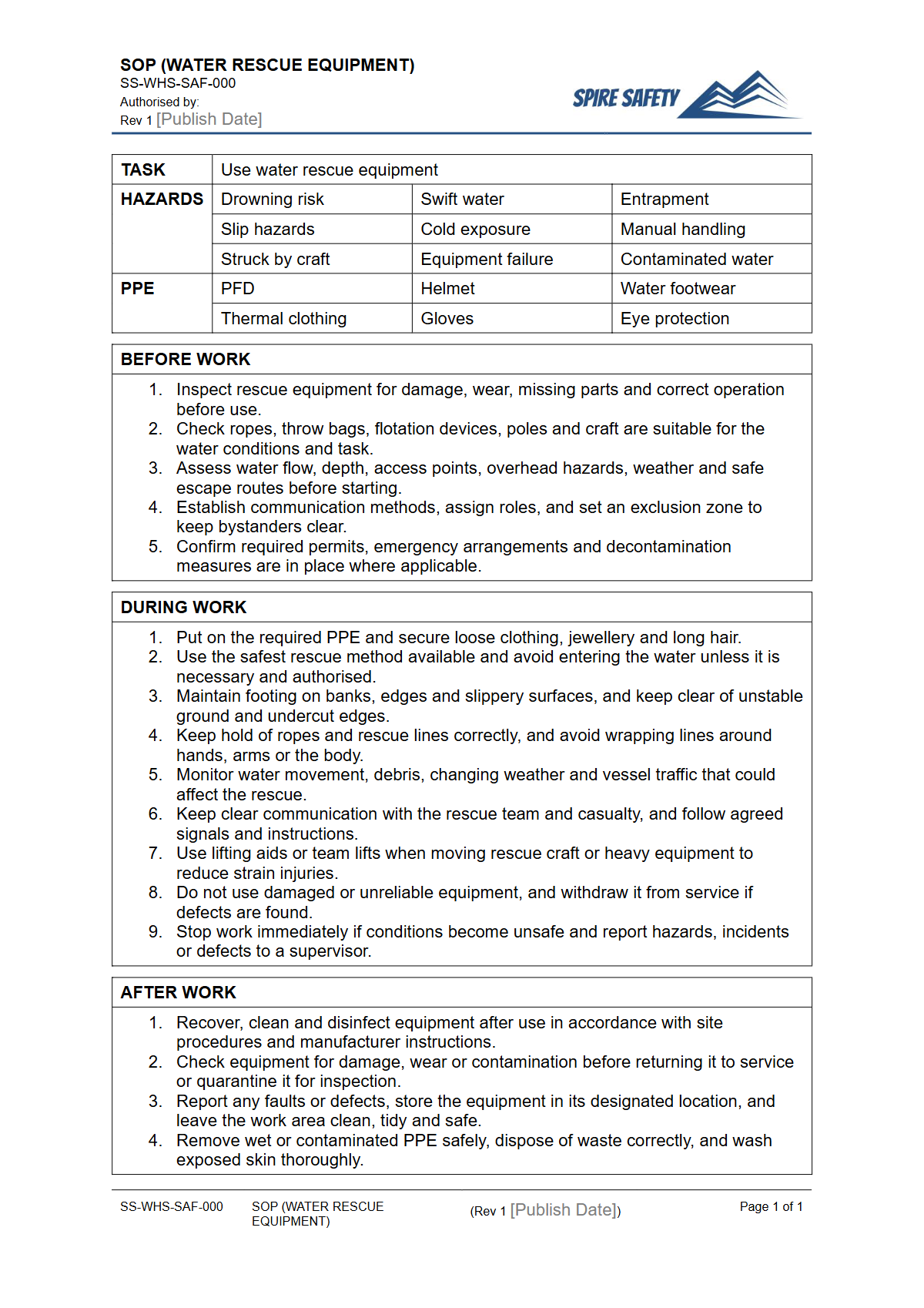
Purpose of the Free Safe Operating Procedure (Water Rescue Equipment) Template
Effectively managing health and safety risks around water bodies is a critical responsibility for many Australian organisations. This Free Safe Operating Procedure (Water Rescue Equipment) Template provides a structured starting point for documenting the safe use, inspection, and maintenance of essential rescue equipment.
Using a clear SOP helps standardise your response to water-based incidents, ensuring that equipment like lifebuoys, throw bags, rescue tubes, and personal flotation devices (PFDs) are always ready for deployment and used correctly by trained personnel. It forms a key part of your risk management documentation, demonstrating a proactive approach to workplace safety.
A well-defined SOP helps meet your primary duty of care under WHS legislation by providing clear, step-by-step instructions that minimise confusion during a high-stress emergency. Implementing documented procedures for critical safety equipment is a cornerstone of effective WHS management systems, creating a safer environment for workers, visitors, and the public.
Video walkthrough
How to use the Free Safe Operating Procedure (Water Rescue Equipment) Template
This template is available for immediate download in both DOCX and PDF formats. We recommend using the DOCX version to customise the document to your specific operational context.
A generic procedure is not sufficient; you must adapt the content to reflect your site-specific hazards, equipment models, environmental conditions (like water currents or depth), and internal emergency response protocols.
Important: This is a template that we have created as a starting point. It must be thoroughly reviewed and customised to suit the specific equipment, personnel, and risks present in your workplace.
We cannot guarantee its suitability for your operations without this customisation.
Key Steps for Customisation
- Identify Equipment: List all water rescue equipment on-site, including manufacturer, model, and location.
- Define Responsibilities: Clearly assign roles for inspection, maintenance, and deployment.
- Incorporate Site Details: Add maps showing equipment locations, access points to the water, and designated muster points.
- Review and Approve: Ensure the final document is reviewed and approved by a competent person, such as a WHS manager or an emergency response coordinator.
If you need guidance on tailoring procedures to complex operational environments, engaging with expert WHS consulting services can provide clarity and ensure your documentation is robust and practical.
When to use this Safe Operating Procedure
The SOP for water rescue equipment is not a document to be filed away and forgotten. It should be actively used in several key situations:
- Induction and Training: Use the SOP as a core training document for all new and existing personnel who work near water or may be involved in a rescue.
- Pre-start and Periodic Inspections: The procedure should outline a checklist for regular inspections to confirm equipment is present, accessible, and in good working order.
- Emergency Drills: Use the SOP to guide practical emergency response drills, allowing teams to rehearse their roles and identify any gaps in the procedure.
- Incident Response: While team members should be familiar enough to act quickly, the SOP serves as the definitive guide for correct equipment use during an actual emergency.
- Post-Incident Review: After any drill or real incident, the SOP should be reviewed and updated to incorporate any lessons learned.
Regular verification ensures that documented procedures are being followed correctly in practice. This process is a fundamental component of WHS compliance auditing, which helps identify deviations before they lead to an incident.
Who should use it
This Safe Operating Procedure is designed for a broad range of personnel and organisations. Any business with a foreseeable risk of drowning has a responsibility to plan for it. Key users include:
- WHS Managers and Safety Officers: For developing, implementing, and reviewing safety protocols as part of the broader safety management system.
- Site Supervisors and Foremen: For conducting toolbox talks, overseeing inspections, and ensuring work crews on projects near water (e.g., bridges, docks, reservoirs) are aware of procedures.
- Emergency Response Teams: As a foundational document for training and executing rescue plans.
- Aquatic Facility Managers: For ensuring lifeguards and other staff at pools, water parks, and beaches follow standardised procedures.
- Agricultural Workers: For managing safety around dams, irrigation channels, and other water bodies on rural properties.
Just as a worker in a trench needs a specific procedure, anyone working near water requires clear guidance. For example, while one team might be referencing a trencher SOP template for excavation work, another team nearby could be responsible for the water safety plan guided by this document.
Common mistakes
Common mistakes to avoid
- Failing to customise the template with site-specific details and emergency contacts.
- Storing rescue equipment in locked boxes, behind obstacles, or too far from the water hazard.
- Neglecting practical, hands-on drills and relying solely on the written procedure for training.
- Not reviewing and updating the SOP after an emergency drill or a real incident.
Legal references
Legal considerations
The following legal requirements may be relevant to this type of work.
- Work Health and Safety Act (Harmonised) — Provides the primary duties for protecting workers and other people from work health and safety risks.
- Work Health and Safety Regulations (Harmonised) — Sets out requirements supporting the management of workplace hazards and risks.
The following codes may be relevant to this type of work.
- Managing WHS Risks Code of Practice — Provides practical guidance on identifying hazards, assessing risks and applying effective controls.
- Work Health and Safety Consultation, Cooperation and Coordination Code of Practice — Provides practical guidance on consulting workers and coordinating with other duty holders.
- Managing the Work Environment and Facilities Code of Practice — Provides practical guidance on safe work environments, workplace facilities and related controls.
Did you know
The Golden Minute
In many drowning incidents, the first 60 seconds are the most critical. Having accessible equipment and a person trained to use it immediately can be the difference between a successful rescue and a fatality.
UV Degradation
Many water rescue devices, especially those with ropes or plastic components like throw bags and lifebuoys, can be weakened by prolonged exposure to sunlight (UV degradation). Your SOP's inspection checklist should include checks for fading, brittleness, and material decay.
FAQ
Frequently asked questions
01What types of equipment should be included in a Water Rescue Equipment SOP?
02How often should water rescue equipment be inspected?
03Is training required in addition to having an SOP for water rescue?
04Can this template be used for both professional lifeguards and construction sites?
Share this resource
Free Safe Operating Procedure (Water Rescue Equipment) Template
Browse Categories
How To Use It
- 1Download and open in Word or PDF.
- 2Replace the placeholders with your business details.
- 3Get it reviewed by a WHS specialist before rollout.
Need it customised?
Our WHS consultants can adapt this template to your site, run a gap analysis, or audit what you already have in place.
Book a Free Consultation WHS consulting servicesor call 1300 156 382
Related templates
- Free Safe Operating Procedure (Water Sample Handover) Template
- Free Safe Operating Procedure (Water Sampling) Template
- Free Safe Operating Procedure (Water Stain Removal) Template
- Free Safe Operating Procedure (Water Tank Inspection) Template
- Free Safe Operating Procedure (Water Valve Inspection) Template
- Free Safe Operating Procedure (Waterway Debris Removal) Template