
Free Safe Operating Procedure (Water Leak Response) Template
Effectively manage water leaks and prevent hazards like slips, falls, and electrical risks with our structured procedure. Download your free template today.
Free Safe Operating Procedure (Water Leak Response) Template
DOCX • 126 KB + PDF
Updated Oct 2026
No signup required
Purpose of the Free Safe Operating Procedure (Water Leak Response) Template
Water leaks in the workplace, whether from burst pipes, equipment failure, or flooding, pose significant safety risks. These include slips, trips, and falls, electrical hazards, structural damage, and the potential for mould growth.
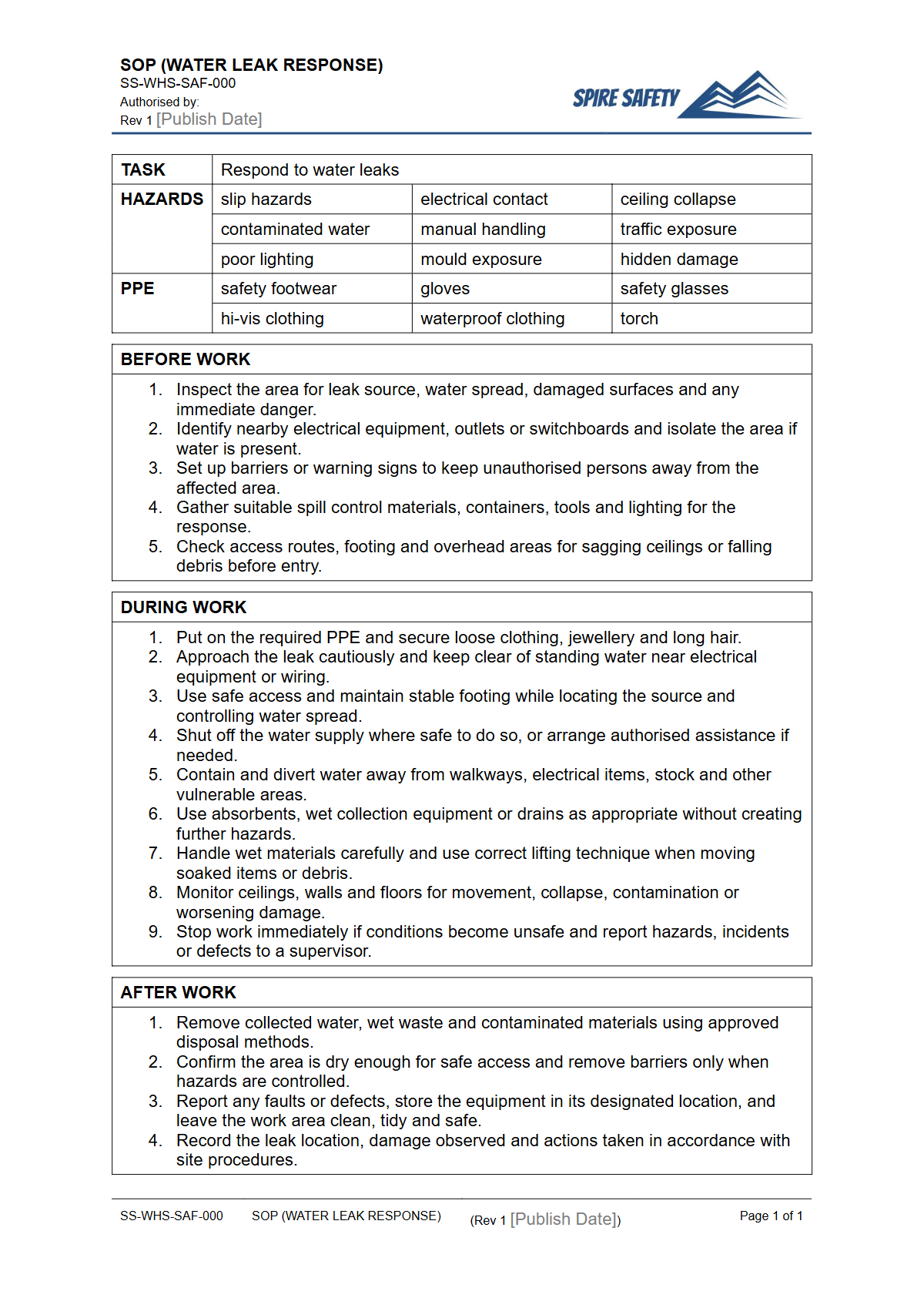
Our Free Safe Operating Procedure (Water Leak Response) Template provides a clear, step-by-step framework to help your team respond to these incidents safely and efficiently. This document is designed to standardise your response, minimise property damage, and ensure the health and safety of all personnel.
A documented SOP helps a Person Conducting a Business or Undertaking (PCBU) fulfil their primary duty of care. It acts as a critical administrative control, ensuring that all workers understand their roles and responsibilities during a potentially hazardous event.
By outlining pre-defined actions for isolating, containing, and cleaning up a leak, you reduce confusion and minimise the risk of injury. This structured approach is a core component of effective comprehensive WHS management systems, demonstrating a commitment to proactive risk management.
Video walkthrough
How to use the Free Safe Operating Procedure (Water Leak Response) Template
This template is provided as a starting point in both DOCX and PDF formats. To make it effective for your organisation, it requires customisation to reflect your specific operational environment.
After downloading, you should review and edit the document to include site-specific details such as emergency contact numbers, locations of water and electrical shut-offs, and the specific types of equipment used in your facility.
Important: We have provided a solid framework based on Australian WHS principles, but you must adapt it to your workplace. This involves a thorough assessment of your site's unique hazards.
We strongly recommend consulting with your maintenance teams, facility managers, and safety committee during the customisation process. Once finalised, the SOP should be used as a training tool for all relevant employees and be readily accessible in areas where leaks may occur. Similar detailed procedures are essential for equipment management, such as the steps outlined in an Air Compressor SOP.
When to use this Safe Operating Procedure
This Safe Operating Procedure should be activated immediately upon the discovery of any uncontrolled water leak. This applies to a wide range of scenarios, from a slow drip from a ceiling tile to a major pipe burst.
It is a proactive document that should be prepared, and its contents understood, long before an incident occurs. Having it ready ensures that the response is immediate and organised, rather than chaotic and improvised.
Regular drills or toolbox talks based on this SOP can help reinforce the correct procedures, ensuring your team can act decisively under pressure. The goal is to embed this safety behaviour so that it becomes second nature, just as you would for any other potential workplace emergency.
Performing regular WHS compliance auditing can verify that such procedures are understood and followed correctly by staff.
Who should use this Safe Operating Procedure
This procedure is intended for a broad range of personnel within an organisation. Primarily, it will be used by maintenance staff and facility managers who are often the first responders to such incidents. However, it is also a vital resource for:
- WHS Officers and Managers: To integrate into the overall safety management system and use for risk assessments and training development.
- Supervisors and Team Leaders: To train their teams on the correct response and to lead the clean-up efforts for minor incidents within their department.
- All Employees: To understand the initial steps to take upon discovering a leak, such as reporting it immediately and avoiding the hazardous area.
Every worker has a responsibility to contribute to a safe work environment, and understanding procedures for common hazards like water leaks is essential. Whether the hazard is water on the floor or a complex piece of equipment, a documented process is key, much like the detailed steps in a Conveyer System SOP are vital for operators.
For more templates and safety documents, you can browse our complete free WHS resources library.
Common mistakes
Common mistakes to avoid
- Failing to isolate electrical supplies in the affected area before starting any clean-up.
- Using incorrect or insufficient PPE, exposing workers to contaminated water or cleaning agents.
- Not properly cordoning off the wet area, allowing other personnel to inadvertently enter a hazardous zone.
- Forgetting to thoroughly document the incident, the response actions taken, and the root cause.
Legal references
Legal considerations
The following legal requirements may be relevant to this type of work.
- Work Health and Safety Act (Harmonised) — Provides the primary duties for protecting workers and other people from work health and safety risks.
- Work Health and Safety Regulations (Harmonised) — Sets out requirements supporting the management of workplace hazards and risks.
The following codes may be relevant to this type of work.
- Managing WHS Risks Code of Practice — Provides practical guidance on identifying hazards, assessing risks and applying effective controls.
- Work Health and Safety Consultation, Cooperation and Coordination Code of Practice — Provides practical guidance on consulting workers and coordinating with other duty holders.
- Managing the Work Environment and Facilities Code of Practice — Provides practical guidance on safe work environments, workplace facilities and related controls.
Did you know
Slip Risk
Slips, trips and falls are a leading cause of workplace injuries in Australia. Water from leaks is a primary contributor to slip hazards that are often preventable with a prompt and correct response.
Hidden Damage
Even a small, slow leak can cause significant structural damage and mould growth over time, leading to costly repairs and potential long-term health issues for workers if not addressed properly.
FAQ
Frequently asked questions
01What should be included in a water leak response SOP?
02Who is responsible for cleaning up a water leak at work?
03How does an SOP for water leaks help with WHS compliance?
04Is this water leak response template suitable for all industries?
Share this resource
Free Safe Operating Procedure (Water Leak Response) Template
Browse Categories
How To Use It
- 1Download and open in Word or PDF.
- 2Replace the placeholders with your business details.
- 3Get it reviewed by a WHS specialist before rollout.
Need it customised?
Our WHS consultants can adapt this template to your site, run a gap analysis, or audit what you already have in place.
Book a Free Consultation WHS consulting servicesor call 1300 156 382
Related templates
- Free Safe Operating Procedure (Water Level Meter) Template
- Free Safe Operating Procedure (Water Main Burst Response) Template
- Free Safe Operating Procedure (Water Main Isolation) Template
- Free Safe Operating Procedure (Water Meter Pit Access) Template
- Free Safe Operating Procedure (Water Meter Pit Clean) Template
- Free Safe Operating Procedure (Water Ram) Template