
Free Safe Operating Procedure (Water Level Meter) Template
Standardise the use of water level meters in your workplace with our detailed template. Download your free Safe Operating Procedure to improve safety today.
Free Safe Operating Procedure (Water Level Meter) Template
DOCX • 126 KB + PDF
Updated Oct 2026
No signup required
Purpose of the Free Safe Operating Procedure (Water Level Meter) Template
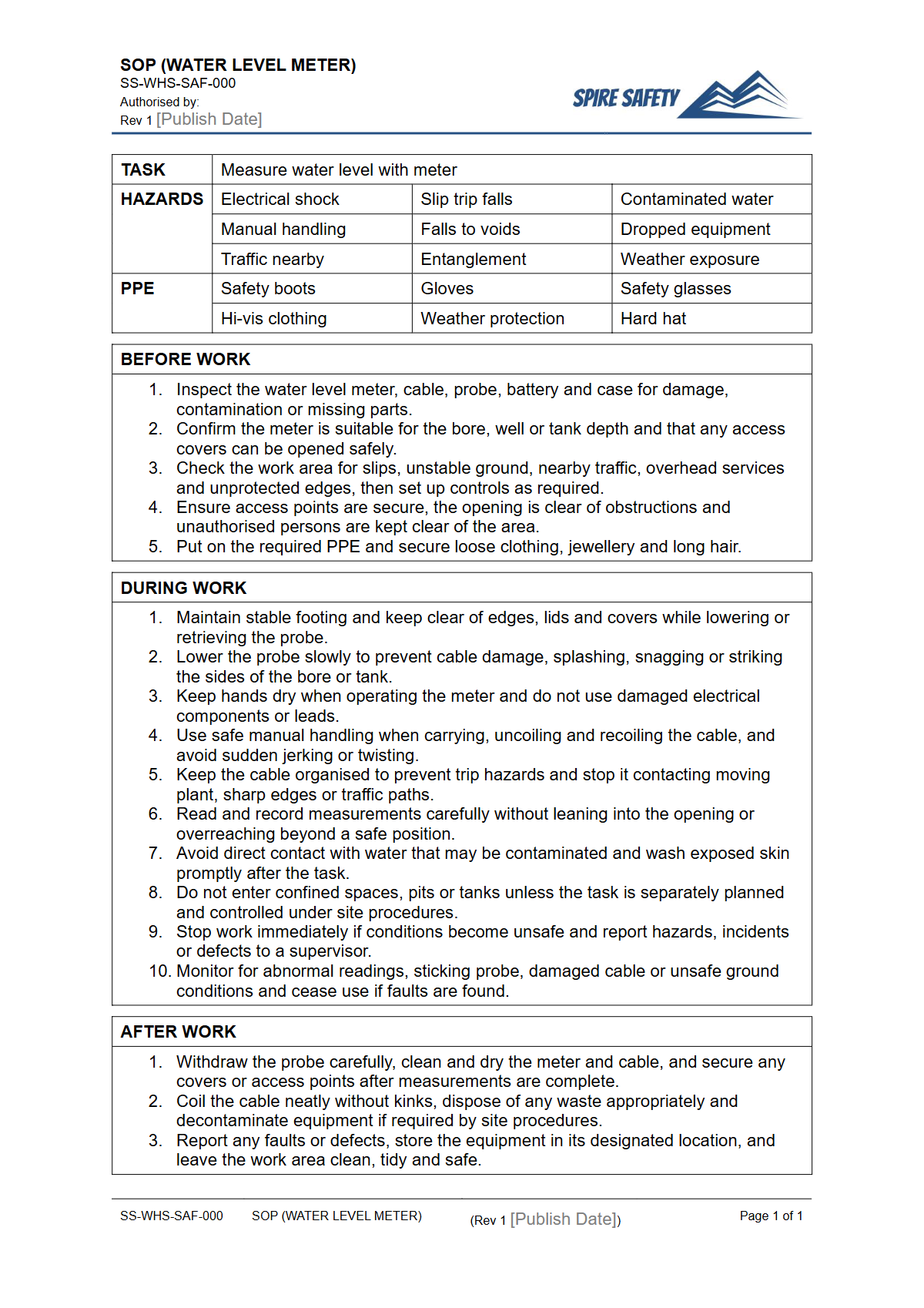
This free Safe Operating Procedure (Water Level Meter) Template provides a structured framework for documenting the safe use of portable water level meters. These devices are essential tools in hydrogeology, environmental monitoring, and construction, but their use involves specific hazards that must be managed.
An SOP is a fundamental administrative control that formalises a safe system of work, helping your organisation meet its duty of care under Australian WHS regulations.
Using this template helps identify risks such as slips, trips, and falls near boreholes or water bodies, manual handling injuries, entanglement with the measuring tape, and potential exposure to contaminated water. By clearly outlining pre-operational checks, step-by-step instructions, and emergency procedures, this document supports consistent and safe work practices for all personnel.
It serves as a critical training tool for new employees and a reference for experienced operators, promoting a proactive safety culture.
Video walkthrough
How to use the Free Safe Operating Procedure (Water Level Meter) Template
Our template is available for download as a DOCX file, allowing for easy customisation to suit your specific operational needs. While it is designed based on the model WHS framework and common industry practice, it is crucial to adapt the content to your workplace.
This involves a competent person assessing the unique risks associated with your site, the specific models of water level meters in use, and your established emergency response plans.
To effectively use this document, you must review and modify each section. Add site-specific details, incorporate manufacturer instructions for your equipment, and clearly define the personal protective equipment (PPE) required for the task. This customisation ensures the SOP is not just a generic document, but a practical tool integrated into your broader WHS management systems.
Important: This is a template only. We have developed it to be aligned with Australian WHS principles, but you must customise it to reflect the specific equipment, hazards, and control measures relevant to your workplace and jurisdiction.
A generic procedure is not sufficient to ensure safety or legal compliance.
When to use it
A Safe Operating Procedure for a water level meter should be developed and implemented before any work involving the equipment commences. It is a mandatory document for any task where the device is used to measure the depth to water in wells, boreholes, standpipes, and tanks.
This applies across various industries and scenarios, including environmental groundwater sampling, geotechnical investigations for construction projects, agricultural water resource management, and monitoring dewatering activities on site.
On construction sites, for example, water level monitoring is often required alongside activities like excavation, which requires its own procedures, such as our FREE Trencher SOP Template. The SOP should be readily accessible to operators at all times, either in a physical or digital format, and used as a direct guide for performing the task safely.
Who should use it
This template is intended for use by Persons Conducting a Business or Undertaking (PCBUs), site managers, WHS advisors, and frontline supervisors responsible for creating and implementing safe work systems. The final, customised SOP should be used by any worker tasked with operating a water level meter, including:
- Environmental Scientists and Technicians
- Geotechnical Engineers and Field Assistants
- Drillers and Drillers' Offsiders
- Agricultural Workers and Farm Managers
- Site Engineers and Construction Personnel
All operators must be trained on the contents of the final SOP to ensure they understand the steps and safety requirements. Competency in using the equipment and following the procedure should be assessed and periodically verified through processes like WHS compliance auditing to confirm that safe practices are being maintained.
Key Elements in this Safe Operating Procedure
Our template provides a comprehensive structure to guide your customisation. It prompts you to detail essential safety information across the entire work cycle. Key sections you will need to populate include:
- Associated Risks and Hazards: A section to list all identified hazards, from falls into open boreholes to ergonomic strains and biological exposure.
- Required Personal Protective Equipment (PPE): Specify the exact PPE needed, such as high-visibility clothing, safety glasses, gloves, and appropriate footwear.
- Pre-Operational Checks: A checklist to ensure the equipment is safe and functional before use. This includes checking battery levels, signal function, and the integrity of the tape and probe. This is particularly important on large projects that may involve other heavy equipment, like those covered in our FREE Scraper SOP (Safe Operating Procedure) Template.
- Step-by-Step Operating Sequence: A clear, logical sequence of actions for safely performing the measurement, from setting up at the wellhead to recording the depth and retrieving the probe.
- Post-Operational Tasks: Instructions for cleaning, decontaminating, and properly storing the equipment to ensure its longevity and prevent cross-contamination between sites.
The principles of documenting safe procedures extend to all types of machinery. You can find similar procedures for agricultural tasks, detailed in resources like the FREE Grain Drill SOP (Safe Operating Procedure) Template, which follows a comparable structure for risk management. For more procedural documents and safety tools, you can explore our complete free WHS resources library.
Common mistakes
Common mistakes to avoid
- Forgetting to decontaminate the probe and tape between monitoring wells, risking cross-contamination of samples.
- Not testing the battery and signals before leaving for a remote site, leading to wasted time and mobilisation costs.
- Working alone near deep or uncovered boreholes without a proper risk assessment and communication plan in place.
- Incorrectly reading the measuring tape or failing to account for 'hang-up', leading to inaccurate depth data.
Legal references
Legal considerations
The following legal requirements may be relevant to this type of work.
- Work Health and Safety Act (Harmonised) — Provides the primary duties for protecting workers and other people from work health and safety risks.
- Work Health and Safety Regulations (Harmonised) — Sets out requirements supporting the management of workplace hazards and risks.
The following codes may be relevant to this type of work.
- Managing WHS Risks Code of Practice — Provides practical guidance on identifying hazards, assessing risks and applying effective controls.
- Work Health and Safety Consultation, Cooperation and Coordination Code of Practice — Provides practical guidance on consulting workers and coordinating with other duty holders.
- Managing the Work Environment and Facilities Code of Practice — Provides practical guidance on safe work environments, workplace facilities and related controls.
Did you know
Conductivity is Key
Most water level meters work by using an electrode on the probe. When the probe touches a conductive liquid like water, it completes an electrical circuit, triggering an audible and visual signal to the operator.
Slips, Trips and Falls
Slips, trips, and falls are a leading cause of serious workplace injury in Australia. Establishing clear procedures and maintaining good housekeeping around boreholes and monitoring wells is a critical control measure.
FAQ
Frequently asked questions
01What is a Safe Operating Procedure (SOP)?
02What are the main hazards when using a water level meter?
03Do I need a separate SOP for different models of water level meters?
04How often should a Safe Operating Procedure be reviewed?
Share this resource
Free Safe Operating Procedure (Water Level Meter) Template
Browse Categories
How To Use It
- 1Download and open in Word or PDF.
- 2Replace the placeholders with your business details.
- 3Get it reviewed by a WHS specialist before rollout.
Need it customised?
Our WHS consultants can adapt this template to your site, run a gap analysis, or audit what you already have in place.
Book a Free Consultation WHS consulting servicesor call 1300 156 382
Related templates
- Free Safe Operating Procedure (Water Main Burst Response) Template
- Free Safe Operating Procedure (Water Main Isolation) Template
- Free Safe Operating Procedure (Water Meter Pit Access) Template
- Free Safe Operating Procedure (Water Meter Pit Clean) Template
- Free Safe Operating Procedure (Water Ram) Template
- Free Safe Operating Procedure (Water Rescue Equipment) Template