
Free Safe Operating Procedure (Waste Transfer Handover) Template
Streamline your waste management with our free Safe Operating Procedure (Waste Transfer Handover) Template. Document key steps and controls. Download now.
Free Safe Operating Procedure (Waste Transfer Handover) Template
DOCX • 126 KB + PDF
Updated Oct 2026
No signup required
Purpose of the Free Safe Operating Procedure (Waste Transfer Handover) Template
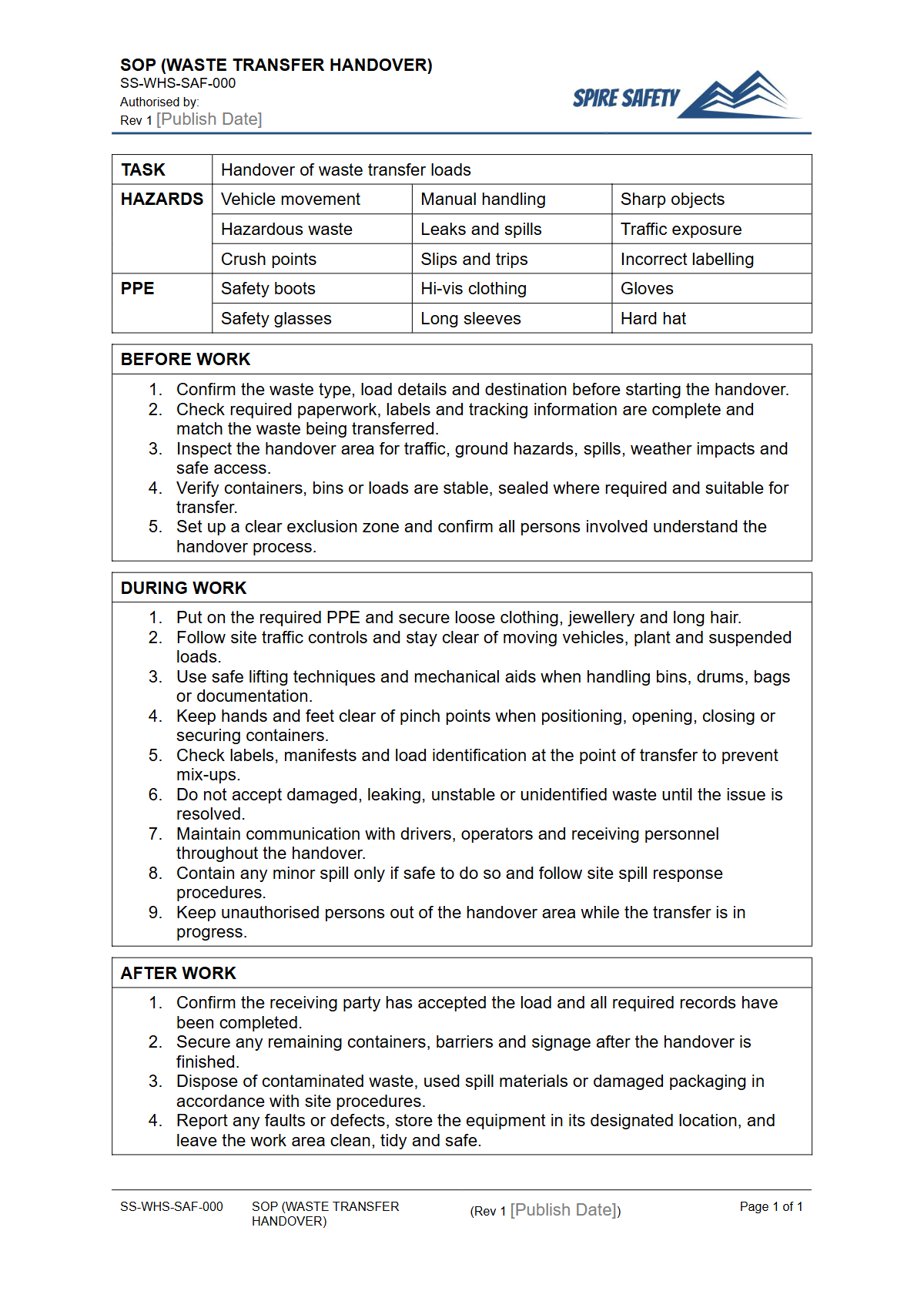
Effectively managing the handover of waste is critical for maintaining a safe and environmentally responsible workplace. Our Free Safe Operating Procedure (Waste Transfer Handover) Template provides a structured framework to help your organisation document the step-by-step process for safely transferring waste materials, whether internally or to an external provider.
This downloadable SOP helps formalise procedures, minimise risks of spills or exposure, and ensure clear communication between all parties involved. By documenting the required checks, communication protocols, and responsibilities, this SOP serves as a vital tool in your broader WHS management system, promoting consistent and safe work practices.
Video walkthrough
How to use the Free Safe Operating Procedure (Waste Transfer Handover) Template
This Safe Operating Procedure is provided as a fully editable DOCX file and a print-ready PDF. To use it effectively, you must customise it to reflect the specific hazards, equipment, and environment of your workplace.
We've included prompts for you to fill in details such as specific types of waste handled, required Personal Protective Equipment (PPE), pre-transfer vehicle and container checks, emergency procedures for spills, and the contact details for all involved parties. This document is a starting point; your organisation is responsible for ensuring the final SOP is comprehensive and accurately reflects your operational risks. If waste is moved using heavy vehicles, ensure procedures align with your FREE Body Truck SOP (Safe Operating Procedure) Template.
When to use a Waste Transfer Handover SOP
This SOP should be implemented and followed whenever there is a formal handover of waste. This includes several common scenarios: transferring waste from a production area to a central storage compound on-site; handing over waste containers to a third-party collection service; moving specialised or hazardous waste between licensed facilities; or internal transfers between different departments or business units.
Using the SOP ensures that at every transfer point, all safety and compliance checks are completed and documented. For complex loading tasks involving machinery, consider cross-referencing with other relevant procedures, such as a FREE Telehandler SOP (Safe Operating Procedure) Template.
Who should use this Safe Operating Procedure
This Safe Operating Procedure is intended for all personnel involved in the waste management lifecycle. Key users include: waste handlers and operators who physically move the waste; supervisors who oversee the process and supports your compliance efforts; logistics and transport coordinators who arrange for collection and transport; and Environmental, Health, and Safety (EHS) officers who are responsible for overall site compliance.
Training all relevant staff on the contents of the finalised SOP is crucial for its successful implementation. For ancillary tasks within the procedure, like accessing high-level bins, ensure workers follow specific equipment guidelines outlined in documents such as a FREE Step Ladder SOP (Safe Operating Procedure) Template.
Regularly reviewing and updating your waste handover procedures is a key part of continuous improvement. A periodic WHS compliance audit can help identify any gaps between your documented procedures and actual practices on the floor.
For guidance on customising this template or developing more complex safety documentation, consider seeking professional WHS consulting. You can also explore our complete free WHS resources library for other templates to support your safety management system.
Common mistakes
Common mistakes to avoid
- Failing to correctly label containers with waste type and hazard information.
- Using inadequate or damaged PPE during handling and transfer.
- Poor communication between the generator and the transporter about the waste's properties.
- Neglecting to complete and sign handover documentation at the point of transfer.
Legal references
Legal considerations
The following legal requirements may be relevant to this type of work.
- Work Health and Safety Act (Harmonised) — Provides the primary duties for protecting workers and other people from work health and safety risks.
- Work Health and Safety Regulations (Harmonised) — Sets out requirements supporting the management of workplace hazards and risks.
The following codes may be relevant to this type of work.
- Managing WHS Risks Code of Practice — Provides practical guidance on identifying hazards, assessing risks and applying effective controls.
- Work Health and Safety Consultation, Cooperation and Coordination Code of Practice — Provides practical guidance on consulting workers and coordinating with other duty holders.
- Managing the Work Environment and Facilities Code of Practice — Provides practical guidance on safe work environments, workplace facilities and related controls.
Did you know
Waste Hierarchy
Australian environmental policy is guided by the waste management hierarchy. It prioritises actions from most to least preferable: avoidance, reuse, recycling, recovery of energy, treatment, and finally, disposal.
FAQ
Frequently asked questions
01What should be included in a waste transfer handover procedure?
02Why is communication so important during waste handover?
03Who is responsible for classifying waste before transfer?
04How often should a Safe Operating Procedure for waste transfer be reviewed?
Share this resource
Free Safe Operating Procedure (Waste Transfer Handover) Template
Browse Categories
How To Use It
- 1Download and open in Word or PDF.
- 2Replace the placeholders with your business details.
- 3Get it reviewed by a WHS specialist before rollout.
Need it customised?
Our WHS consultants can adapt this template to your site, run a gap analysis, or audit what you already have in place.
Book a Free Consultation WHS consulting servicesor call 1300 156 382
Related templates
- Free Safe Operating Procedure (Wastewater Sampling) Template
- Free Safe Operating Procedure (Water Bath) Template
- Free Safe Operating Procedure (Water Leak Response) Template
- Free Safe Operating Procedure (Water Level Meter) Template
- Free Safe Operating Procedure (Water Main Burst Response) Template
- Free Safe Operating Procedure (Water Main Isolation) Template