
Free Safe Operating Procedure (Wastewater Sampling) Template
Download our free Safe Operating Procedure (Wastewater Sampling) Template to document risks and controls for collecting water samples.
Free Safe Operating Procedure (Wastewater Sampling) Template
DOCX • 126 KB + PDF
Updated Oct 2026
No signup required
Purpose of the Free Safe Operating Procedure (Wastewater Sampling) Template
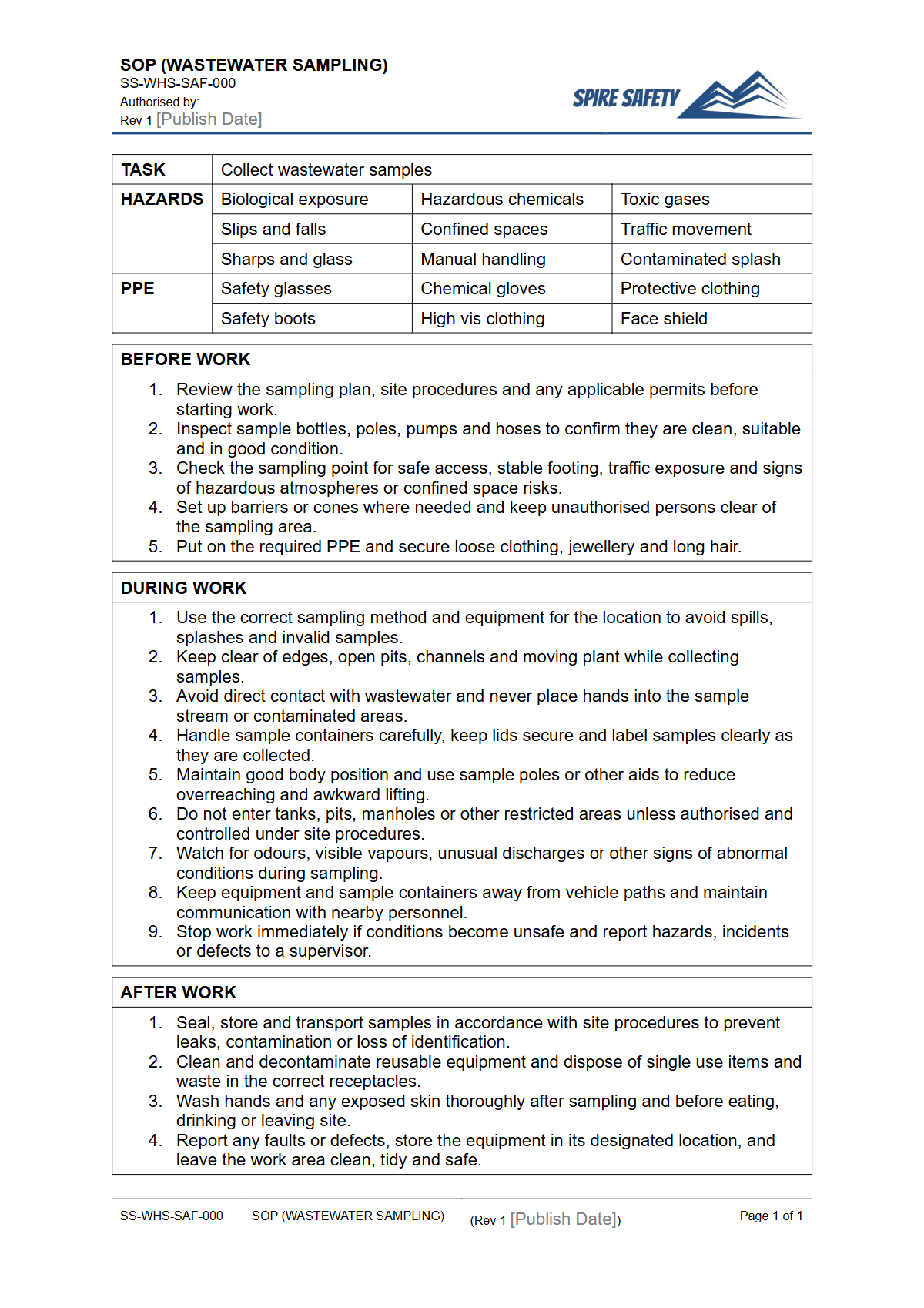
This Free Safe Operating Procedure (Wastewater Sampling) Template provides a structured framework for businesses to document the hazards and control measures associated with collecting samples from wastewater sources. Wastewater sampling presents a unique set of risks, including exposure to biological hazards, chemical contaminants, and physical dangers like slips, trips, falls, and working in confined spaces.
Using a formalised SOP helps ensure that every person performing the task follows a consistent, pre-approved, and safe method, significantly reducing the likelihood of incidents and injuries.
A well-developed Safe Operating Procedure is a critical component of a proactive safety culture. It serves as a practical tool for risk management, demonstrating that a Person Conducting a Business or Undertaking (PCBU) has taken steps to provide and maintain a safe system of work.
This document outlines key considerations from pre-operational checks and required Personal Protective Equipment (PPE) to the step-by-step process and emergency protocols.
Video walkthrough
How to use the Free Safe Operating Procedure (Wastewater Sampling) Template
After downloading the template in your preferred format (DOCX or PDF), you must adapt it to the unique conditions of your workplace. An SOP is not a 'one size fits all' document; its effectiveness depends entirely on its relevance to the specific task.
Review each section and add, remove, or modify content to reflect the actual equipment used, the potential contaminants at your site, the physical environment, and the skill level of your workers.
This template is a starting point. To be effective and support your legal obligations, you must customise it for the specific equipment, chemicals, environment, and personnel at your workplace.
We have included comments and prompts to guide this process. Integrating this and other procedures into your broader safety framework is key to managing risk effectively.
Strong WHS management systems provide the structure needed to ensure documents like SOPs are implemented, reviewed, and improved over time.
What is included in this Safe Operating Procedure?
This SOP template for wastewater sampling includes sections for:
- Designated responsible persons
- Required training and competency
- A comprehensive list of potential hazards and risks
- Required Personal Protective Equipment (PPE)
- Pre-operational safety checks
- A step-by-step guide to performing the sampling task safely
- Waste disposal and clean-up procedures
- Emergency response actions for spills, exposure, or injury
When to use it
A Safe Operating Procedure for wastewater sampling should be developed and approved before any worker is authorised to perform the task. It forms the basis of worker training and induction for this specific activity.
The SOP should be readily available at the location where the sampling occurs or easily accessible to the workers involved. It is also a vital reference document during incident investigations or when processes are being reviewed for potential improvements.
Regular reviews of your safety documentation are essential to maintain their relevance and effectiveness. Procedures should be assessed as part of your internal audit schedule, which can be verified through professional WHS compliance auditing to identify any gaps or opportunities for enhancement.
The SOP must also be reviewed and updated whenever there is a change in equipment, chemicals, location, or legislation, or following any related incident or near-miss.
Who should use it
This template is designed for use by a range of personnel within an organisation. WHS Managers, Environmental Officers, and Site Supervisors can use it to draft the initial procedure.
The draft should then be reviewed and validated in consultation with the workers who will actually be performing the sampling, as they have direct, practical knowledge of the task. Once finalised, the SOP is a mandatory tool for any employee or contractor assigned to collect wastewater samples.
The principles of safe work documented in this procedure are universal, whether the task involves simple dip sampling or using complex auto-samplers. Safe access is a key consideration, and for tasks requiring work near open pits or on elevated platforms, additional procedures may be required. For instance, if access requires temporary ladders, workers must also follow the controls outlined in a FREE Step Ladder SOP Template.
Documenting procedures for all critical tasks helps build a comprehensive safety system. If samples need to be moved between sites, for example, having a clear procedure like a FREE Body Truck SOP (Safe Operating Procedure) Template ensures that transport risks are also managed.
You can find many other document templates in our free WHS resources library to support your organisation's safety goals.
Common mistakes
Common mistakes to avoid
- Using a generic template without customising it for site-specific hazards and controls.
- Failing to list the correct Personal Protective Equipment (PPE) for the specific contaminants present.
- Neglecting to include detailed emergency procedures for spills, chemical exposure, or personal injury.
- Inadequate training on the final, approved procedure before workers are required to perform the task.
Legal references
Legal considerations
The following legal requirements may be relevant to this type of work.
- Work Health and Safety Act (Harmonised) — Provides the primary duties for protecting workers and other people from work health and safety risks.
- Work Health and Safety Regulations (Harmonised) — Sets out requirements supporting the management of workplace hazards and risks.
The following codes may be relevant to this type of work.
- Managing WHS Risks Code of Practice — Provides practical guidance on identifying hazards, assessing risks and applying effective controls.
- Work Health and Safety Consultation, Cooperation and Coordination Code of Practice — Provides practical guidance on consulting workers and coordinating with other duty holders.
- Managing the Work Environment and Facilities Code of Practice — Provides practical guidance on safe work environments, workplace facilities and related controls.
Did you know
A Modern Health Tool
Wastewater-based epidemiology gained global prominence during the COVID-19 pandemic. By testing wastewater, health authorities can monitor the prevalence of viruses and other health markers in a community without needing to test individuals.
FAQ
Frequently asked questions
01What are the main hazards involved in wastewater sampling?
02Is a Safe Operating Procedure a legal requirement for wastewater sampling?
03How often should a wastewater sampling SOP be reviewed?
04What should be included in a wastewater sampling SOP?
Share this resource
Free Safe Operating Procedure (Wastewater Sampling) Template
Browse Categories
How To Use It
- 1Download and open in Word or PDF.
- 2Replace the placeholders with your business details.
- 3Get it reviewed by a WHS specialist before rollout.
Need it customised?
Our WHS consultants can adapt this template to your site, run a gap analysis, or audit what you already have in place.
Book a Free Consultation WHS consulting servicesor call 1300 156 382
Related templates
- Free Safe Operating Procedure (Water Bath) Template
- Free Safe Operating Procedure (Water Leak Response) Template
- Free Safe Operating Procedure (Water Level Meter) Template
- Free Safe Operating Procedure (Water Main Burst Response) Template
- Free Safe Operating Procedure (Water Main Isolation) Template
- Free Safe Operating Procedure (Water Meter Pit Access) Template